🎵 Frequency Harmonics Calculator
Enter any fundamental frequency to instantly calculate all harmonics, wavelengths, periods, and musical notes.
| Note | Octave 3 | Octave 4 | Octave 5 | Octave 6 |
|---|---|---|---|---|
| C | 130.81 Hz | 261.63 Hz | 523.25 Hz | 1046.50 Hz |
| D | 146.83 Hz | 293.66 Hz | 587.33 Hz | 1174.66 Hz |
| E | 164.81 Hz | 329.63 Hz | 659.25 Hz | 1318.51 Hz |
| F | 174.61 Hz | 349.23 Hz | 698.46 Hz | 1396.91 Hz |
| G | 196.00 Hz | 392.00 Hz | 783.99 Hz | 1567.98 Hz |
| A | 220.00 Hz | 440.00 Hz | 880.00 Hz | 1760.00 Hz |
| B | 246.94 Hz | 493.88 Hz | 987.77 Hz | 1975.53 Hz |
| Frequency | Wavelength (m) | Wavelength (cm) | Wavelength (ft) | Period (ms) |
|---|---|---|---|---|
| 20 Hz | 17.15 m | 1715 cm | 56.3 ft | 50.0 ms |
| 50 Hz | 6.86 m | 686 cm | 22.5 ft | 20.0 ms |
| 100 Hz | 3.43 m | 343 cm | 11.3 ft | 10.0 ms |
| 261.63 Hz (C4) | 1.31 m | 131 cm | 4.31 ft | 3.82 ms |
| 440 Hz (A4) | 0.780 m | 78.0 cm | 2.56 ft | 2.27 ms |
| 1000 Hz | 0.343 m | 34.3 cm | 1.12 ft | 1.00 ms |
| 4000 Hz | 0.0858 m | 8.58 cm | 0.28 ft | 0.25 ms |
| 20000 Hz | 0.0172 m | 1.72 cm | 0.056 ft | 0.05 ms |
| Waveform | Harmonics Present | Amplitude Pattern | Common Use |
|---|---|---|---|
| Sine | Fundamental only (1st) | 1/1 | Pure tone, test signal |
| Square | Odd only (1, 3, 5, 7...) | 1/n (odd n) | Digital signals, clarinets |
| Sawtooth | All (1, 2, 3, 4...) | 1/n | Strings, brass, synthesizers |
| Triangle | Odd only (1, 3, 5...) | 1/n² (odd n) | Mellow tone, flute-like |
| Piano | All, strong low partials | Complex decay | Acoustic piano modeling |
| Guitar | All harmonics present | Variable by string | Plucked string instruments |
| THD Level | Classification | Typical Application | Audibility |
|---|---|---|---|
| < 0.01% | Reference grade | Measurement equipment | Inaudible |
| 0.01–0.1% | High fidelity | Studio amplifiers, DACs | Below threshold |
| 0.1–1% | Consumer hi-fi | Home amplifiers, speakers | Rarely audible |
| 1–5% | Moderate distortion | Budget audio, PA systems | Sometimes audible |
| 5–10% | High distortion | Overdrive guitar effects | Clearly audible |
| > 10% | Heavy clipping | Distortion/fuzz pedals | Dominant character |
Harmonies of incidence appear everywhere: in music, physics, electronics radio work, systems of energy, say what you want. At the core of everything, harmony is simply a wave that vibrates at incidence equal to whole multiples of something called the basic incidence. That basic incidence?
It is the lowest incidence, at which the system or wave truly repeats. One also hears that one calls it the first harmony.
How Harmonics Work in Music, Electricity and Radio
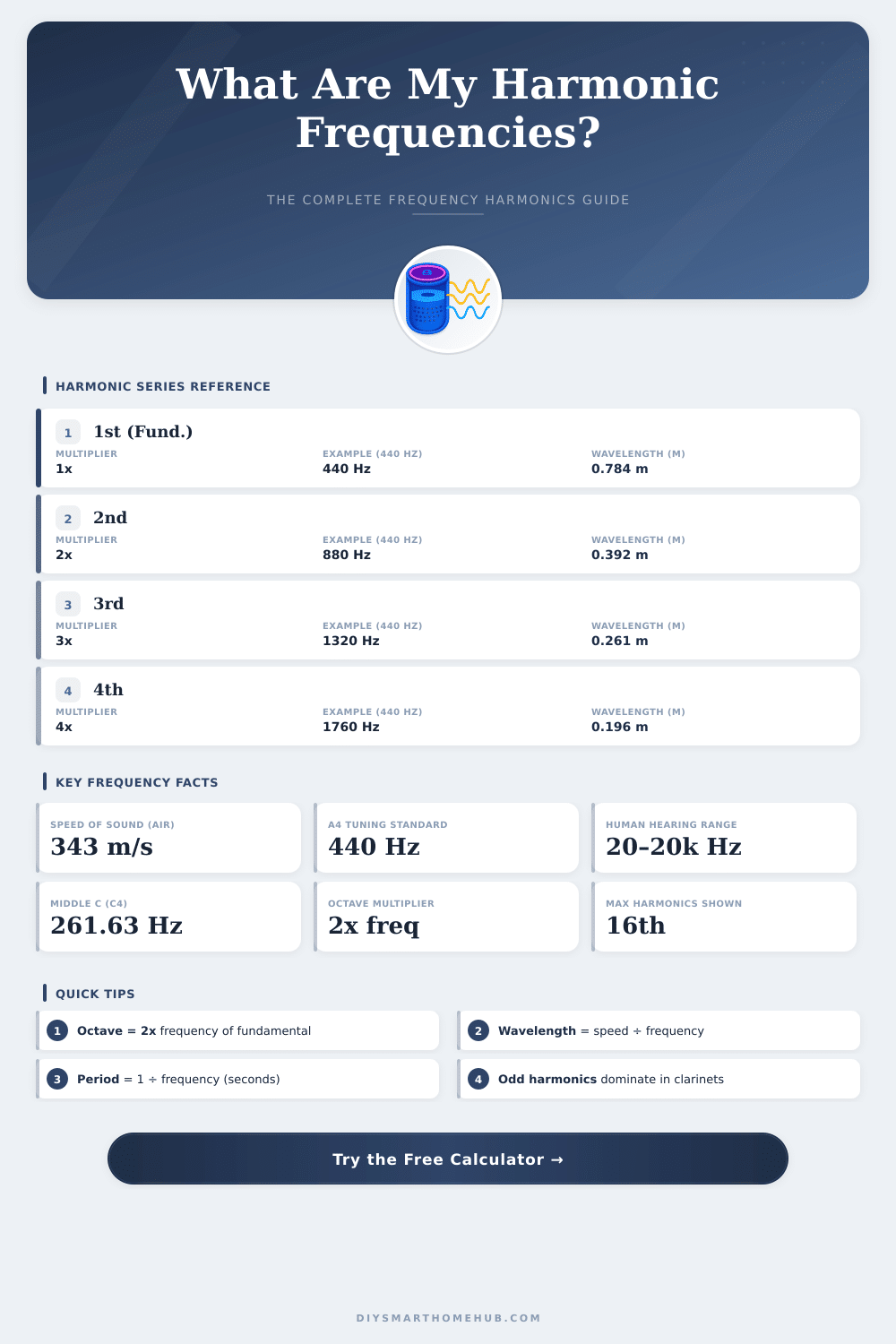
Here is how it works in practice. Assume that the basic incidence is at 100 Hz. Then the harmonies come at 200 Hz, 300 Hz, 400 Hz, 500 Hz and up.
Each of them is simply some whole number of times of the basic incidence. Take another example: 50 Hz is a truly common incidence for supply of AC-energy. From that, the second harmony reaches 100 Hz, the third strikes at 150 Hz and the fourth arrives at 200 Hz.
Any mix of waves that jumps around these incidences stays repeated in that original 50 Hz rhythm.
In music, the causes become even more interesting. Harmonies form the tones that sound above the basic note itself. The mix of those higher tones with the basic.
All that creates the tone colour or the sound character. Exactly because of that, the piano sounds totally different to violin, even if they play the same note. The piano strikes string by means of a low base vibration as basic, and everything over it follows almost the pattern of harmonies.
Each vibrating object or instrument makes its own natural incidences. Each of them forms a clear pattern of standing wave. Most vibrations have several resonant incidences, and instruments usually sound in harmonies of their basic incidence.
For instance, a tube or antenna resonates at whole multiples of the basic, because truly any other incidence would not fit inside its length. When the number of harmony grows higher, more waves store themselves in that same space… Witch causes the waves to shorten and the incidences jump upward.
Electronics brings harmonies in the game also. A pure sine wave has only one incidence. But if one twists that wave, by means of saturation or clipping…
Then it warps to something close to a square wave. When that happens, extra harmonies sharply appear and the sound becomes more buzzing, with more twisted upper tone. A square wave is truly only the basic incidence plus an endless pile of odd whole multiples.
Filters then allow you to isolate only the basic or remove any harmony that you want.
In radio, harmonies become unwanted broadcasts at multiples of your intended incidence, and they cause interference troubles. They happeninwardly of the source, when any nonlinearity sneaks itself in the gear accidentally.