🔋 Zigbee Battery Life Calculator
Estimate how long your Zigbee device battery will last based on transmission frequency, sleep current, and battery chemistry
| Device Type | Sleep Current | TX Current | TX Duration | Typical TX Interval |
|---|---|---|---|---|
| Door / Window Sensor | 1 μA | 25–30 mA | 15–25 ms | On event (+ 1 hr keepalive) |
| Motion / PIR Sensor | 5–15 μA | 25–35 mA | 20–40 ms | On motion + 30s cooldown |
| Temp / Humidity Sensor | 2–5 μA | 25–30 mA | 15–20 ms | 5–15 min periodic |
| Water Leak Sensor | 3–8 μA | 25–30 mA | 15–25 ms | On event + 1 hr keepalive |
| Smart Button | 0.5–2 μA | 25–30 mA | 10–20 ms | On press only |
| Occupancy Sensor | 8–20 μA | 30–40 mA | 20–40 ms | On detection + 10s interval |
| Smoke Detector | 10–30 μA | 30–40 mA | 20–40 ms | 1–5 min heartbeat |
| Soil Moisture | 4–10 μA | 25–35 mA | 15–25 ms | 15–30 min periodic |
| Scenario | Battery | TX/Day | Est. Life | Replacement Cycle |
|---|---|---|---|---|
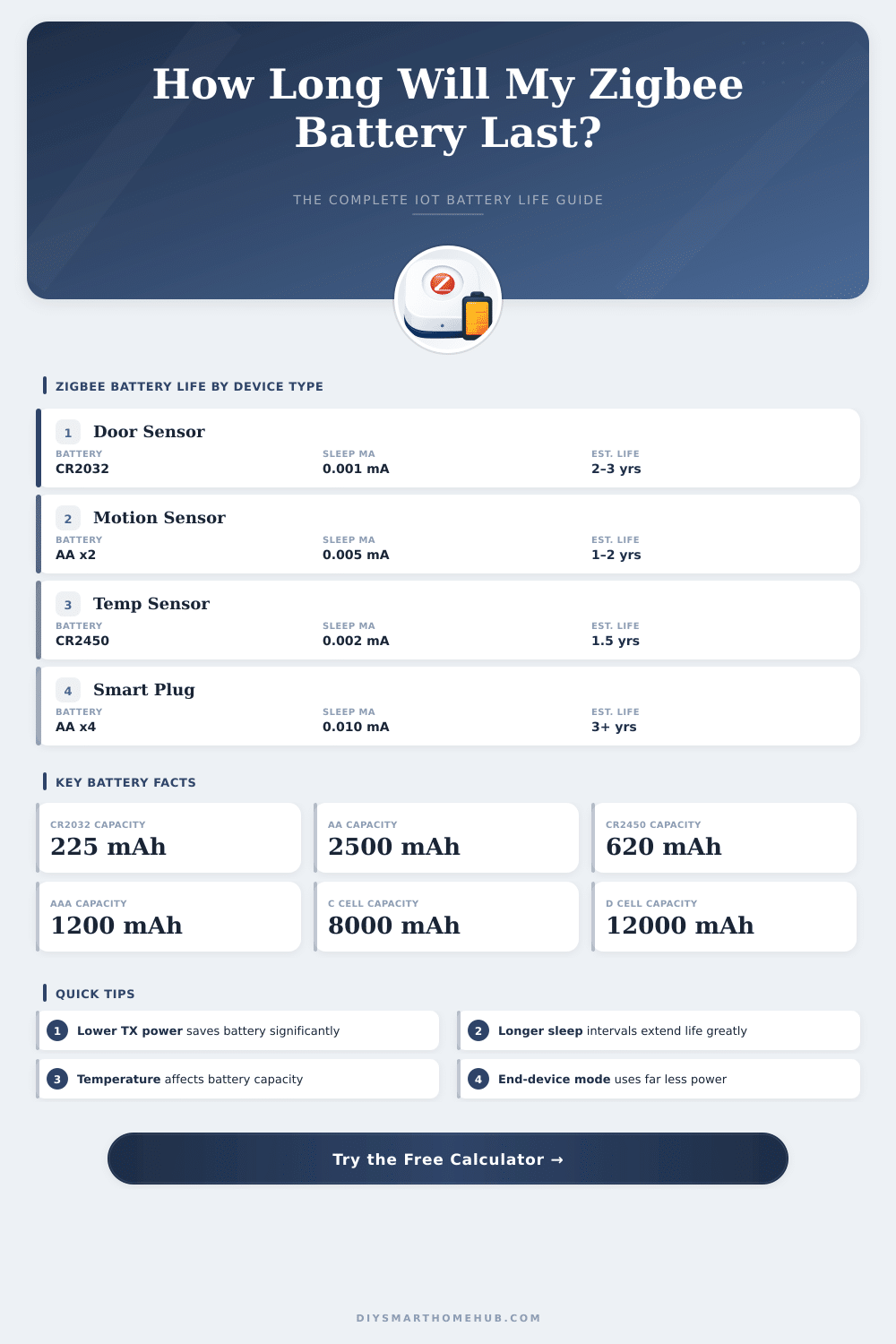
| Low-use door sensor (3 triggers/day) | CR2032 | ~27 | ~2.5 years | Replace annually for safety |
| Busy door sensor (30 triggers/day) | CR2032 | ~54 | ~1.5 years | Every 12–18 months |
| Temp sensor every 5 min | AA x2 | 288 | ~3 years | Every 2–3 years |
| Motion sensor (busy room) | AA x2 | 500+ | ~1 year | Annually |
| Smart button (occasional) | CR2032 | ~5 | 4+ years | Every 3–4 years |
| Smoke detector (5 min heartbeat) | AAA x3 | 288 | ~2 years | Every 1–2 years |
| TX Power Setting | Typical Current | Range (approx.) | Battery Impact |
|---|---|---|---|
| +8 dBm (max) | 35–40 mA | 100+ m (LOS) | Highest |
| +4 dBm | 28–32 mA | 50–80 m (LOS) | High |
| 0 dBm (default) | 22–28 mA | 30–50 m (LOS) | Medium |
| -4 dBm | 18–22 mA | 15–30 m (LOS) | Low |
| -8 dBm | 14–18 mA | 10–20 m (LOS) | Lowest |
Zigbee devices on batteries commonly act surprising. Some of them last several years, while others run out very soon. The output really depends on the brand and the kind of sensors used.
The scene switches of Aqara and Opple, together with the Aqara sensors for temperature and humidity, served around two years and still work fine. Motion sensors of type PIR and door sensors usually require change of batteries after around eight months. The door sensors of Samsung proved to be the most unreliable because some of them required a new Battery already after only four months.
Zigbee Battery Life and Problems
Zigbee devices of Xiaomi use very little energy.
Using more than 30 Zigbee devices scattered through two floors and covering 200 square metres with products of Aqara, Philips and Ikea, together with stick ConBee II, everything works fine without breaks in communication or problems with reliability. In that system the batteries of Aqara sensors last at least one year.
Reporting about batteries creates another big pain. Many devices fail at that. For instance, one device of Aqara signalled low Battery during 22 straight months, while another always showed 100 percent.
Moes produce a Zigbee switch with four ways, that allows single taps, double and hold. Only the reporting about Battery does not always work well. It commonly shows 100 percent during months, and later the Battery sharply runs out without warning.
Getting reliable info about batteries from devices like Hue switches or contact sensors also results in challenges for many users.
Some users meet bad cases of Battery drain. The Samsung Multisensor with CR2450 batteries ran out in only one or two days. A similar problem hit a Zigbee motion sensor, but because it used batteries AAA, it lasted a bit more long.
In another situation, a sensor for temperature and a detector for motion lost up to 60 percent of Battery only in too days after full charge. Taking care of around 15 sensors can seem like an endless struggle, where automations fail or buttons stop working because of sudden drain of Battery.
Zigbee switches of Niko last more than 36,000 presses. That matches to more than seven years of use without need to change the Battery. Sensors of Sonoff require unused and fresh coin cell batteries, which really bothers.
Average Eneloop rechargeable batteries work well in Zigbee devices, but the professional versions with bigger capacity better suit devices with high drain.
Here is something useful to know. Zigbee power plugs must keep their receiver always active, so they can not work on batteries. Zigbee devices on batteries usually are only senders, not receivers.
That makes it hard to find Zigbee lights on batteries. Even so, some devices run on Battery, like thermostats and engines for curtains, and can still receive orders. A thermostat normally needs less than five seconds to change the time after getting a command.
Swapping dead batteries in Zigbee sensors is not always simple. The correct method commonly stays unclear, and sensors sometimes do not restart well after the change. Connecting Zigbee devices on regular electricity to a normal UPS provides a repeater withbackup Battery, which forms a practical solution.