⚡ Wire Gauge Properties Calculator
Calculate AWG wire ampacity, weight, resistance & dimensions for copper, aluminum & more
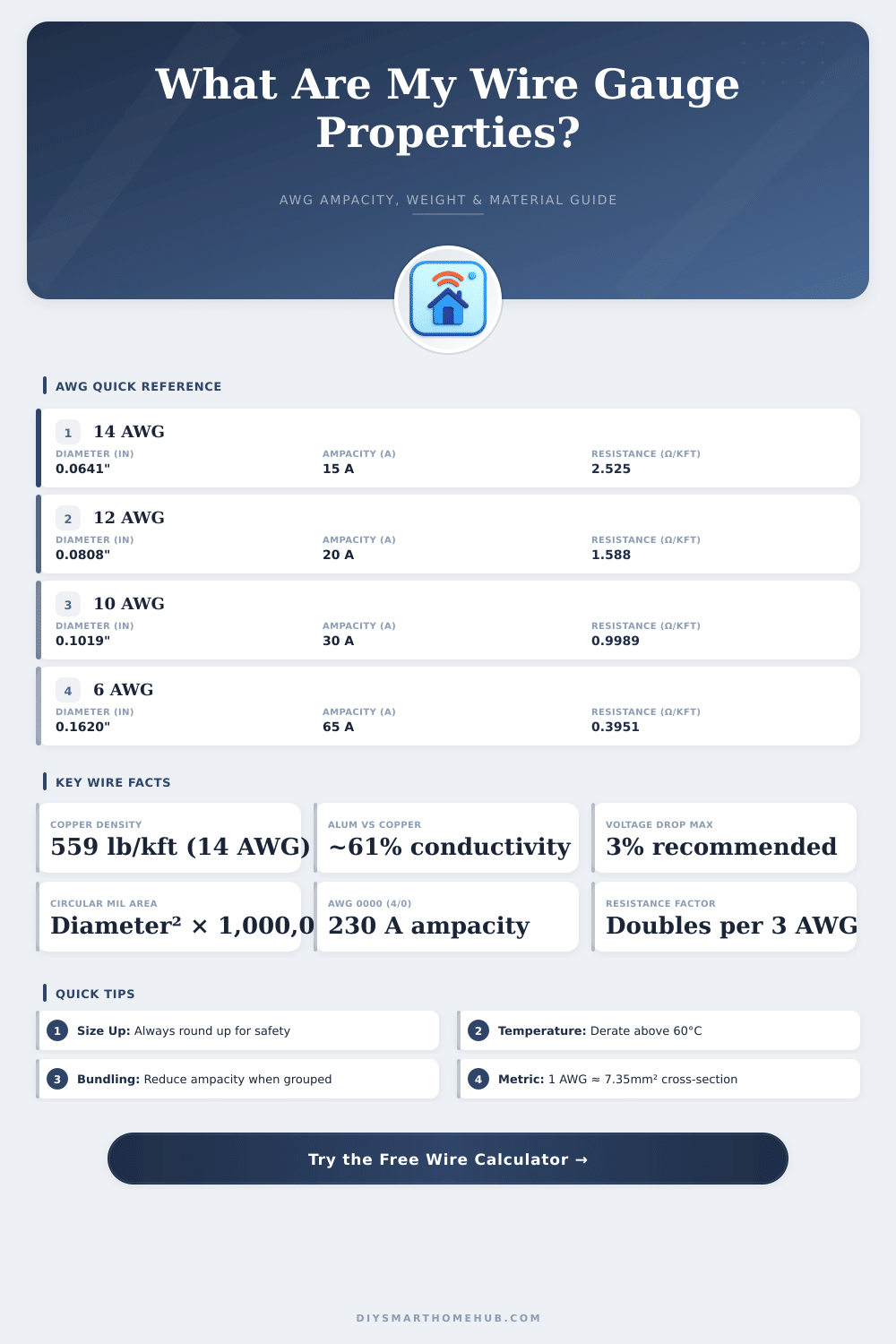
| AWG | Diameter (in) | Diameter (mm) | Area (kcmil) | Cu 60°C (A) | Cu 75°C (A) | Al 75°C (A) | Cu Weight (lb/kft) | Resistance (Ω/kft) |
|---|---|---|---|---|---|---|---|---|
| 18 | 0.0403 | 1.024 | 1.624 | 14 | 14 | — | 4.92 | 6.385 |
| 16 | 0.0508 | 1.291 | 2.583 | 13 | 13 | — | 7.82 | 4.016 |
| 14 | 0.0641 | 1.628 | 4.107 | 15 | 20 | — | 12.43 | 2.525 |
| 12 | 0.0808 | 2.053 | 6.530 | 20 | 25 | 20 | 19.77 | 1.588 |
| 10 | 0.1019 | 2.588 | 10.38 | 30 | 35 | 30 | 31.43 | 0.9989 |
| 8 | 0.1285 | 3.264 | 16.51 | 40 | 50 | 40 | 49.98 | 0.6282 |
| 6 | 0.1620 | 4.115 | 26.25 | 55 | 65 | 50 | 79.46 | 0.3951 |
| 4 | 0.2043 | 5.189 | 41.74 | 70 | 85 | 65 | 126.4 | 0.2485 |
| 2 | 0.2576 | 6.544 | 66.37 | 95 | 115 | 90 | 200.9 | 0.1563 |
| 1 | 0.2893 | 7.348 | 83.69 | 110 | 130 | 100 | 253.3 | 0.1239 |
| 1/0 | 0.3249 | 8.252 | 105.6 | 125 | 150 | 120 | 319.5 | 0.09827 |
| 2/0 | 0.3648 | 9.266 | 133.1 | 145 | 175 | 135 | 402.8 | 0.07793 |
| 3/0 | 0.4096 | 10.40 | 167.8 | 165 | 200 | 155 | 507.8 | 0.06180 |
| 4/0 | 0.4600 | 11.68 | 211.6 | 195 | 230 | 180 | 640.5 | 0.04901 |
| Ambient Temp (°C) | Ambient Temp (°F) | 60°C Wire Factor | 75°C Wire Factor | 90°C Wire Factor |
|---|---|---|---|---|
| 10 | 50 | 1.29 | 1.20 | 1.15 |
| 20 | 68 | 1.15 | 1.11 | 1.08 |
| 30 | 86 | 1.00 | 1.00 | 1.00 |
| 40 | 104 | 0.82 | 0.88 | 0.91 |
| 50 | 122 | 0.58 | 0.75 | 0.82 |
| 60 | 140 | — | 0.58 | 0.71 |
| 70 | 158 | — | 0.35 | 0.58 |
| Current-Carrying Conductors | Ampacity Multiplier | Example: 14 AWG at 75°C | Example: 12 AWG at 75°C |
|---|---|---|---|
| 1–3 | 1.00 (no derating) | 20 A | 25 A |
| 4–6 | 0.80 | 16 A | 20 A |
| 7–9 | 0.70 | 14 A | 17.5 A |
| 10–20 | 0.50 | 10 A | 12.5 A |
| 21–30 | 0.45 | 9 A | 11.25 A |
| 31–40 | 0.40 | 8 A | 10 A |
| 41+ | 0.35 | 7 A | 8.75 A |
The wire gauge of wire helps to estimate the diameter of wires. This size decides how much electricity it can safely bear, together with its resistance and mass. The American system of wire gauge, or AWG, dates from 1857 and stays the standard in United States for estimating diameter of wires.
It counts for round, solid, non-iron and conducting wires, and the measures follow the standard ASTM B 258.
What Is Wire Gauge and Why It Matters
Here the spot that commonly confuses folks. The numbering works the reverse way than many hope. In higher number of the wire gauge, the wire is more small.
Like this, wire of 14 wire gauge is actually fatter than that of 16 wire gauge. Less big number shows bigger and thick wire. That reversed relation one finds not only at electrical wires, but also at metal sheets, nails and jewellery.
One can share the wire gauges in two main kinds: empirical and geometrical. The empirical holds all the more old systems. The AWG itself is a standardised logarithmic step pattern, which simply says, that the sizes follow a certain mathematical pattern instead of being casual.
Why the thickness matters that much? Fat wire has fewer resistance and fits to bear more ampacity than thin over same length. If you use wire too small for the involved ampacity, it can overheat and even burn.
For high ampacity, one requires bigger wires to escape too much warming, that wood could melt the wire or its cover. For safety, the wire gauge of the wire must match with the ampacity of the circuit.
The voltage drop is other important cause. By means of wire of 12 wire gauge on 40 feet of total way, with 1.6 amps, the drop is only around 0.2 volts. If you choose less big wire, the drop grows quickly.
14 wire gauge gives 0.3 volts, 16 wire gauge 0.5, 18 wire gauge 0.81 and 20 wire gauge around 1.2 volts. At low levels like 12 volts, losing even 2 volts is serious trouble, rather than losing 2 from 120.
Also the distance plays a role. The load together with the distance decides, what size of wire is needed. The ability to bear ampacity depends directly on the diameter, similar to a water pipe system, where broader tubes allow more flow.
Wire with thicker wire gauge, so less big number, also has fewer resistance over a certain distance.
For typical wiring in buildings, 12 AWG works well for circuits of 20 amps and 14 AWG for 15 amps. Stranded wire acts a bit differently than solid. The whole cross area of stranded wire ends up a bit bigger than equal solid, but at 60 Hz theelectrical properties end up being the same.