⚡ Wire Gauge Calculator
Find the correct AWG wire size based on amperage, voltage, run length, and material — with voltage drop analysis
| AWG Size | Diameter (in / mm) | Copper 60°C | Copper 75°C | Copper 90°C | Aluminum 75°C | Resistance (Ω/1000ft) |
|---|---|---|---|---|---|---|
| 18 AWG | 0.0403 / 1.024 | — | — | 14A | — | 6.385 |
| 16 AWG | 0.0508 / 1.291 | — | — | 18A | — | 4.016 |
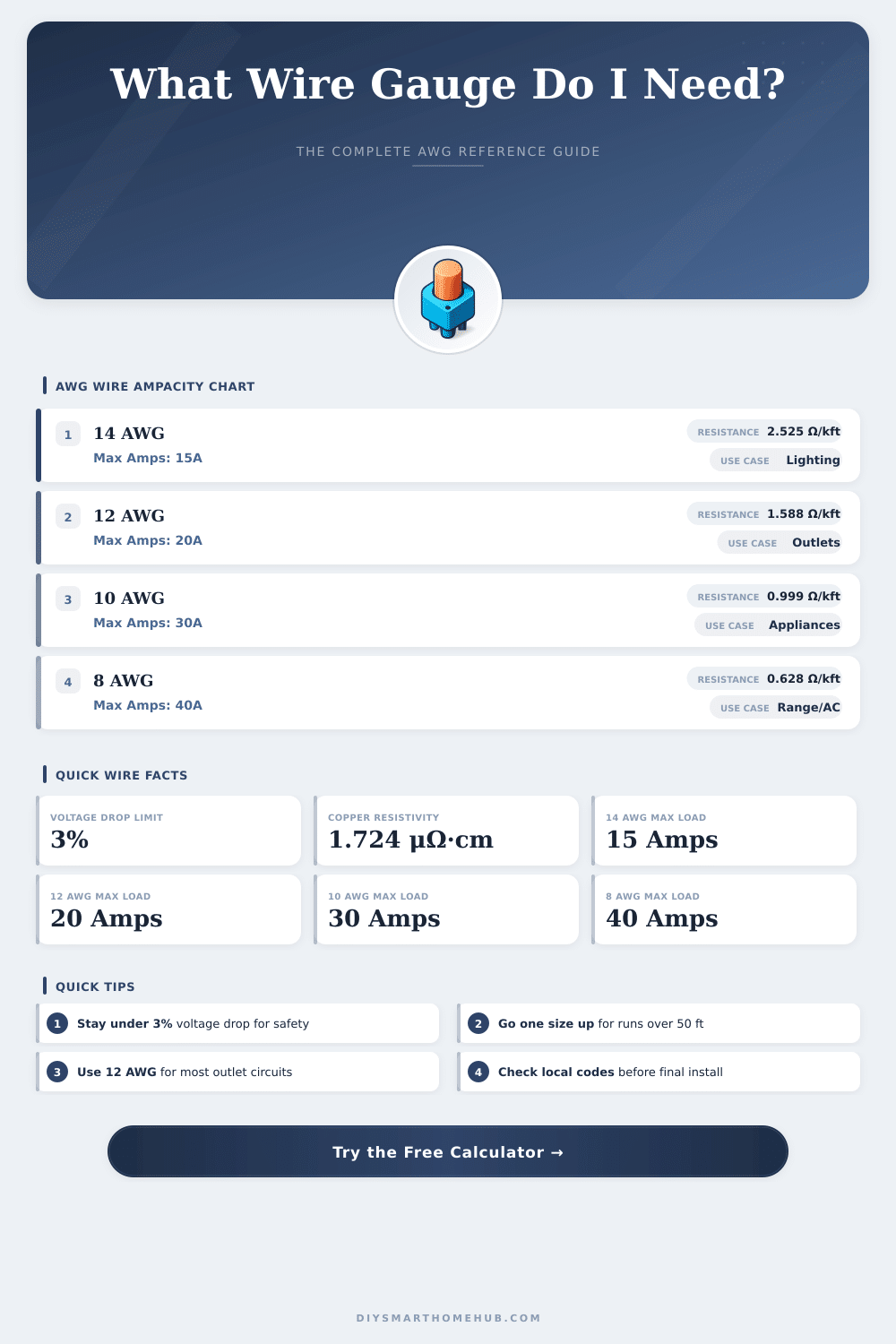
| 14 AWG | 0.0641 / 1.628 | 15A | 20A | 25A | — | 2.525 |
| 12 AWG | 0.0808 / 2.053 | 20A | 25A | 30A | 20A | 1.588 |
| 10 AWG | 0.1019 / 2.588 | 30A | 35A | 40A | 30A | 0.999 |
| 8 AWG | 0.1285 / 3.264 | 40A | 50A | 55A | 40A | 0.628 |
| 6 AWG | 0.1620 / 4.115 | 55A | 65A | 75A | 50A | 0.395 |
| 4 AWG | 0.2043 / 5.189 | 70A | 85A | 95A | 65A | 0.249 |
| 3 AWG | 0.2294 / 5.827 | 85A | 100A | 115A | 75A | 0.197 |
| 2 AWG | 0.2576 / 6.544 | 95A | 115A | 130A | 90A | 0.156 |
| 1 AWG | 0.2893 / 7.348 | 110A | 130A | 145A | 100A | 0.124 |
| 1/0 AWG | 0.3249 / 8.251 | 125A | 150A | 170A | 120A | 0.0983 |
| 2/0 AWG | 0.3648 / 9.266 | 145A | 175A | 195A | 135A | 0.0779 |
| 3/0 AWG | 0.4096 / 10.40 | 165A | 200A | 225A | 155A | 0.0618 |
| 4/0 AWG | 0.4600 / 11.68 | 195A | 230A | 260A | 180A | 0.0490 |
| 250 MCM | 0.5000 / 12.70 | 215A | 255A | 290A | 205A | 0.0415 |
| 350 MCM | 0.5916 / 15.03 | 260A | 310A | 350A | 250A | 0.0297 |
| 500 MCM | 0.7071 / 17.96 | 320A | 380A | 430A | 310A | 0.0208 |
| AWG | 25 ft run | 50 ft run | 75 ft run | 100 ft run | 150 ft run |
|---|---|---|---|---|---|
| 14 AWG @ 15A | 1.19V (1.0%) | 2.38V (2.0%) | 3.57V (3.0%) | 4.76V (4.0%) | 7.14V (6.0%) |
| 12 AWG @ 20A | 1.00V (0.8%) | 1.99V (1.7%) | 2.99V (2.5%) | 3.98V (3.3%) | 5.97V (5.0%) |
| 10 AWG @ 30A | 0.94V (0.8%) | 1.88V (1.6%) | 2.82V (2.4%) | 3.75V (3.1%) | 5.63V (4.7%) |
| 8 AWG @ 40A | 0.79V (0.7%) | 1.58V (1.3%) | 2.37V (2.0%) | 3.15V (2.6%) | 4.73V (3.9%) |
| 6 AWG @ 55A | 0.68V (0.6%) | 1.36V (1.1%) | 2.03V (1.7%) | 2.71V (2.3%) | 4.07V (3.4%) |
* Values calculated for 120V single-phase AC. Actual drop = 2 × length × resistance × amps / 1000
| Application | Typical Load | Recommended AWG | Breaker Size | Notes |
|---|---|---|---|---|
| Lighting (standard) | 10–15A | 14 AWG Cu | 15A | NEC 210.19 |
| General Outlets | 15–20A | 12 AWG Cu | 20A | Most common |
| Kitchen / Bath GFCI | 20A | 12 AWG Cu | 20A | GFCI required |
| Refrigerator | 15–20A | 12 AWG Cu | 20A | Dedicated circuit |
| Dishwasher | 15A | 14 AWG Cu | 15A | Dedicated circuit |
| Microwave | 20A | 12 AWG Cu | 20A | Dedicated preferred |
| Clothes Dryer | 30A | 10 AWG Cu | 30A | 240V / 4-wire |
| Electric Range | 40–50A | 8 AWG Cu | 50A | 240V / 4-wire |
| Water Heater | 25A | 10 AWG Cu | 30A | 240V |
| Central A/C | 30–50A | 10–8 AWG Cu | Per nameplate | 240V |
| EV Charger (Level 2) | 40–50A | 8–6 AWG Cu | 50A | 240V GFCI |
| Hot Tub / Spa | 50–60A | 6 AWG Cu | 60A | 240V GFCI |
| Subpanel (60A) | 60A | 6 AWG Cu | 60A | 4-wire feed |
| Subpanel (100A) | 100A | 1/0 AWG Cu | 100A | 4-wire feed |
wire gauge ratings serve to estimate the size of wires. They tell you the diameter by means of numbers. Here the tricky part however, the numbers work opposite to what many expect.
A low number shows big wire. A high number points to thin wire. Like this, 10 gauge wire is bigger than 14 gauge.
What Wire Gauge Numbers Mean
This commonly confuses people at first.
The gauge rating comes truly from the process of wire making. One makes wire through pulling of metal rod by means of a tool called a die and always the wire exits a bit thinner. The gauge depends on how many times one drew the wire through such tools.
So, more pulls result in thin wires with bigger numbers.
In the United States one measures wires by means of the American wire gauge system, or AWG for short. This system exists since about 1857 and one uses it mainly in North America for round, solid wires. In other parts of the world one measures wires in square millimeters.
There is also the British SWG, or Standard Wire Gauge, and the international standard IEC 60228. All those systems have a fixed set of common wire sizes, that grows in steps.
gauge numbers do not limit to electrical wires. The same idea for measuring thickness appears in jewelry, sheet metals and nails.
Fixed gauge tools are made up of discs that form a circle or oval with slots around the edge. Every slot has a different size, marked by number. One lays the wire or sheet metal in the slot to measure its outer size.
Every gauge points to a particular diameter and cross section area.
In many houses 14 AWG and 12 AWG are the usual wire sizes for lighting and outlet circuits. Fourteen gauge wire usually bears 15 amp circuits. Twelve gauge wire works for 20 amp circuits, that feeds heavy loads.
Saying “12 gauge wire” or “Nr. 12 AWG” means the same.
Choosing the right gauge is important. Thin wire causes more resistance and loss of voltage. With 12 gauge wire in 40 feet the voltage falls only by 0.2 volts.
But if one chooses 18 gauge, the fall jumps to 0.81 volts. At 20 gauge it reaches 1.2 volts. To choose the write gauge one counts the amps and the length of the cable, then checks a table of wire ratings to find a gauge that safely bears both.
Using thickerwire than needed is always a good idea, bigger capacity helps to carry the flow.