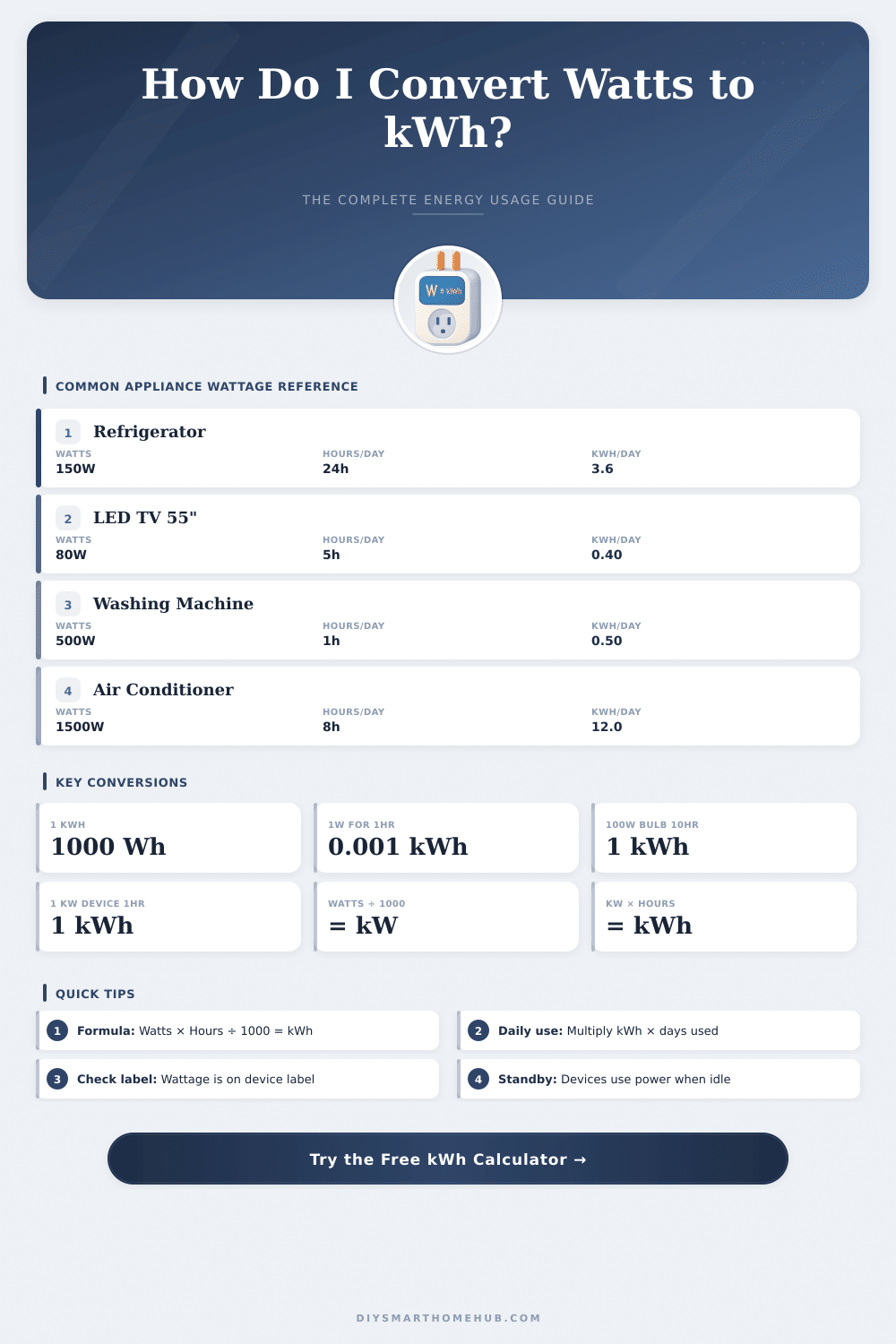
⚡ Wattage to kWh Converter
Convert watts to kilowatt-hours for any appliance — daily, monthly, or yearly usage
| Wattage (W) | 1 Hour (kWh) | 8 Hours (kWh) | 24 Hours (kWh) | 30 Days (kWh) | 1 Year (kWh) |
|---|---|---|---|---|---|
| 10W (LED bulb) | 0.010 | 0.080 | 0.240 | 7.2 | 87.6 |
| 60W (incandescent) | 0.060 | 0.480 | 1.440 | 43.2 | 525.6 |
| 100W | 0.100 | 0.800 | 2.400 | 72.0 | 876.0 |
| 150W (fridge) | 0.150 | 1.200 | 3.600 | 108.0 | 1,314.0 |
| 300W (desktop) | 0.300 | 2.400 | 7.200 | 216.0 | 2,628.0 |
| 500W (washer) | 0.500 | 4.000 | 12.000 | 360.0 | 4,380.0 |
| 1,000W (microwave) | 1.000 | 8.000 | 24.000 | 720.0 | 8,760.0 |
| 1,500W (A/C) | 1.500 | 12.000 | 36.000 | 1,080.0 | 13,140.0 |
| 2,400W (oven) | 2.400 | 19.200 | 57.600 | 1,728.0 | 21,024.0 |
| 5,000W (HVAC) | 5.000 | 40.000 | 120.000 | 3,600.0 | 43,800.0 |
| Appliance | Typical Watts | Avg Hours/Day | kWh/Month | kWh/Year |
|---|---|---|---|---|
| Refrigerator | 100 – 200W | 24 | 72 – 144 | 876 – 1,752 |
| Air Conditioner (central) | 3,000 – 5,000W | 8 | 720 – 1,200 | 8,760 – 14,600 |
| Air Conditioner (window) | 500 – 1,500W | 8 | 120 – 360 | 1,460 – 4,380 |
| LED Television 55" | 60 – 100W | 5 | 9 – 15 | 109 – 183 |
| Washing Machine | 400 – 600W | 1 | 12 – 18 | 146 – 219 |
| Electric Dryer | 4,000 – 6,000W | 1 | 120 – 180 | 1,460 – 2,190 |
| Electric Water Heater | 3,000 – 4,500W | 3 | 270 – 405 | 3,285 – 4,928 |
| Desktop Computer | 200 – 400W | 8 | 48 – 96 | 584 – 1,168 |
| Laptop Computer | 30 – 70W | 8 | 7.2 – 16.8 | 87.6 – 204.4 |
| Dishwasher | 1,200 – 2,400W | 1 | 36 – 72 | 438 – 876 |
| Microwave | 800 – 1,200W | 0.5 | 12 – 18 | 146 – 219 |
| LED Light Bulb | 5 – 15W | 6 | 0.9 – 2.7 | 10.9 – 32.9 |
| From Unit | To Unit | Formula | Example |
|---|---|---|---|
| Watts (W) | Kilowatts (kW) | W ÷ 1,000 | 1,500W ÷ 1,000 = 1.5 kW |
| Kilowatts (kW) | Watts (W) | kW × 1,000 | 1.5 kW × 1,000 = 1,500W |
| Watts + Time | kWh | (W × h) ÷ 1,000 | (1,500W × 8h) ÷ 1,000 = 12 kWh |
| kW + Time | kWh | kW × hours | 1.5 kW × 8h = 12 kWh |
| kWh | Joules (J) | kWh × 3,600,000 | 1 kWh = 3,600,000 J |
| kWh | BTU | kWh × 3,412.14 | 1 kWh = 3,412.14 BTU |
| kWh | MJ (Megajoules) | kWh × 3.6 | 1 kWh = 3.6 MJ |
| Wh (Watt-hours) | kWh | Wh ÷ 1,000 | 500 Wh ÷ 1,000 = 0.5 kWh |
Mighty converter works as practical helper, and it appears in various forms according to the needs of folks. Between them commonly presents the kind for microwave boilers. That allows to enter the time of cook and the level of power from the label of packed food later it finds the right duration for other device.
Also exist programs for phones, that does everything from memory. Those entirely estimate the precise heating time according to the power and the pointed minutes on the package of the food, adapting to any microwave available home.
How to Choose and Use a Voltage Converter
Moreover there are voltage adapters for journeys. They lower the 220V-flow of electricity until 110V. One wants them for lands with 220V-rule, for instance in Europe, Asia or Australia. Some versions include bottom switch for devices until 50W and upper for those until 2000W. In addition, step-down utilities in 230 watts alter 220V in 110V. They usually include USB-C-gates and help to launch American utilities away from home.
Even so not every device requires converter. During travel, one requires it chiefly for hair dryers and heaters. The rest, as computers and cells, commonly work by means of simple adapter, because they already operate in 220V. Heat products, as flat irons, curlers or kettles, want much power, so that tiny converter would not help.
A hair dryer alone uses five tiems more than computer, phone and razor together.
To choose the right size of utilities. Little, non-heating razor goes well with 100-watt converter. Because of more bulky heating device, one must use stronger version.
Surpass a bit the involved power is grate. Like this the utility works more easily and stays less warm. There is no big loss of impact, if the used power is under the allowed maximum.
When one uses basic transformer type, one must keep it in cool place with good airflow, because it makes much warming. Final converter should not surpass 110 percent of the involved power. Those extra 10 percent protect against changes in voltage.
Also there are calculators for power, that help to convert between different electrical values. One kind allows to enter milliamp-hours and voltage to receive watt-hours. Others estimate watts by means of basic rule, where volts multiply by amps to match watts.
Knowing that rule is useful, because some utilities show only amps on labels instead of watts. Watts estimate power, while watt-hours or kilowatt-hours estimate energy. They bind, butdiffer, as if thousands each hour against whole thousands.