⚡ Watt & Ampere Calculator
Convert between Watts, Amps, Volts & Ohms using Ohm’s Law and Power formulas
| Appliance | Watts (W) | Amps @ 120V | Amps @ 240V | Amps @ 230V |
|---|---|---|---|---|
| LED Bulb (standard) | 8–15W | 0.07–0.13A | 0.03–0.06A | 0.03–0.07A |
| Incandescent Bulb 60W | 60W | 0.50A | 0.25A | 0.26A |
| Laptop Computer | 45–90W | 0.38–0.75A | 0.19–0.38A | 0.20–0.39A |
| Desktop Computer | 200–500W | 1.67–4.17A | 0.83–2.08A | 0.87–2.17A |
| Refrigerator | 100–200W | 0.83–1.67A | 0.42–0.83A | 0.43–0.87A |
| Microwave Oven | 900–1500W | 7.5–12.5A | 3.75–6.25A | 3.91–6.52A |
| Toaster | 800–1500W | 6.67–12.5A | 3.33–6.25A | 3.48–6.52A |
| Coffee Maker | 900–1200W | 7.5–10A | 3.75–5A | 3.91–5.22A |
| Dishwasher | 1200–1800W | 10–15A | 5–7.5A | 5.22–7.83A |
| Washing Machine | 500–1000W | 4.17–8.33A | 2.08–4.17A | 2.17–4.35A |
| Electric Dryer | 4000–6000W | 33.3–50A | 16.7–25A | 17.4–26.1A |
| Space Heater | 750–1500W | 6.25–12.5A | 3.13–6.25A | 3.26–6.52A |
| Air Conditioner (window) | 500–1500W | 4.17–12.5A | 2.08–6.25A | 2.17–6.52A |
| Central AC (3-ton) | 3000–4000W | 25–33.3A | 12.5–16.7A | 13.0–17.4A |
| Electric Water Heater | 3000–4500W | 25–37.5A | 12.5–18.75A | 13.0–19.6A |
| EV Charger (Level 1) | 1440W | 12A | 6A | 6.26A |
| EV Charger (Level 2) | 7200–9600W | 60–80A | 30–40A | 31.3–41.7A |
| Breaker Size | Max Load (NEC 80%) | Max Watts @ 120V | Max Watts @ 240V | Typical Use |
|---|---|---|---|---|
| 15A | 12A | 1,440W | 2,880W | Lighting, outlets |
| 20A | 16A | 1,920W | 3,840W | Kitchen, bathroom |
| 30A | 24A | 2,880W | 5,760W | Dryers, HVAC |
| 40A | 32A | 3,840W | 7,680W | Ranges, EV chargers |
| 50A | 40A | 4,800W | 9,600W | Large appliances |
| 60A | 48A | 5,760W | 11,520W | Sub-panels, pools |
| 100A | 80A | 9,600W | 19,200W | Small home panel |
| 200A | 160A | 19,200W | 38,400W | Standard home panel |
| Watts | @ 12V (DC) | @ 120V (AC) | @ 240V (AC) | @ 230V (AC) |
|---|---|---|---|---|
| 100W | 8.33A | 0.83A | 0.42A | 0.43A |
| 250W | 20.8A | 2.08A | 1.04A | 1.09A |
| 500W | 41.7A | 4.17A | 2.08A | 2.17A |
| 750W | 62.5A | 6.25A | 3.13A | 3.26A |
| 1000W (1kW) | 83.3A | 8.33A | 4.17A | 4.35A |
| 1500W | 125A | 12.5A | 6.25A | 6.52A |
| 2000W (2kW) | 166.7A | 16.67A | 8.33A | 8.70A |
| 3000W (3kW) | 250A | 25A | 12.5A | 13.04A |
| 5000W (5kW) | 416.7A | 41.67A | 20.83A | 21.74A |
| 10000W (10kW) | 833.3A | 83.33A | 41.67A | 43.48A |
Watts and amperes are two of the most common terms when talking about electricity. They measure different things, but they are closely connected. Understanding how they work together makes it easier to figure out how much power a device needs.
An ampere, or amp for short, is a unit of electric current. It measures the number of electrons flowing past a certain point in a conductor over a specific amount of time. One amp equals one coulomb of charge per second.
What Are Watts, Amps, and Volts?
A coulomb is the electric charge of roughly 6.8 billion billion electrons. So amps basically tell you how much electrical flow is happening. Think of it like water in a river.
The amperage is the amount of water flowing through that river.
Watts measure something different. Watts tell you about power, which is the amount of energy flowing per second. One watt equals one joule of energy in one second.
The watt was developed by mechanical engineer James Watt. While amps show current, watts show how much work the electricity is actually doing.
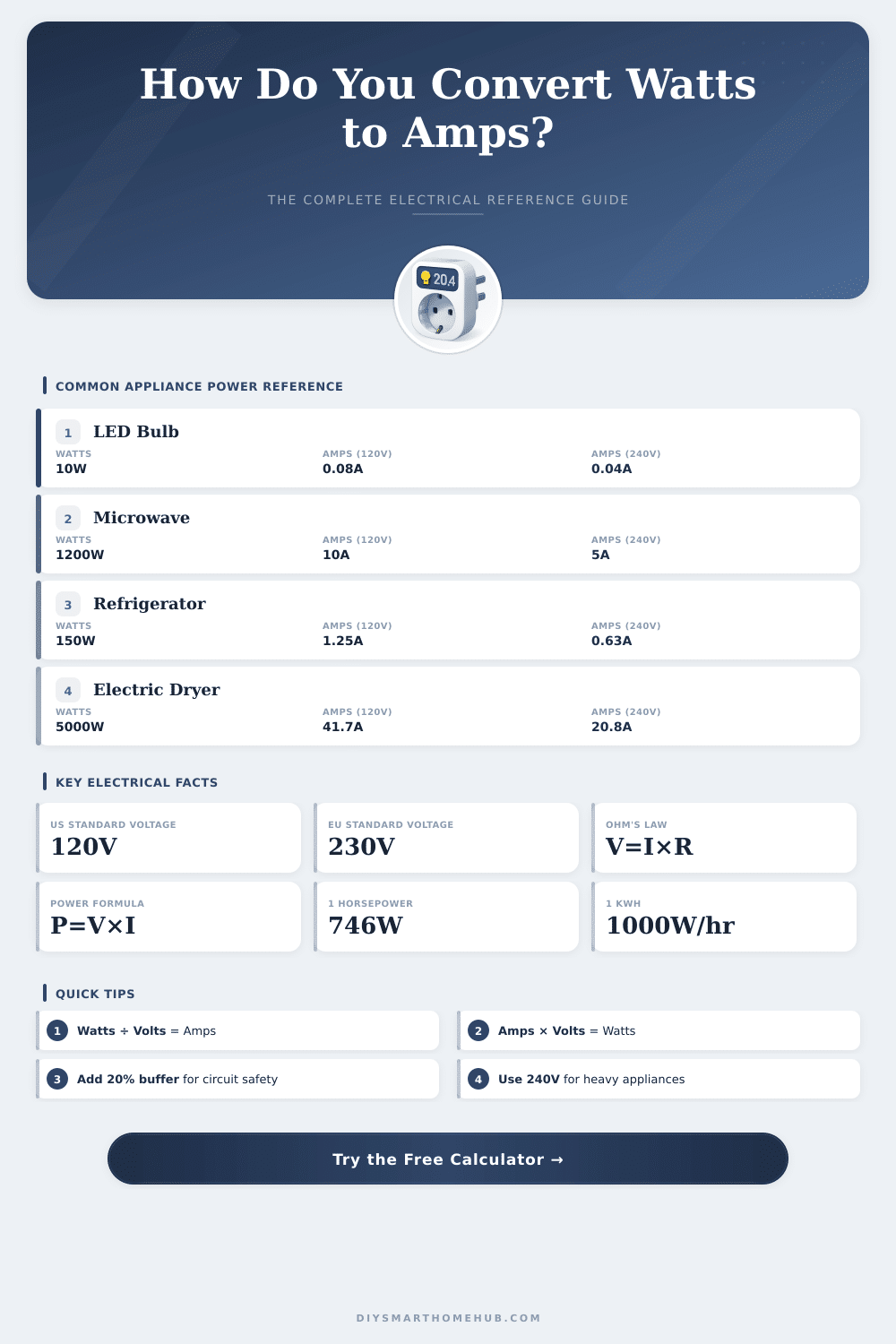
Here is where things get interesting. Amps multiplied by volts equals watts. That formula is the key to everything.
If you have an appliance that uses 5 amps at 120 volts, it uses 600 watts. Or flip it around and divide wattage by voltage to find amps. For example, 10 amps of current at 240 volts generates 2400 watts of power.
This means the same current can deliver twice as much power if the voltage is doubled.
The higher the wattage, the more power and output from the appliance. Watts are especially useful for comparing energy demand across devices because they reflect the total power draw. Electrical appliances pretty much always have their power requirements listed in watts since that is what gets billed and what they convert into other kinds of energy like heat, light, or mechanical energy.
Voltage fits into all of this too. Think of voltage as pressure. Like the height difference of a river, or steam pressure in a boiler.
Amps would be the pipe diameter or water volume. Watts would be the energy that water produces as it flows. When you have high voltage and high amperage together, you get a lot of electrical power.
Watt ratings show real power while volt-ampere ratings show apparent power. Manufacturers display both values on electronic products to show energy consumption and current draw. In DC circuits, volt-amperes and watts are equal.
But in AC circuits, current may lead or follow voltage, which changes things a bit. Conduits and fuses get rated in amperes since their power loss relates to current rather than the voltage applied at one end.
A watt is basically a volt times an amp. Pretty simple when you break it down.