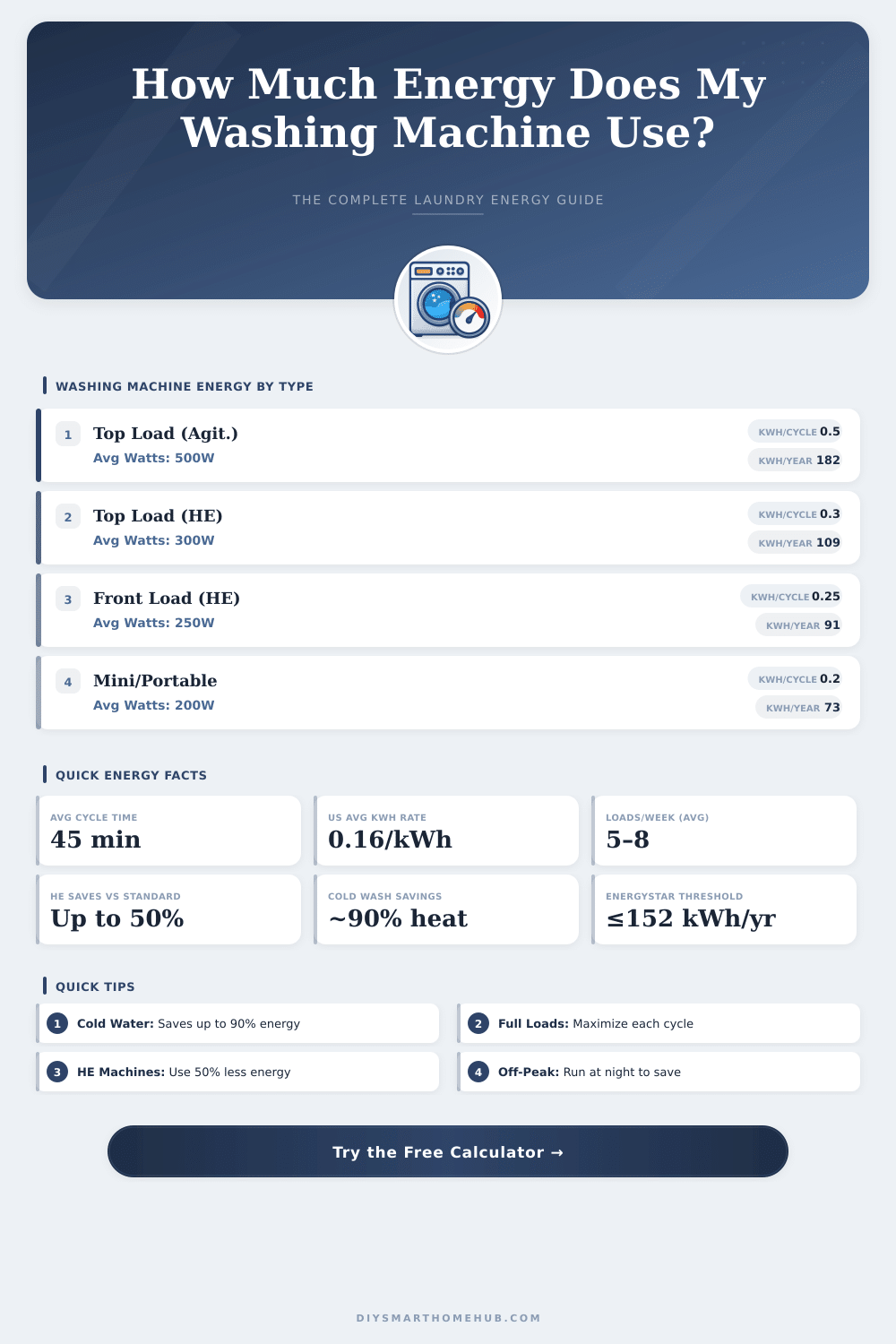
⚡ Washing Machine Energy Usage Calculator
Calculate your washer's kWh per cycle, monthly & annual energy consumption instantly.
| Wattage | 30 min | 45 min | 60 min | 90 min | Annual* (kWh) |
|---|---|---|---|---|---|
| 200W (Portable) | 0.10 kWh | 0.15 kWh | 0.20 kWh | 0.30 kWh | 62 |
| 250W (HE Front) | 0.13 kWh | 0.19 kWh | 0.25 kWh | 0.38 kWh | 77 |
| 300W (HE Top) | 0.15 kWh | 0.23 kWh | 0.30 kWh | 0.45 kWh | 93 |
| 400W (Front Std) | 0.20 kWh | 0.30 kWh | 0.40 kWh | 0.60 kWh | 124 |
| 500W (Top Agit.) | 0.25 kWh | 0.38 kWh | 0.50 kWh | 0.75 kWh | 155 |
| 800W (Commercial) | 0.40 kWh | 0.60 kWh | 0.80 kWh | 1.20 kWh | 248 |
| 1200W (Combo) | 0.60 kWh | 0.90 kWh | 1.20 kWh | 1.80 kWh | 373 |
*Annual estimate based on 8 loads/week, 45-min cycles.
| Setting | Energy Multiplier | Effect | Best For |
|---|---|---|---|
| Cold Wash | ×1.00 (baseline) | No heating needed | Colors, delicates |
| Warm Wash | ×1.15 (+15%) | Mild heating element | Mixed loads |
| Hot Wash | ×1.30 (+30%) | Full heating element | Whites, sanitize |
| Small Load (50%) | ×0.85 | Shorter fill, less motor | Quick washes |
| Medium Load (75%) | ×1.00 (baseline) | Standard operation | Most loads |
| Full Load (100%) | ×1.10 (+10%) | Most efficient per item | Best practice |
| Low Spin (600 RPM) | ×0.95 | Less motor energy | Delicates |
| High Spin (1400 RPM) | ×1.08 (+8%) | More motor energy | Fast drying |
| Machine Type | kWh/Cycle | kWh/Week | kWh/Month | kWh/Year | MJ/Year |
|---|---|---|---|---|---|
| Portable Mini (200W) | 0.15 | 1.20 | 5.20 | 62 | 223 |
| HE Front-Load (250W) | 0.19 | 1.52 | 6.58 | 79 | 284 |
| HE Top-Load (300W) | 0.23 | 1.84 | 7.97 | 96 | 346 |
| Front-Load Std (400W) | 0.31 | 2.48 | 10.75 | 129 | 465 |
| Top-Load Agitator (500W) | 0.44 | 3.52 | 15.25 | 183 | 659 |
| Heavy-Duty (700W) | 0.54 | 4.32 | 18.71 | 225 | 810 |
| Commercial (800W) | 0.62 | 4.96 | 21.48 | 258 | 929 |
| Combo Unit (1200W) | 0.92 | 7.36 | 31.89 | 383 | 1,379 |
A washing machine is important part of everyday life, silently running in laundry rooms almost everywhere. They clean clothes and other items, but they also use electricity what increases the energy bill of the home. So it is useful to understand how a washing machine uses energy, so that one can save money over time.
Here is a fact that maybe will surprise many. The motor of a washing machine actually needs very little power when it simply moves the clothes over there and back. Even during the spin phase it does not use as much.
How Washing Machines Use Energy
Almost all the energy goes to heating of the water. Because of that, washing in lower temperatures can really change the use. Machines made since 2013 according to the eco-design rules of EU can still clean well at temperatures as low as 30°C or even 20°C.
The eco rules in modern machines use less water and heat it to a lower temperature. To make up for that, the program lasts longer. That seems a bit odd, but running the motor longer with calm work usually spends less energy overall than strongly heating a big amount of water.
The heating of the water makes up about 90% of the total energy used in one load.
If one runs a washing machine three times weekly, one uses about 140.4 kilowatt-hours of electricity yearly. That matches to around $1.66 monthly and $19.92 yearly. That is not a huge amount, but it adds up.
The rated power in watts, shown on the machine, is the maximum power that it can draw at any point during the cycle. That peak mostly happens during the spin, when the motor works most hard. But the energy rating is another thing.
It is based on the total energy for a complete wash cycle and gives a clearer idea about the electrical costs. However different programs use different amounts, so the rating is based on a standard test cycle.
In EU, energy ratings go from A to G. An A-rated machine uses much less energy than a G-rated one and can save hundreds of dollars during its lifetime. Even so one eco wash at an A-rated machine can last long. For instance, a 40, 60°C program can take three hours and 48 minutes.
Machines certified by Energy Star also use smart technology to reduce water use. A full-size Energy Star machine uses around 14 gallons for one load, compared with 20 gallons in a standard machine. High-efficiency top-loading washing machines also save water and electricity, while they usually are taller and deeper then front-loading models.
Often washing half loads usually wastes water and energy. It is better to wait until the drum is full. Another thing worth knowing: a washing machine that spins the clothes well means less drying time later.
A dryer uses much more energy than a washing machine, so bettercentrifugal result is an important part of the total energy picture.