💡 Warehouse Lighting Calculator
Calculate the number of fixtures and total lumens needed for any warehouse or industrial space
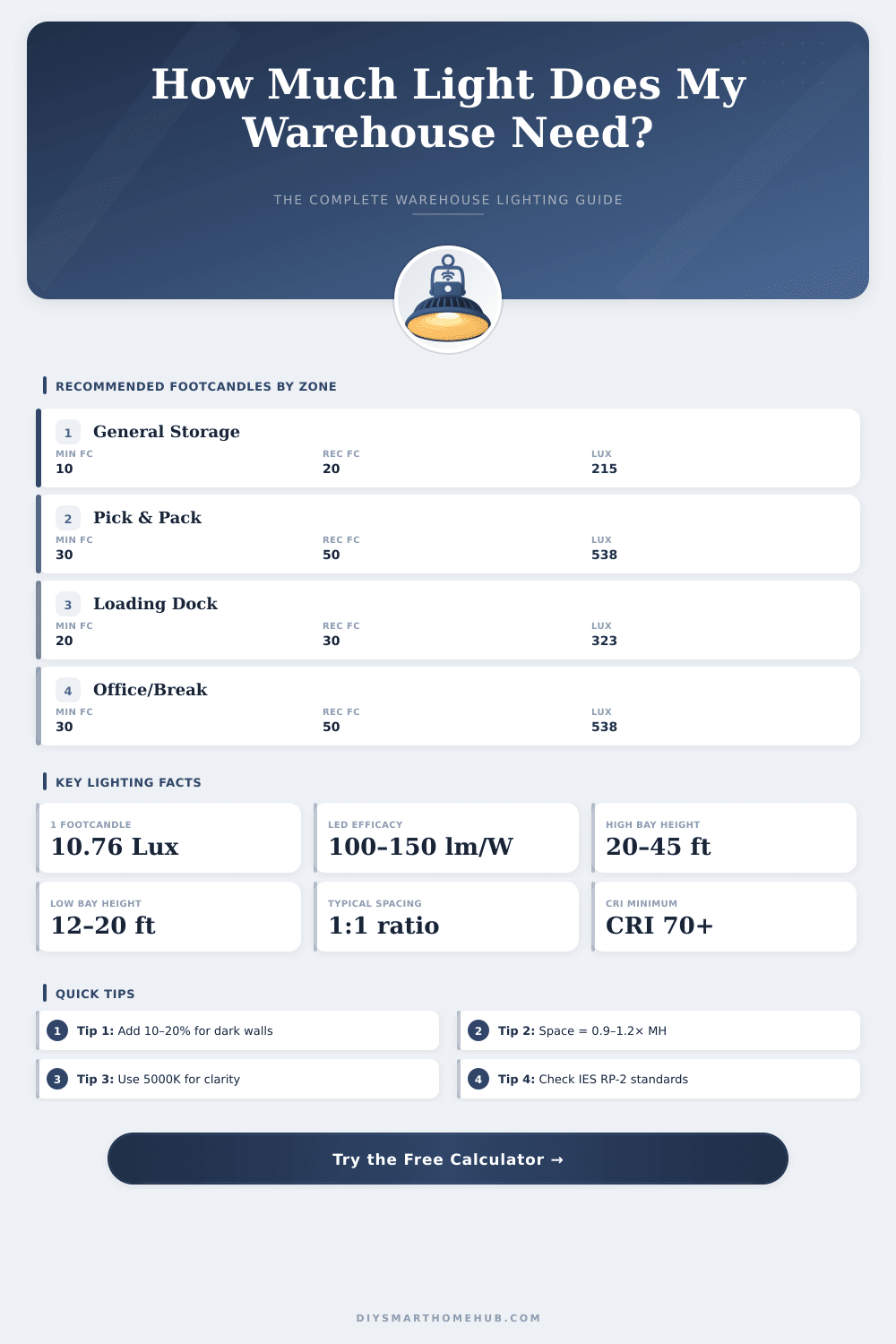
| Zone / Task | Min FC | Recommended FC | Lux Equivalent | IES Standard |
|---|---|---|---|---|
| Bulk / Pallet Storage | 5 | 10 | 108 | IES RP-2 |
| General Storage | 10 | 20 | 215 | IES RP-2 |
| Loading Dock | 20 | 30 | 323 | IES RP-2 |
| Cold Storage / Freezer | 20 | 30 | 323 | IES RP-2 |
| Pick & Pack / Fulfillment | 30 | 50 | 538 | IES RP-2 |
| Office / Break Room | 30 | 50 | 538 | IES RP-7 |
| Assembly / Light Inspection | 50 | 75 | 807 | IES RP-7 |
| Fine Inspection / QC | 100 | 150 | 1,614 | IES RP-7 |
| Hazmat / Safety Zone | 20 | 30 | 323 | OSHA 1910.120 |
14,000 lm
21,000 lm
28,000 lm
33,600 lm
8,000 lm
10,500 lm
20,000 lm
Efficacy
| Ceiling Height | Fixture Type | Max Spacing (ft) | Max Spacing (m) | Beam Angle |
|---|---|---|---|---|
| 10–15 ft (3–4.5 m) | LED Low Bay | 10–12 | 3.0–3.7 | 120° |
| 15–20 ft (4.5–6 m) | LED Low Bay | 12–15 | 3.7–4.6 | 120° |
| 20–30 ft (6–9 m) | LED High Bay | 15–20 | 4.6–6.1 | 90–120° |
| 30–40 ft (9–12 m) | LED High Bay | 20–25 | 6.1–7.6 | 60–90° |
| 40–50 ft (12–15 m) | LED UFO High Bay | 25–30 | 7.6–9.1 | 60° |
| Project | Area (sq ft) | Area (m²) | Zone | Fixtures Needed* |
|---|---|---|---|---|
| Small Storage Unit | 4,000 | 372 | General Storage | 18–24 |
| Medium Warehouse | 15,000 | 1,394 | General Storage | 65–85 |
| Pick & Pack Center | 8,000 | 743 | Pick & Pack | 55–75 |
| Large Distribution Center | 60,000 | 5,574 | General Storage | 260–330 |
| Loading Dock Area | 2,400 | 223 | Loading Dock | 18–24 |
| Cold Storage Facility | 4,800 | 446 | Cold Storage | 28–36 |
*Estimate based on 150W LED High Bay (21,000 lm), CU 0.70, LLF 0.80
Fixtures Needed = (FC Target × Area) ÷ (Lumens per Fixture × CU × LLF). Always round up to the nearest whole number. Add 10–15% if your walls are dark or shelving blocks light distribution.
Use LED Low Bay fixtures for ceilings under 20 ft (6 m). Use LED High Bay for 20–40 ft (6–12 m) ceilings. For ceilings above 40 ft (12 m), use narrow-beam UFO high bay fixtures (60° beam angle) to concentrate light on the work plane.
warehouse lighting is an important investment for any vast area, where human working happens. It backs the workers in their choices and ensures safe cleanup of the products. Moreover, good lighting helps drivers of forklifts move through the galleries without any troubles.
Areas with open structures, high ceilings and few windows most urgently require lighting that is planned specially for such circumstances.
Warehouse Lighting: Bright, Safe, and Saves Energy
The kind of installed lamps depends on the features of the building and on the presence of natural light. For instance, in a warehouse with glass roof windows one can receive much light during the day, but when the sun sets, the space risks becoming black and dangerous. Rightly then artificial lighting truly matters.
High bay lamps are the most commonly chosen solution for stores. They most effectively operate in places, where the ceilings pass twenty feet in height. One uses them in commercial places like workshops, warehouse spaces, retail stores, factories and similar gym rooms.
The arrangement of the lamps also plays a role. In open storage with big, spaced objects, a symmetrical net of fixtures with round-shaped expansion operates well. For linear galleries in storage, another method with intended corners for work is more useful.
One of the main reasons that folks switch to LED is the saving of energy. Replacing old 400-watt metal halide high bay lamps with 200-watt LED alternatives delivers immediate white glow. There is no warm-up time and no drone.
LED lamps can also replace hidden lamps, that consume more then 1000 watts, with fixtures that use only around 360 watts. They cost a lot to buy, but they cost less in usage over time. A wise strategy is to wait until the current lamps require refill, and then switch to LED.
Wise warehouse lighting takes things to a higher level. Such systems form a digital net of smart lamps with sensors. They work with high energy efficiency and offer adjustable light, that allows flexible usage of the space.
The main target stays good visibility to create a safe and productive work space.
When one wires warehouse lamps, asking lighting suppliers helps a lot. They are fit to suggest products that answer for the precise area. Because one commonly controls lamps from several entry points, solutions exist for simple switches through the whole building.
CRI is another thing that one must know about. CRI above eighty is already enough, but if color accuracy matters, a higher value is better. Output of light around 130 lumens each watt is reasonable, although some warehouse lamps reach 170 to 180 lumens each watt.
There are also online stores with more than 24,000 lighting items, including fixtures, bulbs, controls andaccessories. Some of them offer calculators to find ideal lamps for particular spaces.