⚡ Transformer Fuse Size Calculator
Calculate the correct primary & secondary fuse ratings based on NEC 450.3 for any transformer
| kVA Rating | Primary 120V | Primary 240V | Primary 480V | Secondary 120V | Secondary 240V |
|---|---|---|---|---|---|
| 0.5 kVA | 6A → 15A | 3A → 15A | 2A → 15A | 5A → 15A | 3A → 15A |
| 1 kVA | 10.4A → 15A | 5.2A → 15A | 2.6A → 15A | 8.3A → 15A | 4.2A → 15A |
| 2 kVA | 20.8A → 30A | 10.4A → 15A | 5.2A → 15A | 16.7A → 20A | 8.3A → 15A |
| 3 kVA | 31.3A → 40A | 15.6A → 20A | 7.8A → 15A | 25A → 30A | 12.5A → 15A |
| 5 kVA | 52.1A → 70A | 26A → 30A | 13A → 15A | 41.7A → 50A | 20.8A → 25A |
| 7.5 kVA | 78.1A → 100A | 39.1A → 50A | 19.5A → 25A | 62.5A → 80A | 31.3A → 40A |
| 10 kVA | 104.2A → 125A | 52.1A → 60A | 26A → 30A | 83.3A → 100A | 41.7A → 50A |
| 15 kVA | 156.3A → 200A | 78.1A → 100A | 39.1A → 50A | 125A → 150A | 62.5A → 80A |
| 25 kVA | 260.4A → 300A | 130.2A → 150A | 65.1A → 80A | 208.3A → 250A | 104.2A → 125A |
| 37.5 kVA | 390.6A → 400A | 195.3A → 200A | 97.7A → 110A | 312.5A → 350A | 156.3A → 175A |
| kVA Rating | FLA Primary (A) | 125% Primary | Recommended Fuse | FLA Secondary 208V | Secondary Fuse |
|---|---|---|---|---|---|
| 9 kVA | 10.8A | 13.5A | 15A | 25A | 30A |
| 15 kVA | 18.0A | 22.5A | 25A | 41.6A | 50A |
| 30 kVA | 36.1A | 45.1A | 50A | 83.3A | 100A |
| 45 kVA | 54.1A | 67.6A | 70A | 124.9A | 150A |
| 75 kVA | 90.2A | 112.8A | 125A | 208.2A | 225A |
| 112.5 kVA | 135.3A | 169.1A | 175A | 312.3A | 350A |
| 150 kVA | 180.4A | 225.5A | 250A | 416.4A | 450A |
| 225 kVA | 270.6A | 338.2A | 350A | 624.5A | 700A |
| 300 kVA | 360.8A | 451.0A | 500A | 832.7A | 900A |
| 500 kVA | 601.4A | 751.7A | 800A | 1387.8A | 1600A |
| Location | Impedance | Primary Max % | Secondary Max % | Notes |
|---|---|---|---|---|
| Supervised (supervisory controlled) | Any | 250% | 250% | NEC 450.3(A) |
| Unsupervised – Primary Only | < 6% | 125% | — | NEC 450.3(B) Row 1 |
| Unsupervised – Primary Only | ≥ 6% | 300% | — | NEC 450.3(B) Row 2 |
| Unsupervised – Both Sides | < 6% | 250% | 125% | NEC 450.3(B) Row 3 |
| Unsupervised – Both Sides | ≥ 6% | 250% | 250% | NEC 450.3(B) Row 4 |
| Calculated Amps | Next Standard Fuse | Calculated Amps | Next Standard Fuse |
|---|---|---|---|
| 0 – 15A | 15A | 151 – 175A | 175A |
| 16 – 20A | 20A | 176 – 200A | 200A |
| 21 – 25A | 25A | 201 – 225A | 225A |
| 26 – 30A | 30A | 226 – 250A | 250A |
| 31 – 35A | 35A | 251 – 300A | 300A |
| 36 – 40A | 40A | 301 – 350A | 350A |
| 41 – 50A | 50A | 351 – 400A | 400A |
| 51 – 60A | 60A | 401 – 450A | 450A |
| 61 – 70A | 70A | 451 – 500A | 500A |
| 71 – 80A | 80A | 501 – 600A | 600A |
| 81 – 90A | 90A | 601 – 700A | 700A |
| 91 – 100A | 100A | 701 – 800A | 800A |
| 101 – 110A | 110A | 801 – 1000A | 1000A |
| 111 – 125A | 125A | 1001 – 1200A | 1200A |
| 126 – 150A | 150A | 1201 – 1600A | 1600A |
Election of the right fuse for a transformer seems simple, but it quickly becomes a difficult task. The main protective fuse must handle the strong inrush of current in a transformer that reaches up to 30 times the usual current for around 0.01 seconds. When the device first turns on, that sudden energy spike can destroy a fuse that is a bit too small.
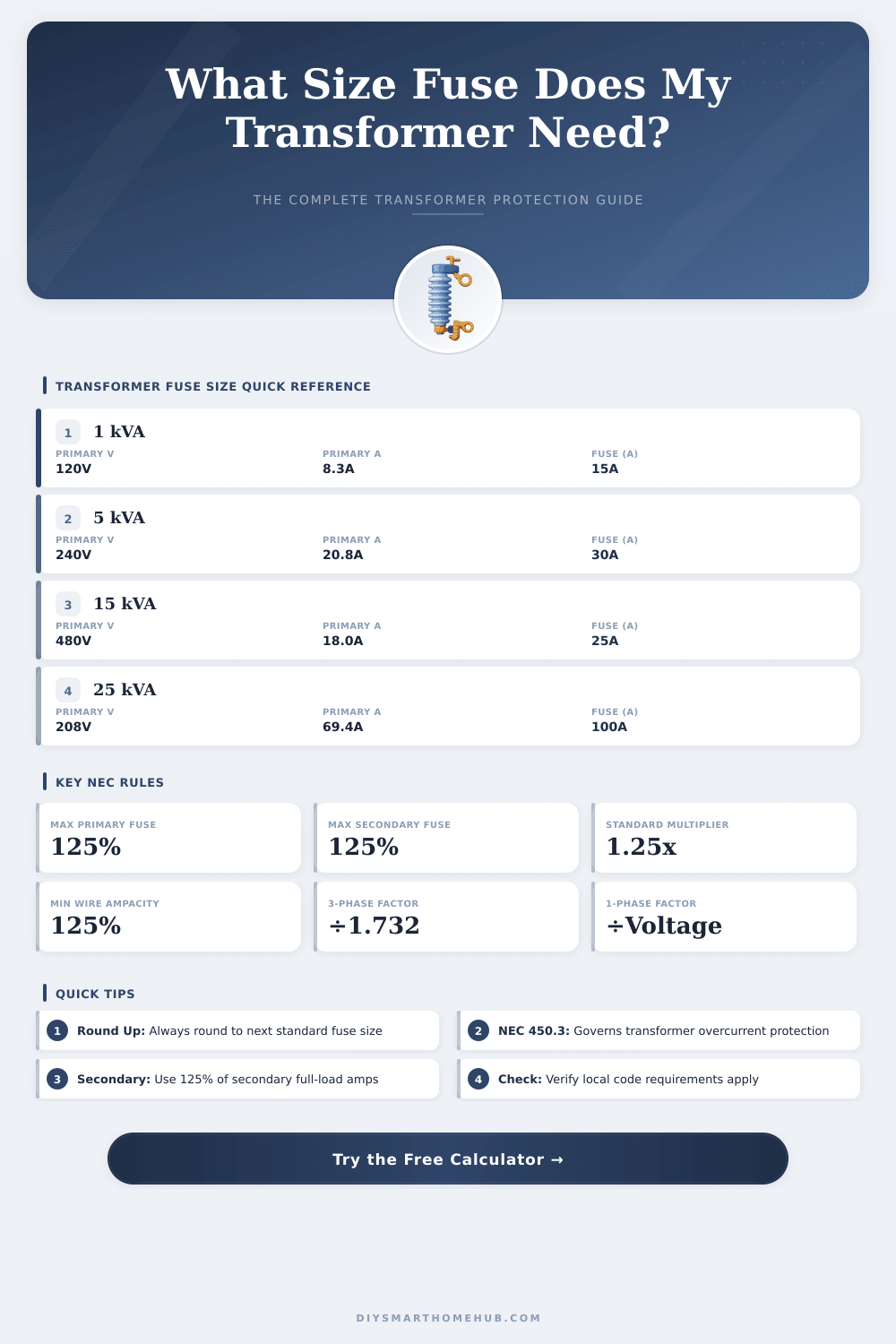
The fuse usually is designed for 125 % of the maximum kVA of the transformer. For instance, a 45-kVA step-up transformer with 125-amp input requires a 156-amp fuse at 125 %, so one rounds it to standard 175-amp size. The section 450.3(B) of NEC shows the biggest fuse values and serves as an important guide for right choices.
How to Choose a Fuse for a Transformer
Sizes of circuit breaker and fuse follow NEC 450.3 together with the standard values from NEC 240.6(A).
Some installations apply up to 250 % rating. For a 10 000-kVA transformer in 480 volts three-phase, the computation uses the formula with 1,732 and later multipleis by 2,5.
In smaller transformers the calculations are easier. A 40-VA transformer with 24-volt secondary coil at 1.67 amps, a 2-amp fuse answers. In the basic side with 120 volts, the same device takes almost 0.33 amps, and the nearest standard fuse works.
Fourth sample: a 75-watt transformer in 120 volts uses 0.625 amps, so a 0.5-amp fuse forms a good start.
Cheaper transformers sometimes use some idle current, so plan for around 0.5 amps in the main input fuse is wise four units of lower quality.
For work with utilities and usual volts like 19.9 and 7.6, it is enough to recall only four fuse sizes for most tasks. A 25-kVA transformer at 19.9 requires a 3-amp fuse. A 50-kVA at 19.9 requires a 5-amp fuse.
At 7.6 volts, 25-kVA takes 10 amps while 50-kVA reaches 15 amps.
Fuses of CC-class have smoother curves than those of J- and RK-classes. CC-fuses come in sizes of around 0.2 to 30 amps. When one skips the secondary protection, the primary can be fused at 125 % of the primary current, then rounding to the next usual size.
Before, choices of fuses at makers of transformers meant line-to-line primary at 480 volts and line-to-neutral secondary at 120 volts. If the transformer is wired only for 120-volt output, even secondary fusing doesnotnecessarily need to be there.
A fuse mainly serves to protect the wires, so it is always chosen according to the ratings of the wires too.