🔋 Trail Camera Battery Life Calculator
Estimate how long your trail camera batteries will last based on usage, camera type, and conditions
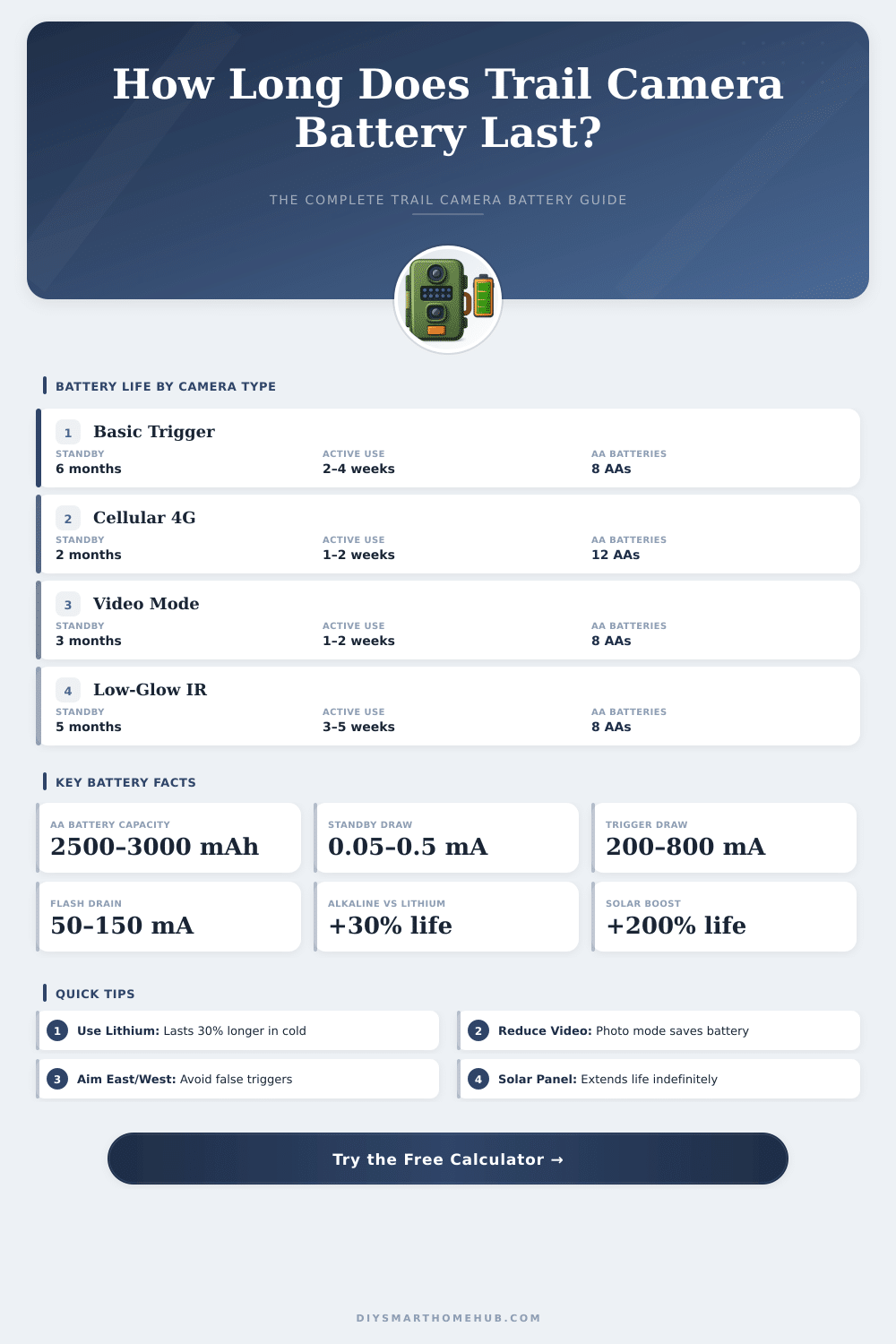
| Temperature Range | Condition | Battery Efficiency | Life Modifier | Recommended Battery |
|---|---|---|---|---|
| Above 85°F (29°C) | Hot Summer | 90–95% | -5% | Alkaline or Lithium |
| 40–85°F (4–29°C) | Mild / Ideal | 100% | None | Any battery type |
| 20–40°F (-7–4°C) | Cold Weather | 70–85% | -20% | Lithium strongly recommended |
| Below 20°F (-7°C) | Freezing | 40–60% | -45% | Lithium only |
| Camera Type | Standby Only | Low Use (6/day) | Moderate (24/day) | Heavy (60/day) |
|---|---|---|---|---|
| Basic Trigger (8 AA Alkaline) | 6+ months | 90–120 days | 30–50 days | 10–18 days |
| Low-Glow IR (8 AA Lithium) | 8+ months | 110–150 days | 40–60 days | 14–22 days |
| Black Flash (12 AA Lithium) | 10+ months | 130–180 days | 50–75 days | 18–28 days |
| 4G Cellular (12 AA Lithium) | 60–90 days | 30–45 days | 14–25 days | 5–10 days |
| Video Mode (8 AA Lithium) | 5+ months | 45–60 days | 15–25 days | 5–10 days |
| 12V External Pack | 18+ months | 300+ days | 120–180 days | 45–75 days |
| Event Type | Avg Current Draw | Duration | mAh Per Event | Events Per 1,000 mAh |
|---|---|---|---|---|
| Photo – Low Flash | 200 mA | ~3 sec | 0.17 mAh | ~5,900 |
| Photo – Normal Flash | 350 mA | ~3 sec | 0.29 mAh | ~3,400 |
| Photo – High Flash | 600 mA | ~3 sec | 0.50 mAh | ~2,000 |
| Video 30 sec – Normal | 500 mA | 30 sec | 4.17 mAh | ~240 |
| Cellular Transmission | 800 mA | ~10 sec | 2.22 mAh | ~450 |
| Standby (per hour) | 0.2 mA | 60 min | 0.20 mAh | 5,000 hrs |
Alkaline batteries can lose up to 50% of their capacity in freezing temperatures. Lithium batteries maintain near full performance down to -40°F (-40°C) and are the only real choice for winter deployments.
Aim your camera east or west (not toward the rising or setting sun) and clear vegetation within the detection zone. False triggers from wind-blown branches or sunlight are the #1 cause of unexpected battery drain on trail cameras.
Trail cameras stand in the woods for long times, sometimes weeks, sometimes whole months. Problems happen because commonly visiting them for control leaves human smells that warn the creatures. So you need batteries that last the whole period, together with an SD card that fits a big number of photographs.
For choosing the right battery lithium is the best option. Those AA-type batteries give a stable voltage level, what matters, because most trail cameras work at 6V or 12V. They work well, regardless of the surroundings that you put before them. What sets lithium batteries apart is their steady and faithful voltage; that results in clearer and quality images.
Best Batteries for Trail Cameras
Alkaline batteries seem practical and are easily available, but their power slowly drops, especially when the temperature falls.
Energizer Ultimate Lithium is the favourite for many users, especially those that struggle with rough winter conditions. In cold lithium truly beats alkaline. It beats them clearly in cold situations and lasts much more long, without risk of leak.
Even so, there is one wierd cause for mention; they can cheat you, showing a lot of energy staying and later sharply end. I noticed that at Energizer Lithium something above 1.6 volts yet gives good output, during fresh marks reach around 1.75 volts.
The price bothers a bit. At almost 20 dollars for an eight-pack, lithium batteries are not cheap. Some prefer Duracell Optimum, that one can buy easily in common stores.
The white and gray batteries of Amazon Business, sold in big packages of 150, form another cheap option. Rayovac High Energy costs a bit more, but it keeps its power well.
Here it gets interesting… Trail cameras can photograph until 20 000 images with won set of batteries and work during eight until 12 months. A good camera stays here at least six months without change.
When batteries will exactly end, who can predict? It is the difficult part. You must consider the number of photographs that it takes, the difference between day and night, the cold and the needs of your model.
Video recording drains them more quickly, just like rechargeable sets, overnight rule and long time delays. I noted that turning overnight photographs off and skipping sight entirely help stretch the total. Leaving the camera at four feet high and removing grass and branches also reduces false settings, and fewer false ones mean more battery life.
Rechargeable NiMH batteries usually do not deserve the trouble. Their low voltage needs more electricity, and they lose force too soon, what causes the camera to shut off early. Some trail cameras indeed come with rechargeable lithium-ion sets as an option.
There is also the way with a 12V mini-solar panel, they have built-in batteries and are designed specially for trail cameras, if you want something connected to outside energy. And for getting more, there are outside power cables, some even against chewing of curious animals.
Certain apps, like Spypoint, allow you to note that you use lithium batteries. That helps, because lithium gives maximum voltage level during the whole time, during which alkaline ones slowly die. Low-glow infrared cameras use fairly little energy, but some IR trail cameras need more thanalkline ones can well provide.