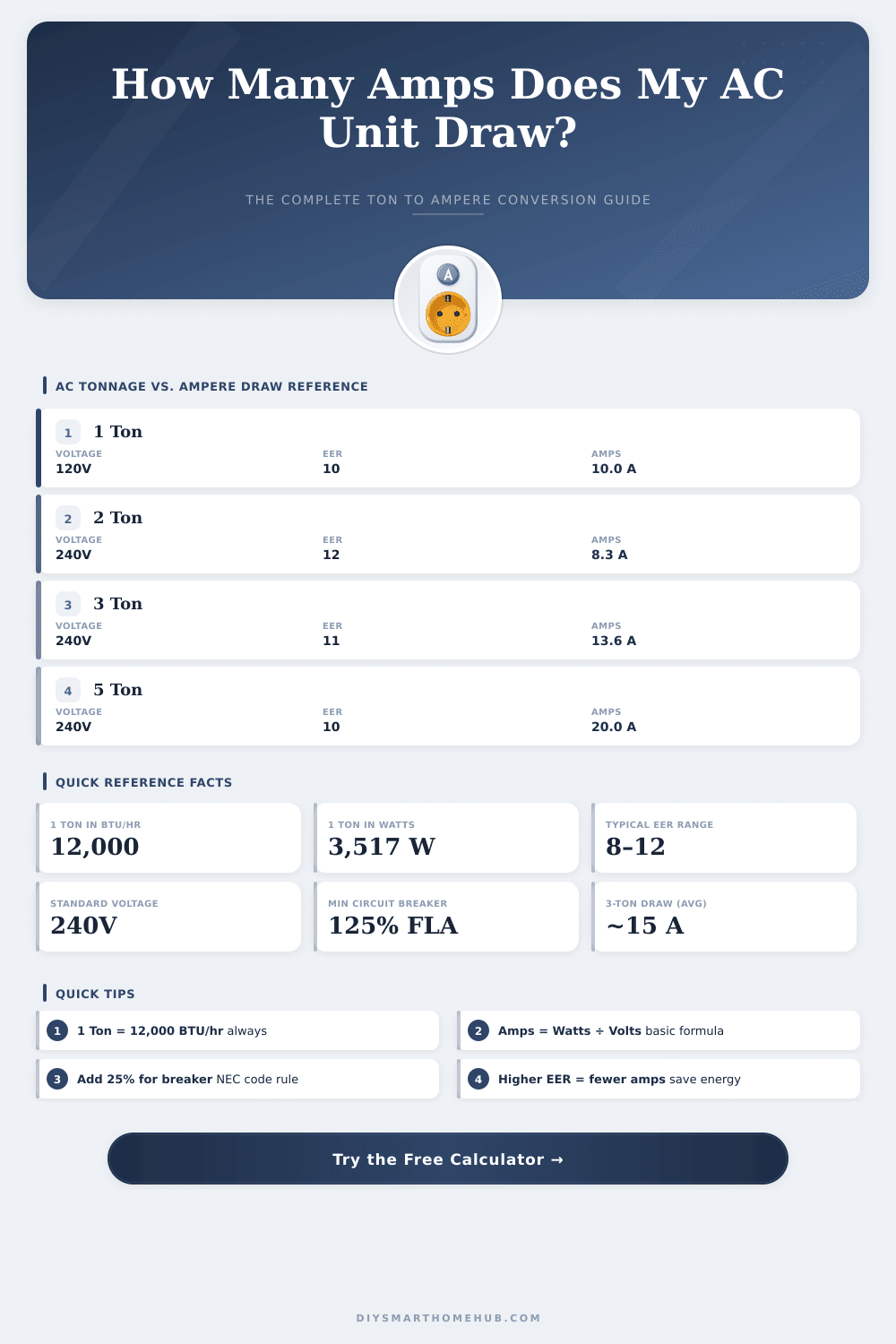
⚡ Ton to Ampere Calculator
Convert AC tonnage to ampere draw instantly — enter tons, voltage & efficiency for accurate results
| Tons | BTU/hr | Watts | Amps @ 120V | Amps @ 240V | Amps @ 480V |
|---|---|---|---|---|---|
| 0.5 Ton | 6,000 | 600 | 5.9 A | 2.9 A | 1.5 A |
| 1.0 Ton | 12,000 | 1,200 | 11.8 A | 5.9 A | 2.9 A |
| 1.5 Ton | 18,000 | 1,800 | 17.6 A | 8.8 A | 4.4 A |
| 2.0 Ton | 24,000 | 2,400 | 23.5 A | 11.8 A | 5.9 A |
| 2.5 Ton | 30,000 | 3,000 | 29.4 A | 14.7 A | 7.4 A |
| 3.0 Ton | 36,000 | 3,600 | 35.3 A | 17.6 A | 8.8 A |
| 3.5 Ton | 42,000 | 4,200 | 41.2 A | 20.6 A | 10.3 A |
| 4.0 Ton | 48,000 | 4,800 | 47.1 A | 23.5 A | 11.8 A |
| 5.0 Ton | 60,000 | 6,000 | 58.8 A | 29.4 A | 14.7 A |
| 10 Ton | 120,000 | 12,000 | 117.6 A | 58.8 A | 29.4 A |
| EER Rating | Input Watts | Amps @ 240V (PF 1.0) | Amps @ 240V (PF 0.85) | Annual kWh (1,500 hrs) |
|---|---|---|---|---|
| EER 8 | 4,500 W | 18.75 A | 22.1 A | 6,750 kWh |
| EER 9 | 4,000 W | 16.67 A | 19.6 A | 6,000 kWh |
| EER 10 | 3,600 W | 15.00 A | 17.6 A | 5,400 kWh |
| EER 11 | 3,273 W | 13.64 A | 16.0 A | 4,909 kWh |
| EER 12 | 3,000 W | 12.50 A | 14.7 A | 4,500 kWh |
| EER 14 | 2,571 W | 10.71 A | 12.6 A | 3,857 kWh |
| EER 16 | 2,250 W | 9.38 A | 11.0 A | 3,375 kWh |
| AC Size | Typical FLA (A) | Min Circuit (125%) | Max Breaker (175%) | Wire Gauge (AWG) |
|---|---|---|---|---|
| 1 Ton (120V) | 10 A | 12.5 A → 15A breaker | 17.5 A → 20A breaker | 14 AWG |
| 1.5 Ton (240V) | 8 A | 10 A → 15A breaker | 14 A → 15A breaker | 14 AWG |
| 2 Ton (240V) | 12 A | 15 A → 20A breaker | 21 A → 25A breaker | 12 AWG |
| 3 Ton (240V) | 17 A | 21.3 A → 25A breaker | 29.8 A → 30A breaker | 10 AWG |
| 4 Ton (240V) | 23 A | 28.8 A → 30A breaker | 40.3 A → 40A breaker | 8 AWG |
| 5 Ton (240V) | 29 A | 36.3 A → 40A breaker | 50.8 A → 50A breaker | 8 AWG |
| 5 Ton (480V 3-ph) | 15 A | 18.8 A → 20A breaker | 26.3 A → 30A breaker | 12 AWG |
| Application | Recommended Tons | Typical Voltage | Approx. Amps |
|---|---|---|---|
| Small bedroom / studio | 0.5 – 1 Ton | 120V | 6 – 12 A |
| Single-room window AC | 1 – 1.5 Ton | 120V / 240V | 8 – 18 A |
| 2-bedroom home | 1.5 – 2 Ton | 240V | 9 – 12 A |
| 3-bedroom home | 2 – 3 Ton | 240V | 12 – 18 A |
| 4-bedroom home | 3 – 4 Ton | 240V | 18 – 24 A |
| Small office / retail | 3 – 5 Ton | 240V / 480V | 15 – 30 A |
| Large commercial space | 5 – 20 Ton | 480V 3-phase | 15 – 50 A |
| Industrial facility | 20+ Ton | 480V 3-phase | 50+ A |
The word “ampere” appears commonly when one talks about air cooling systems. One ton of refrigeration matches to 12 000 BTU each hour what pushes it as a measure of energy flow. That corresponds to around 3 517 watts.
Like this, ton no simply shows 12 000 BTU… It exactly points to 12 000 BTU during one hour.
How Many Amps Does an Air Conditioner Draw
One ton of cooling skill matches to 3 516,85 volt-ampere. One can also say that is around 3,5 kVA. Another way, one volt-ampere matches to 0,000284 tons of refrigeration.
Such conversions help when one counts electrical loads for cooling gear.
For counting the flow in ampere for certain devices, one multiplies the tons of refrigeration by 3 516,85, then divides that by the voltage, the effeciency and the power factor. With ideal settings, a one-ton device operates on 120 volts and draws about 29 ampere. In actual life the values differ.
An old three-ton unit, tested at 240 volts, used around 19 ampere, what gives about 1,5 kVA each ton. The breakers of that device were rated at 30 ampere. In 220-volt devices, a rough rule says around 6,5 ampere each ton.
Tools for converting power allow to exchange between various units, for instance kilowatts, watts, volt-ampere, BTU each hour, BTU each minute, horsepowers and tons of refrigeration. The main idea is, that power is energy divided buy time.
One 1,5-ton air conditioner usually consumes around 1 500 watts. With 220 volts and power factor of 0,8, the flow comes to about 8,5 ampere. A 10-ampere breaker would cut it easily, so a 16-ampere one is better.
Some specialists advise even a 20-ampere breaker for safe handling of the load.
For a two-ton air conditioner on a single-phase 240-volt net with power factor of 0,8, the calculation shows around 13,5 ampere. A 20-ampere breaker works well here. The used formula is basic: the flow matches to the wattage divided by voltage times power factor.
Two tons of skill correspond roughly to 2 600 watts.
Big systems need attention in the planning. A 10-ton unit on 415-volt three-phase power draws about 13 to 18 ampere, according to the efficiency, with power factor around 0,9. For 5-ton home split setups, the sizes of breakers usually fall between 40 and 70 ampere.
Always check the label of thefactory for precise values.
The rating of EER for a device also matters. It helps to convert use of BTU into real use of energy. New units most commonly have better EER ratings.
Various builds and temperatures change the values, so there is not one solution for every case.