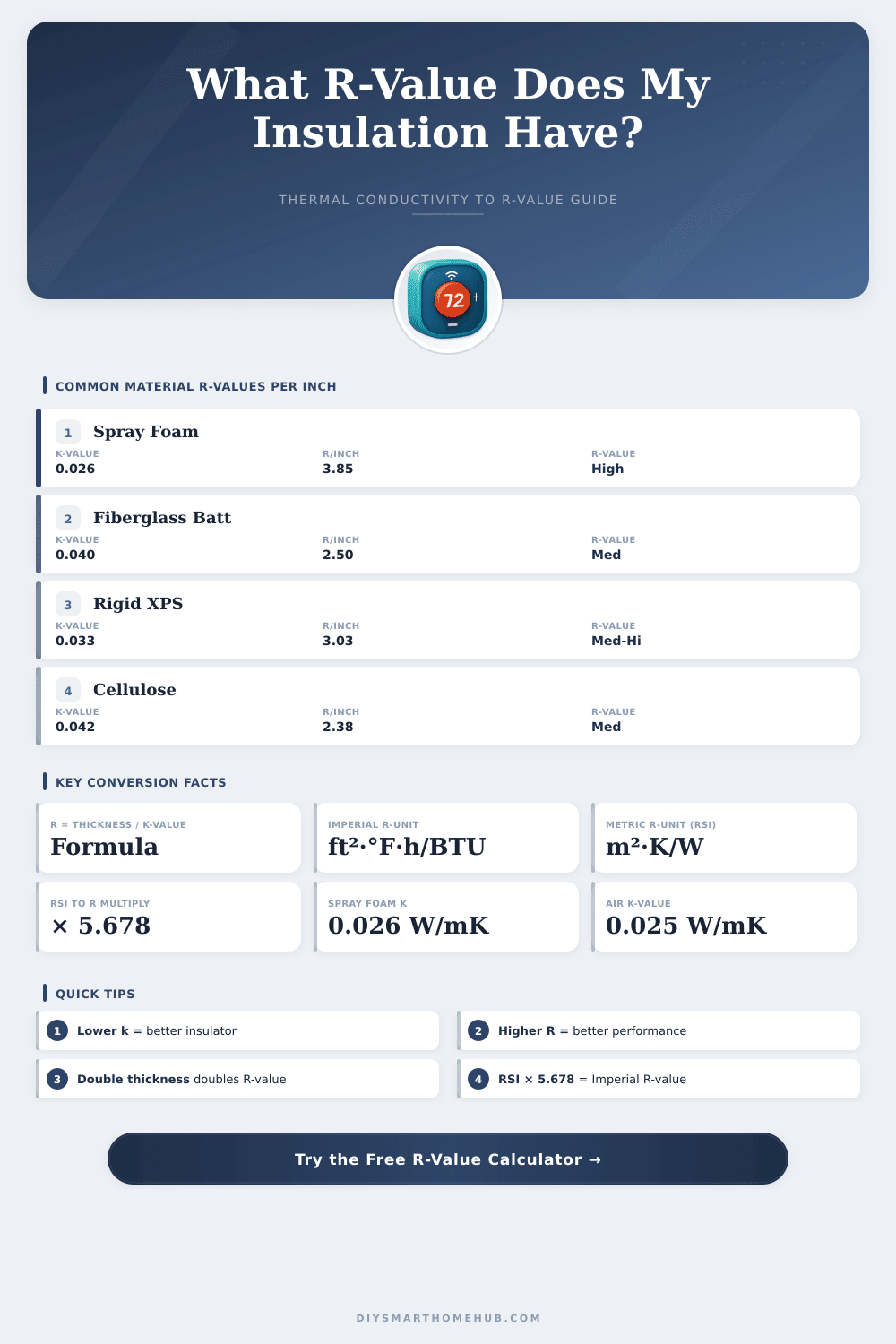
🌡️ Thermal Conductivity to R-Value Calculator
Convert k-value (W/m·K) to R-value & RSI instantly. Supports imperial & metric units for any insulation material.
| Material | k-Value (W/m·K) | R-Value per Inch | RSI per 25mm | Performance |
|---|---|---|---|---|
| Aerogel Blanket | 0.015 | 4.23 | 1.67 | Excellent |
| Closed-Cell Spray Foam | 0.026 | 6.50 | 0.96 | Excellent |
| Polyisocyanurate (Polyiso) | 0.022 | 7.20 | 1.14 | Excellent |
| XPS Rigid Board | 0.033 | 5.00 | 0.76 | Good |
| EPS Rigid Board | 0.037 | 4.47 | 0.68 | Good |
| Open-Cell Spray Foam | 0.039 | 3.80 | 0.64 | Good |
| Mineral Wool / Rock Wool | 0.038 | 3.90 | 0.66 | Good |
| Fiberglass Batt | 0.040 | 3.50 | 0.63 | Fair |
| Blown Fiberglass | 0.044 | 2.20 | 0.57 | Fair |
| Cellulose (blown) | 0.042 | 3.60 | 0.60 | Fair |
| Cork Board | 0.045 | 3.27 | 0.56 | Fair |
| Wood Fiber Board | 0.050 | 2.94 | 0.50 | Fair |
| Perlite Board | 0.060 | 2.45 | 0.42 | Low |
| Material | Target R-13 | Target R-19 | Target R-30 | Target R-38 |
|---|---|---|---|---|
| Closed-Cell Spray Foam | 2.0 in / 51mm | 2.9 in / 74mm | 4.6 in / 117mm | 5.8 in / 147mm |
| Polyiso Board | 1.8 in / 46mm | 2.6 in / 66mm | 4.2 in / 107mm | 5.3 in / 135mm |
| XPS Rigid Board | 2.6 in / 66mm | 3.8 in / 97mm | 6.0 in / 152mm | 7.6 in / 193mm |
| EPS Rigid Board | 2.9 in / 74mm | 4.3 in / 109mm | 6.7 in / 170mm | 8.5 in / 216mm |
| Fiberglass Batt | 3.7 in / 94mm | 5.4 in / 137mm | 8.6 in / 218mm | 10.9 in / 277mm |
| Cellulose (blown) | 3.6 in / 91mm | 5.3 in / 135mm | 8.3 in / 211mm | 10.6 in / 269mm |
| Mineral Wool Batt | 3.3 in / 84mm | 4.9 in / 124mm | 7.7 in / 196mm | 9.7 in / 246mm |
| Aerogel Blanket | 3.1 in / 79mm | 4.5 in / 114mm | 7.1 in / 180mm | 9.0 in / 229mm |
| RSI Value (m²·K/W) | Imperial R-Value | Application | Typical Use |
|---|---|---|---|
| RSI 1.0 | R-5.7 | Minimal insulation | Interior walls (mild climate) |
| RSI 1.5 | R-8.5 | Basic insulation | Basement walls |
| RSI 2.3 | R-13 | Standard walls | 2x4 stud cavity |
| RSI 3.3 | R-19 | Enhanced walls | 2x6 stud cavity |
| RSI 5.3 | R-30 | Ceiling / attic | Moderate climate attic |
| RSI 6.7 | R-38 | High-performance attic | Cold climate ceiling |
| RSI 8.6 | R-49 | Super-insulated | Passive house standards |
| RSI 10.6 | R-60 | Extreme insulation | Arctic / cold climate |
R-value simply says how well material resists heat flow. The bigger the value, the more it stops heat escape through it. It likes to guard at the gateway, the stronger it is, the harder heat finds way through.
Heat always moves, going from warmer places to colder, year after year. During cold outside, the pleasant heat in your house wants to stay inside. Sometimes everything flips; outside heat tries to push in.
What R-value Tells You About Insulation
You can not fully stop this move, but well chosen materials will greatly slow it.
Here everything gets interesting: R-value and U-value are basically opponents. The link between them is simple; R equals one divided by U, and flipping it gives U-value. High R-value helps you.
Low U-value too. Both show the same: less heat passes through. Thermal conductivity is another part in that game, it measures how easily heat travles through material.
Good insulation has low thermal conductivity.
Counting R-value is not hard. Take the thickness of the material in metres and divide it by its thermal conductivity, which is measured in W/mK. Thicker layers usually give stronger resistance against heat.
For instance, cellulose insulation has thermal conductivity of 0.04 W/mK. If you lay one metre thick, the R-value reaches around 25 m²·K/W.
R-value depends on the type of material, on its density and on the thickness that you use. The benefit is that you can add R-values won to the other. In a wall or ceiling the materials meet, which gives the full picture about the thermal resistance.
That makes the choice of insulations easier when buying.
R-value is found in many products. Insulation for buildings gets most attention, but also sleeping pads for camping depend on it. For a summer tent, R-value between one and two is enough for the task.
For winter trips you need something with four, five or even higher. Sleeping pads are tested according to ASTM F3340 standards, which helps to compare products fairly between brands. Rather than only thickness, R-value tells the real story about how much heat it truly keeps.
The main point is that in real life the numbers almost never match with labs. Take RVs, thermal bridges, heat leaks and windows all reduce the real effect. A wall with label R-9 could act only as R-3 after building.
Metal strips and steel parts lead heat like highways. RVs have troubles with heat keeping because of little thermal mass and too manysmall spaces.
Buildings meet the same problems. Joints, gaps and materials that fight each other during assembly, steal from the true effect of insulation. When choosing insulation, values K, U, R and C all matter for the real performance of your thermal wrapping.