🔊 Speaker Wattage Calculator
Find the right amplifier power for your room — get RMS wattage, SPL levels, and speaker coverage instantly
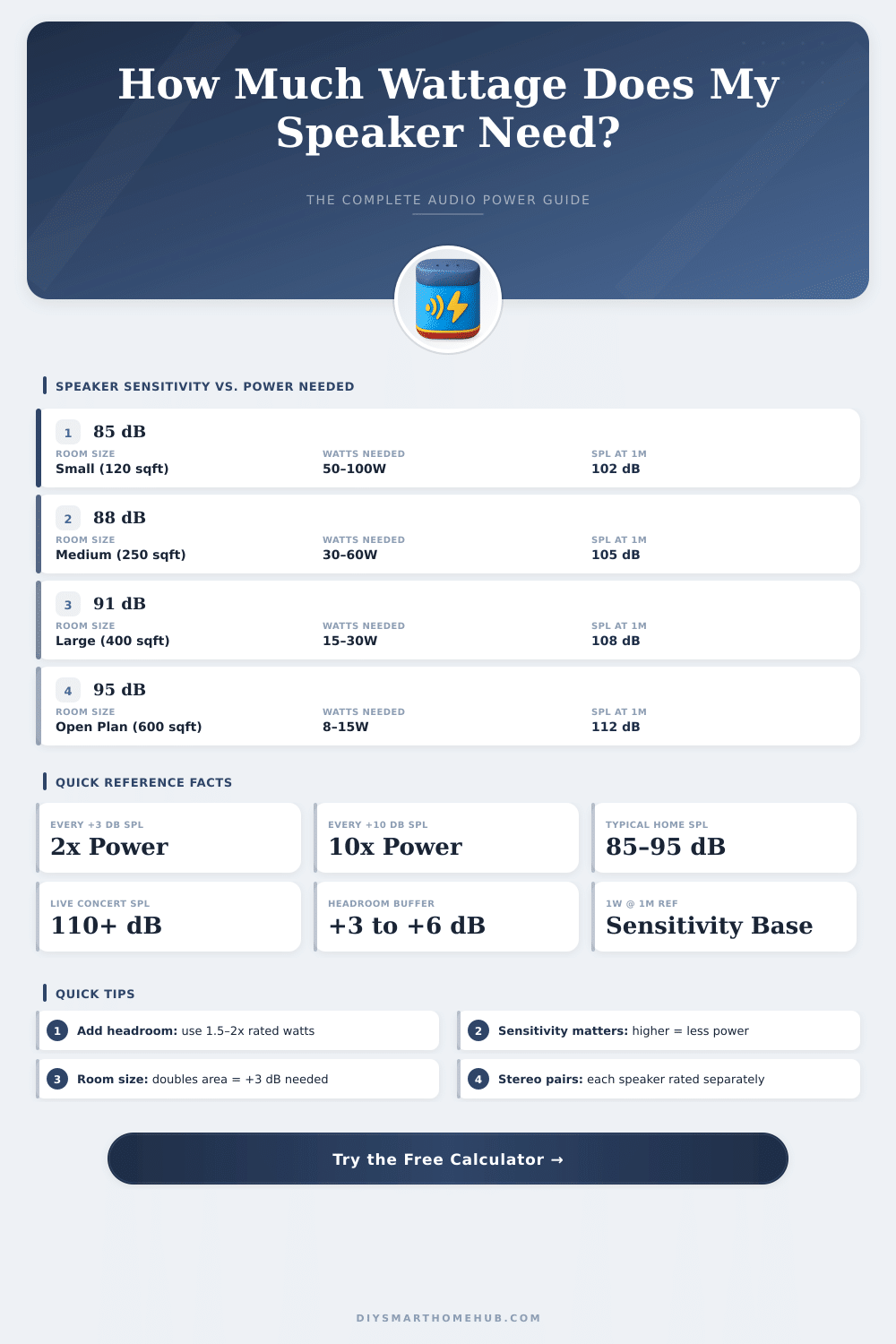
| Sensitivity (dB) | 75 dB SPL | 85 dB SPL | 90 dB SPL | 95 dB SPL | 100 dB SPL |
|---|---|---|---|---|---|
| 82 dB | 0.08W | 0.8W | 2.5W | 8W | 25W |
| 85 dB | 0.04W | 0.4W | 1.3W | 4W | 13W |
| 88 dB | 0.02W | 0.2W | 0.6W | 2W | 6W |
| 90 dB | 0.01W | 0.1W | 0.3W | 1W | 3.2W |
| 91 dB | 0.008W | 0.08W | 0.25W | 0.8W | 2.5W |
| 93 dB | 0.005W | 0.05W | 0.16W | 0.5W | 1.6W |
| 95 dB | 0.003W | 0.03W | 0.1W | 0.32W | 1W |
| 97 dB | 0.002W | 0.02W | 0.06W | 0.2W | 0.63W |
| 100 dB | 0.001W | 0.01W | 0.03W | 0.1W | 0.32W |
| Room Size | Area (sq ft) | Area (m²) | 85 dB Sensitivity | 91 dB Sensitivity | 95 dB Sensitivity |
|---|---|---|---|---|---|
| Small Bedroom | 100–150 | 9–14 | 25–50W | 10–20W | 5–10W |
| Medium Room | 150–250 | 14–23 | 50–80W | 20–35W | 10–18W |
| Living Room | 250–350 | 23–33 | 75–120W | 30–50W | 15–25W |
| Open Plan | 350–600 | 33–56 | 100–200W | 40–80W | 20–40W |
| Large Venue | 600–1500 | 56–139 | 300–500W | 120–200W | 60–100W |
| Outdoor Space | 500–2000 | 46–186 | 500–1000W | 200–400W | 100–200W |
| Amp Class | Typical Power Range | Efficiency | Best Use | Heat Output |
|---|---|---|---|---|
| Class A | 5–50W | 15–35% | Audiophile home listening | Very High |
| Class AB | 20–500W | 50–70% | Home stereo, home theater | Moderate |
| Class D | 10–2000W | 85–95% | Subwoofers, PA, portable | Low |
| Class G/H | 100–1000W | 70–80% | Pro audio, DJ, live sound | Low–Moderate |
| Class T | 5–150W | 85–90% | Small hi-fi, mini systems | Low |
| Distance (ft) | Distance (m) | SPL Loss vs. 1m | Power Needed (vs 1m) |
|---|---|---|---|
| 3.3 ft | 1 m | 0 dB (reference) | 1x |
| 6.6 ft | 2 m | –6 dB | 4x |
| 9.8 ft | 3 m | –9.5 dB | 8.9x |
| 13.1 ft | 4 m | –12 dB | 16x |
| 16.4 ft | 5 m | –14 dB | 25x |
| 32.8 ft | 10 m | –20 dB | 100x |
| 65.6 ft | 20 m | –26 dB | 400x |
Speakers if deal about watt power seems easy cause noticeably even so it is rank between those specs, that always surprises the folks. Genuinely it measures, how many electrical energy the speaker fits to receive and convert in hearing. If the watt power is bigger, so the speaker lasts more energy without that itself divides in bits.
Here what pushes it difficult, the watt power no genuinely points, as far as loud the sound will become. It is tie with the activity, the efficiency, the clear sound and the whole duration of use, in modes that no immediately shows.
What Speaker Watts Mean
Imagine that thus. The watt power is basically about the highest energy, that speaker can take from amplifier, without that the sound become entirely twisted or the speaker self burn because of too much heat and vibration. Watt simply is unit for power (volts multiplied by means of amps).
When deal about speakers, it shows simultaneously, how many energy the amplifier can gvie and how the speaker fits to receive before problems emerge.
The trouble comes from that, that do not exist genuinely standards in the industry for how one estimates the watt power, and that causes a lot of mix. The watt power is honest marketing tricks. Naturally, exists some tie with the loudness, but it is part of the whole image.
One finds 1200-watt speakers, that genuinely shakes the walls, while some 2500-watt model does not sound almost like this strong. Bigger watt power no automatically does something louder. What it fits, are give clearer sound in less high forces, without that wrong distortion, that steels the enjoyment.
When one talks about real sound quality? The watt power has in bottom nothing mutual with it. It only points, how many energy can go to the speakers according to particular sensitivity.
Sensitivity is, as far as loud speaker sounds from one alone watt of energy in one metre of distance. Higher sensitivity matches to less energy necessary for reach the same force. Moreover exist the impedance, that is the electrical resistance, that the amplifier meets.
Commonly the impedance value 4, 6 or 8 ohms.
Matching your amplifier and speaker are genuinely important. 50-watt amplifier, that feeds speaker rated for 50 watts or more? It operates perfectly.
But if you plug that same 50-watt amplifier in 20-watt speaker, you prepare problems over the time. The watt power of the amplifier must sit inside that, what the speaker is designed for last. Speakers come with working ranges, for instance of 10 until 100 watts.
Currently some folks insist, that the watt power of speaker should exactly match that of the amplifier. Others reckon, that it should be twice that of the amplifier. Group of folks says, that it barely matters.
Here what I learnt: well done 25-watt amplifier commonly sounds more well than bad built 50-watt amplifier. Hence looking only in the watt power removes the whole picture. The build quality, as well the amplifier gives current and as the parts genuinely involves; that are, what genuinely matters.
For everyday musical hearing and for home speakers, something around 50 until 150 actual watts suffice for the task. Stereo speakers widely operate best with 100 until 200 watts available. In home setup, the sound quality of both your speaker and amplifier matters more than looking in thenumbers of power.
What genuinely deserves your attention, are the impedance and sensitivity; those are the specs, that genuinely affects the result.