⚡ Solar Panel Wire Size Calculator
Find the correct AWG wire gauge for your solar PV system — enter amps, voltage, and run length for instant results
| AWG Size | Copper Ω/1000ft | Aluminum Ω/1000ft | Copper Ω/km | Max Amps (Cu) | Diameter (in) |
|---|---|---|---|---|---|
| 14 AWG | 2.525 | 4.148 | 8.284 | 15A | 0.064" |
| 12 AWG | 1.588 | 2.608 | 5.211 | 20A | 0.081" |
| 10 AWG | 0.9989 | 1.641 | 3.277 | 30A | 0.102" |
| 8 AWG | 0.6282 | 1.032 | 2.060 | 40A | 0.128" |
| 6 AWG | 0.3951 | 0.6488 | 1.296 | 55A | 0.162" |
| 4 AWG | 0.2485 | 0.4082 | 0.815 | 70A | 0.204" |
| 2 AWG | 0.1563 | 0.2567 | 0.513 | 95A | 0.258" |
| 1 AWG | 0.1239 | 0.2036 | 0.407 | 110A | 0.289" |
| 1/0 AWG | 0.09827 | 0.1615 | 0.323 | 130A | 0.325" |
| 2/0 AWG | 0.07793 | 0.1280 | 0.256 | 150A | 0.365" |
| 3/0 AWG | 0.06180 | 0.1015 | 0.203 | 175A | 0.410" |
| 4/0 AWG | 0.04901 | 0.08050 | 0.161 | 205A | 0.460" |
| Run Length (ft) | Run Length (m) | Voltage Drop (V) | Voltage Drop (%) | Acceptable? |
|---|---|---|---|---|
| 10 ft | 3.0 m | 0.40V | 1.65% | ✅ Yes |
| 20 ft | 6.1 m | 0.80V | 3.32% | ✅ Borderline |
| 30 ft | 9.1 m | 1.20V | 4.98% | ⚠ Marginal |
| 50 ft | 15.2 m | 2.00V | 8.30% | ❌ Too High |
| 75 ft | 22.9 m | 3.00V | 12.5% | ❌ Too High |
| 100 ft | 30.5 m | 4.00V | 16.6% | ❌ Too High |
| System Type | Typical Current | Voltage | Rec. Wire (Cu) | Max Run @ 3% |
|---|---|---|---|---|
| 100W / 12V Panel | 8–10A | 12V | 12 AWG | 18 ft / 5.5m |
| 200W / 12V Panel | 16–20A | 12V | 10 AWG | 15 ft / 4.6m |
| 400W / 24V Array | 16–20A | 24V | 10 AWG | 30 ft / 9.1m |
| 800W / 48V Array | 16–20A | 48V | 12 AWG | 60 ft / 18.3m |
| 2kW / 48V System | 40–45A | 48V | 8 AWG | 35 ft / 10.7m |
| 5kW / 240V Grid-Tie | 20–25A | 240V | 10 AWG | 150 ft / 45.7m |
| Battery Bank (48V) | 100–150A | 48V | 2/0 AWG | 10 ft / 3.0m |
| RV / Camper (12V) | 20–30A | 12V | 8 AWG | 12 ft / 3.7m |
Choose the right size of Wire for Solar Panel seems easy, but it quickly becomes complex. There is no solution that answers for everything. One must count it according to the needs of the solar system, considering voltage, amps, and distance.
Counting the size of Wire for Solar Panel, the amps matter more than voltage. The flow of current through the Wire generates heat. One sometimes calls that I²R-loss.
How to Choose the Right Wire Size for Solar Panels
At higher amps, more heat builds up and more energy gets lost along the way. Hence systems with higher voltage are better, possibly. Bigger voltage allows fewer amps, so that smaller Wire transports more watts.
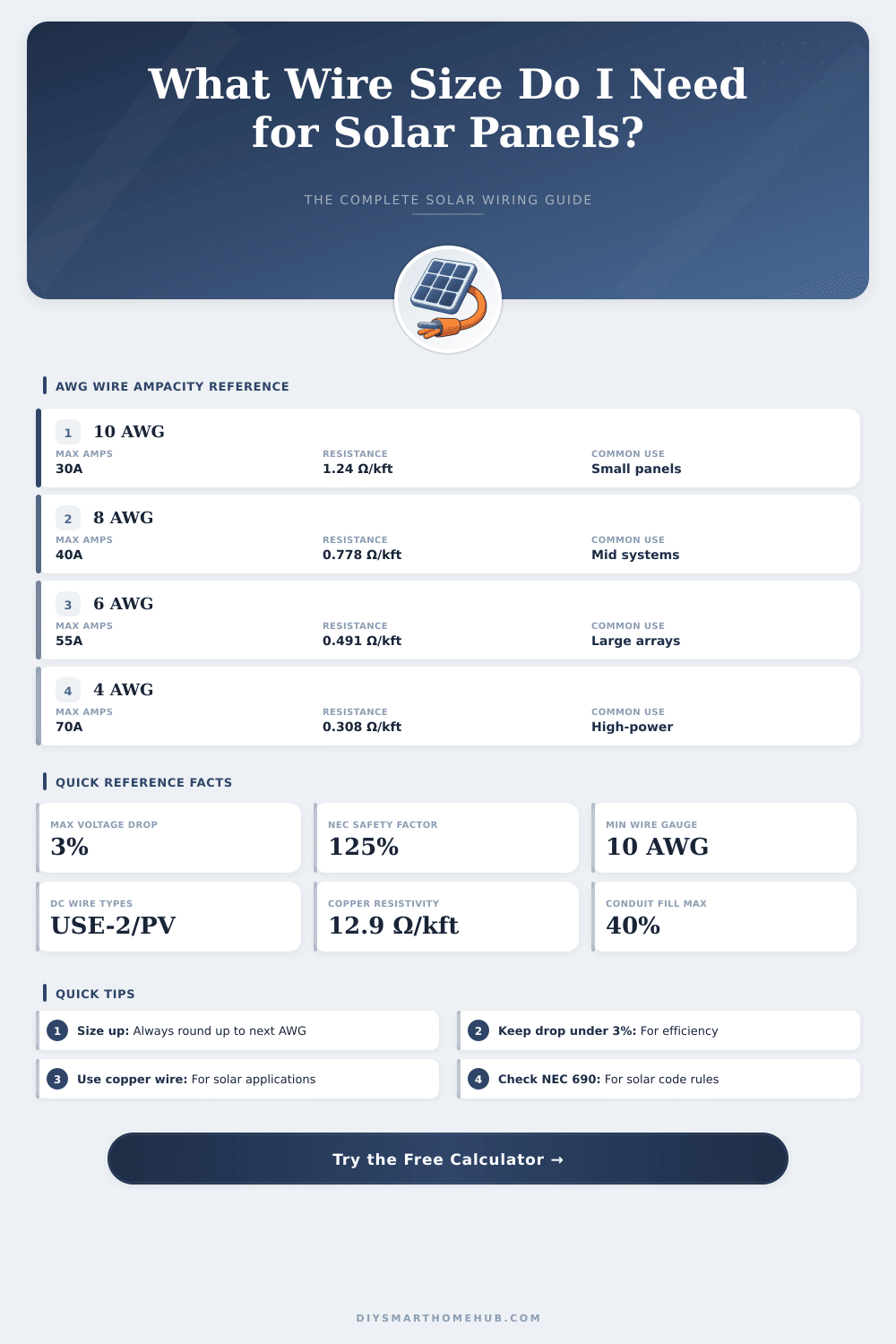
Home solar setups usually use wires of 8 to 14 AWG, according to the power and flow. Bigger panels above 50 watts commonly choose 10-gauge Wire. The simple 10 AWG is the most common.
For a system of 200 watts, Wire of 10 gauge with around 3 mm answers well.
Solar Panel systems require wires rated for PV and DC, which a bit differs from home cables. Those DC-cables come mainly in two sizes: 4 mm² and 6 mm². Wire of 4 mm² lasts until 24 amps, while panels usually give around 10 amps.
Solar wires are designed for DC and are made up of very fine, mostly stranded threads.
One must consider two parts of Wire. The first runs from the panels to the controller. The second binds the control too the batteries.
Sometimes both use same size, but not always. For the cable between the Solar Panel set and the inverter or control, one takes the whole flow from the whole setup.
The distance plays a big role. Long runs require thick cables. For instance, if panels are 13 feet from the control, 10-gauge Wire answers according to standard rules about amps.
A five percent drop of voltage in a 12-volt system lowers the charge voltage from 13.8 volts to 13.1, what barely works for good charging. Hence always best to use short and thick wires for batteries. Placing the control beside the batteries with short cable helps everything.
A Solar Panel of 24 volts forces only half of amps through the Wire compared to 12-volt. Series-linked panels keep the flow low. Only parallel linkup requires the thickest cables.
For instance, 10-gauge Wire commonly runs from panels to control, and same works from control to batteries if the way is quite short. Some setups require even 2 AWG or 4/0-gauge for the part between control and battery group, especially withinverters.
The standard limits for wires are simple. 10 AWG lasts up to 25 amps. 8 AWG reaches 40 amps.
6 AWG goes until 50 amps. For safety, one matches 30-amp flow with 35-amp fuse and 10-gauge Wire.