☀️ Solar Panel Tilt Angle Calculator
Find the optimal tilt angle for your solar panels based on latitude, season, and installation type
| Latitude | Year-Round | Summer Tilt | Winter Tilt | Example City |
|---|---|---|---|---|
| 15° N/S | 15° | 0° – 5° | 30° – 35° | Guatemala City / Harare |
| 20° N/S | 20° | 5° | 35° | Honolulu / Rio de Janeiro |
| 25° N/S | 25° | 10° | 40° | Miami / Brisbane |
| 30° N/S | 30° | 15° | 45° | Cairo / Sydney |
| 35° N/S | 35° | 20° | 50° | Los Angeles / Buenos Aires |
| 40° N/S | 40° | 25° | 55° | New York / Wellington |
| 45° N/S | 45° | 30° | 60° | Portland / Christchurch |
| 50° N/S | 50° | 35° | 65° | London / Cape Town |
| 55° N/S | 55° | 40° | 70° | Edinburgh / Ushuaia |
| 60° N/S | 60° | 45° | 75° | Helsinki / Tierra del Fuego |
| Season / Period | Tilt Formula | Example (Lat 35°) | Goal |
|---|---|---|---|
| Year-Round (Fixed) | Latitude ° | 35° | Balanced annual output |
| Summer (High Sun) | Latitude – 15° | 20° | Max summer generation |
| Winter (Low Sun) | Latitude + 15° | 50° | Max winter generation |
| Spring Equinox | Latitude – 2.5° | 32.5° | Equinox optimization |
| Fall Equinox | Latitude + 2.5° | 37.5° | Equinox optimization |
| Flat Roof Minimum | 10° minimum | 10° | Self-cleaning rain runoff |
| Snow Shedding | Latitude + 20° | 55° | Minimize snow accumulation |
| Tilt Angle | Shadow Length (per ft height) | Min Row Spacing (3ft panel) | Min Row Spacing (metric 1m) |
|---|---|---|---|
| 10° | 0.18 ft/ft | 0.54 ft (6.5 in) | 0.18 m |
| 15° | 0.27 ft/ft | 0.81 ft (9.7 in) | 0.27 m |
| 20° | 0.36 ft/ft | 1.08 ft (13 in) | 0.36 m |
| 25° | 0.47 ft/ft | 1.41 ft (17 in) | 0.47 m |
| 30° | 0.58 ft/ft | 1.74 ft (21 in) | 0.58 m |
| 35° | 0.70 ft/ft | 2.10 ft (25 in) | 0.70 m |
| 40° | 0.84 ft/ft | 2.52 ft (30 in) | 0.84 m |
| 45° | 1.00 ft/ft | 3.00 ft (36 in) | 1.00 m |
| 50° | 1.19 ft/ft | 3.57 ft (43 in) | 1.19 m |
| City | Latitude | Optimal Annual Tilt | Winter Tilt | Summer Tilt |
|---|---|---|---|---|
| Miami, FL | 25.8° N | 26° | 41° | 11° |
| Los Angeles, CA | 34.1° N | 34° | 49° | 19° |
| Phoenix, AZ | 33.4° N | 33° | 48° | 18° |
| Dallas, TX | 32.8° N | 33° | 48° | 18° |
| New York, NY | 40.7° N | 41° | 56° | 26° |
| Chicago, IL | 41.9° N | 42° | 57° | 27° |
| Seattle, WA | 47.6° N | 48° | 63° | 33° |
| London, UK | 51.5° N | 52° | 67° | 37° |
| Sydney, AU | 33.9° S | 34° | 49° | 19° |
| Melbourne, AU | 37.8° S | 38° | 53° | 23° |
Getting the right tilt angle for solar panel really changes how much energy they make. The tilt angle is the most easily controlled part, because many solar setups stay set with a fixed position. Place, seasons and the efficiency of the system also matter, but the pitch stays something that most folks can change themselves.
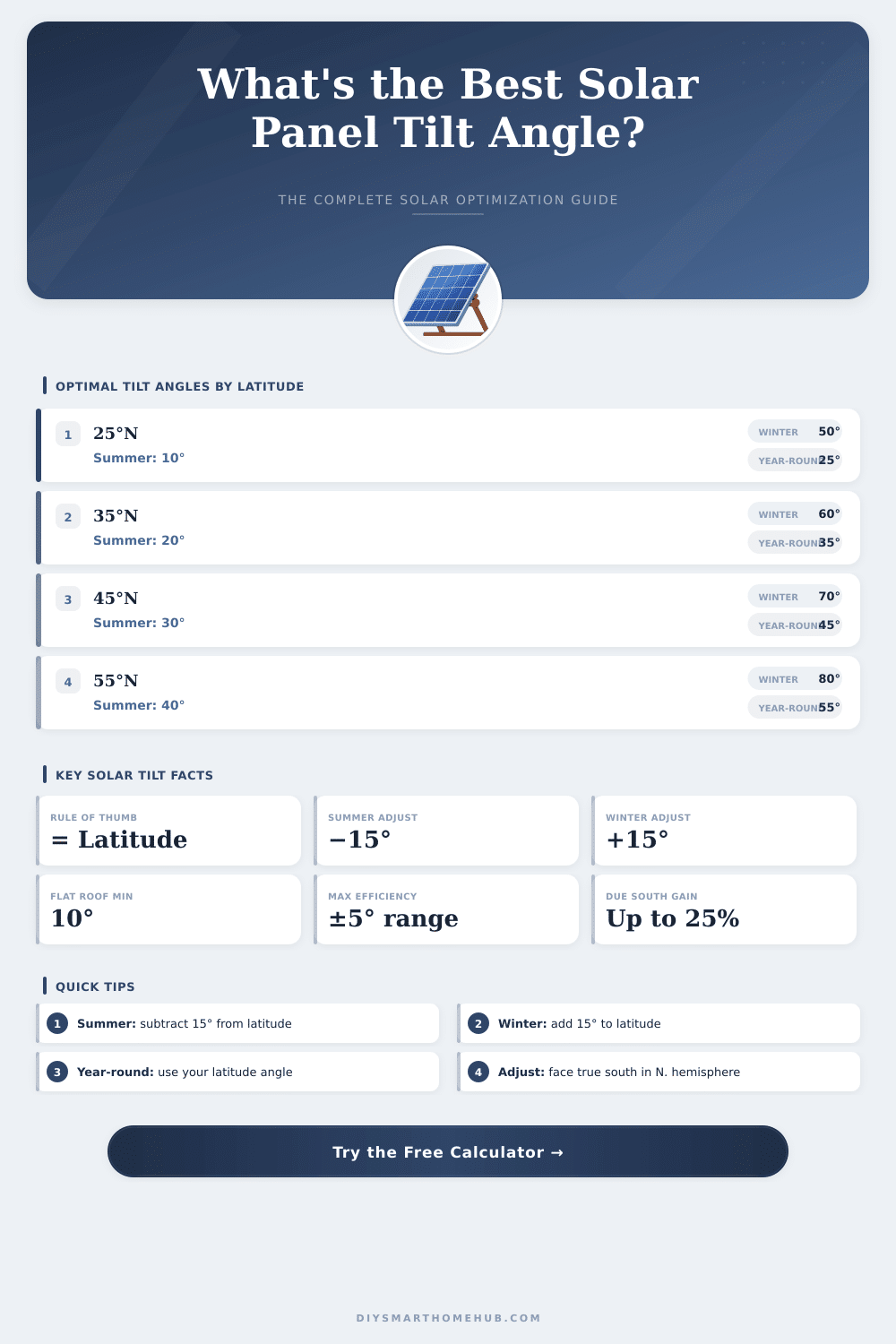
A common simple rule suggests to set the pitch equal to your latitude. So, if you live at 32 degrees north, you should tilt the panels at around 32 degrees. Beyond that, many suggest to add 15 degrees for the winter and remove 15 for the summer.
How to Choose the Right Tilt Angle for Solar Panels
For instance, for 34 degrees of latitude, the ideal winter 49 degrees and summer 19 degrees work well.
In ideal conditions, solar panel always would point directly facing the sun. Like this they catch the most direct rays. So tracking solar systems are always more used in business projects.
Two-axis tracking means panels twist from east to west the whole day and adjust the pitch according to the daily sun angle. But home setups commonly stay fixed, so the choice of good tilt angle is importnat.
For panels in the northern half of the globe, you should point them south. The direction commonly matters even more then the tilt angle itself. And it must be geographic south, not magnetic, because compass readings change according to the region.
Some install panels fully flat, especially on business buildings with flat roofs or on caravans to save space. Flat positions clearly do not give best results, but you can make up for it with more panels. So that rain can clean them, installers usually keep the pitch at 10 degrees.
One person found that a 10-degree tilt angle allows good air flow under the roof and lets water runoff the panels.
Adjustable supports commonly have three positions for deep winter, spring-fall and summer. But moving heavy panels is not simple work. It needs more than one person.
Some systems use tilting tools that let panels move between 0 and 60 degrees freely. Extra tilt angle also makes it easier to reach the space below for wiring and roof care.
A 45-degree tilt angle can be a good middle ground for those who want to boost output during spring and autumn. For short camping trips of one-two days, flat panels are enough. For moretime, position and tilt angle to the sun deserve the effort.
Stanford University itself created a formula for guessing the best pitch according to hemisphere and latitude.