☀️ Solar Panel String & Series-Parallel Calculator
Calculate voltage, current, power, and optimal string configuration for your solar array
| Configuration | Voltage Effect | Current Effect | Best Use Case |
|---|---|---|---|
| Series (S) | Multiplies (V × panels) | Stays same | High-voltage string inverters |
| Parallel (P) | Stays same | Multiplies (A × strings) | Low-voltage, shading tolerance |
| Series-Parallel | Multiplies per string | Multiplies per parallel | Large arrays, multi-MPPT |
| Microinverters | Panel-level (1:1) | Panel-level (1:1) | Shading, complex rooftops |
| DC Optimizers | String-level MPPT | Panel-level | Partial shading mitigation |
| Inverter Type | MPPT Range | Max Voc | Max Isc / String |
|---|---|---|---|
| Residential String (600V) | 100–480V | 600V | 15A |
| Residential String (1000V) | 200–800V | 1000V | 20A |
| Commercial String (1500V) | 500–1300V | 1500V | 30A |
| Microinverter (250W) | 22–45V | 60V | 15A |
| Hybrid / Battery (48V) | 120–430V | 500V | 12A |
| Off-Grid (24V system) | 30–70V | 100V | 20A |
| Temp (°C) | Correction Factor (Mono) | Voc Multiplier | Notes |
|---|---|---|---|
| −25°C | +17.5% | 1.175 | Extreme cold — check NEC |
| −10°C | +12.25% | 1.122 | Cold climate standard |
| 0°C | +8.75% | 1.088 | Freezing point |
| +25°C (STC) | 0% | 1.000 | Standard test condition |
| +50°C | −8.75% | 0.913 | Hot climate, roof mount |
| +70°C | −15.75% | 0.843 | Max typical cell temp |
| System Size | Panel Count | Typical String | Array Voltage (Vmp) |
|---|---|---|---|
| 3 kW | 8 × 375W | 8S×1P | ~296V |
| 5 kW | 12 × 420W | 6S×2P | ~241V |
| 6.6 kW | 16 × 415W | 8S×2P | ~320V |
| 10 kW | 24 × 415W | 8S×3P | ~320V |
| 13.2 kW | 30 × 440W | 10S×3P | ~400V |
| 20 kW | 44 × 455W | 11S×4P | ~440V |
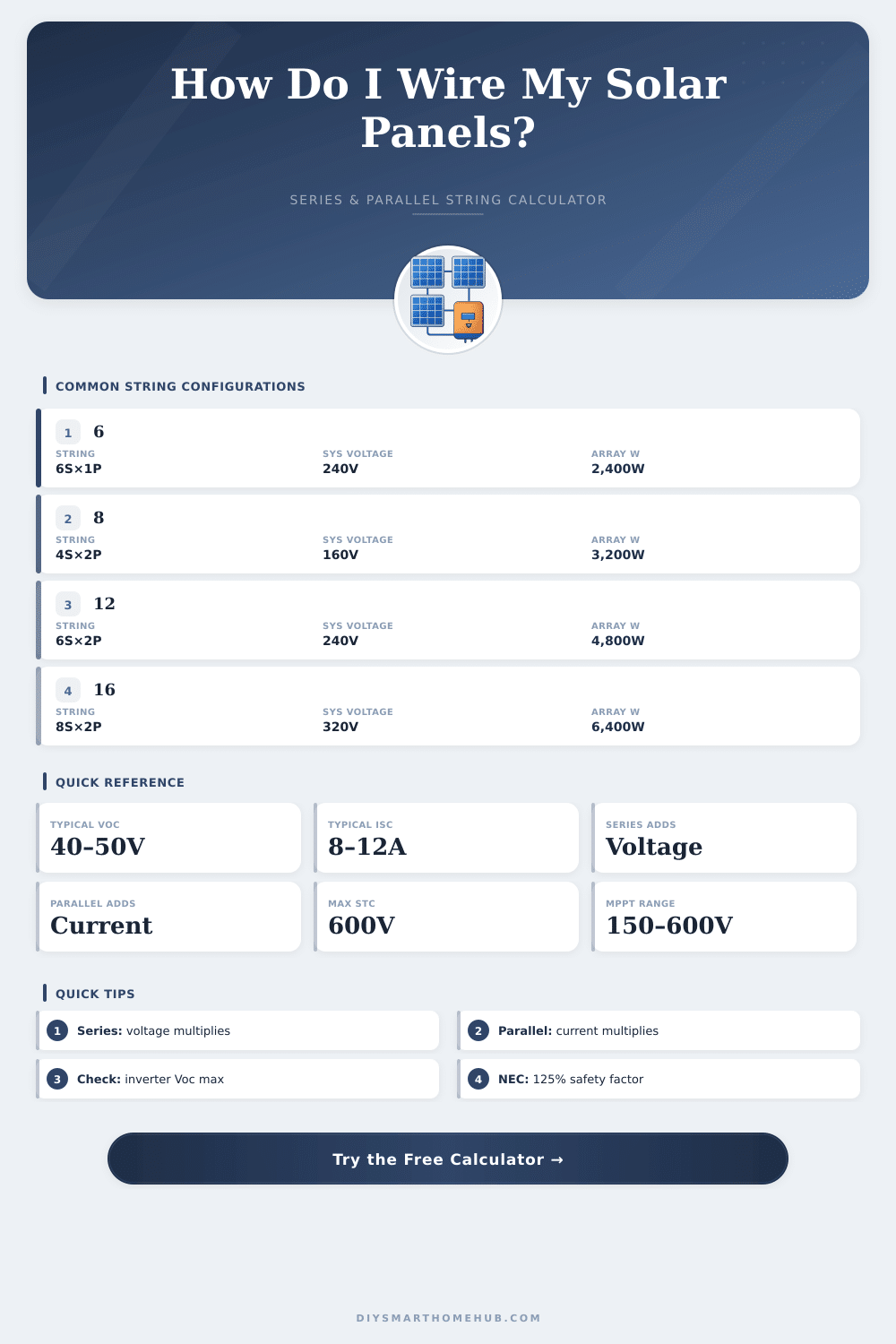
Solar Panel string consists of a group of panels bound one after the other, that all add their energy to one single entry of your inverter… Something like a chain setup. Here is how it works: the positive pole of one panel binds directly to the negative pole of the next forming continuous flow through all of them.
In the solar energy sector one calls that whole process “stringing“.
How Solar Panel Strings Work
The sizing of strings is the place where the real calculation enters. It deals with finding the right amount of panels for one entry, to reach best output, and done wrong it can truly reduce the impact of your setup. Take a realistic sample: one grid-tied system had 24 panels of Mission Solar, each with 360 W, all bound to one single inverter SMA Sunny Boy, that fits 7700 W. Those panels one arranged in strings, that directed the energy directly to the inverter.
What does a string inverter do? It simply changes the permanent electricity from your panels into alternating flowing energy, that can feed your house or go back to the net. In big commercial or group solar setups, every panel could bind to one central big inverter.
With stirng inverters one has more small sets of panels, each with its own inverter, and when panels arrange in sorted rows and columns as in business drafts, that costs less each megawatt and gives clearly better conversion results.
Here is what is key about the function of strings. If one panel in the series becomes shaded; even only partly, it can draw down the whole production of the string. The weakest element in any circuit becomes a fence for everything else bound to it.
Here is why folks use several strings. When shade hits one of them, the rest keep working without pause. The same happens if a panel fails…
Only one string suffers the impact.
Many modern inverters come with several MPPT-entries, and every group of panels pointed in another direction should have its own entry or even separate inverter. Mixing different angles in one string is not a good idea, because they do not produce energy in the same rhythm. Some systems escape that buy means of SolarEdge setups, that use optimizers with full voltage regulation, which makes partial shading less of a problem.
Voltage is another part of the puzzle that really matters. Before, when less new panels were usual, the maximum voltage of a string reached around 1000 V DC, because that was the limit that inverters could last. Higher voltage means lower flow through your cables, which reduces the energy loss.
It benefits also your budget, copper costs a lot, so less amount allows to use thinner cable. While you count, how many panels fit for one string, you add the open-circuit voltage of each and care, that the amount stays under the maximum input limit of your inverter.
Working with fewer strings at higher voltage, pushing it correctly to the limit of the inverter during cold days, truly cuts tolls in the cables. Panels in series add their voltages, while in parallel one adds the flows. Series-parallel combination iswhat most people choose to balance impact and safety.