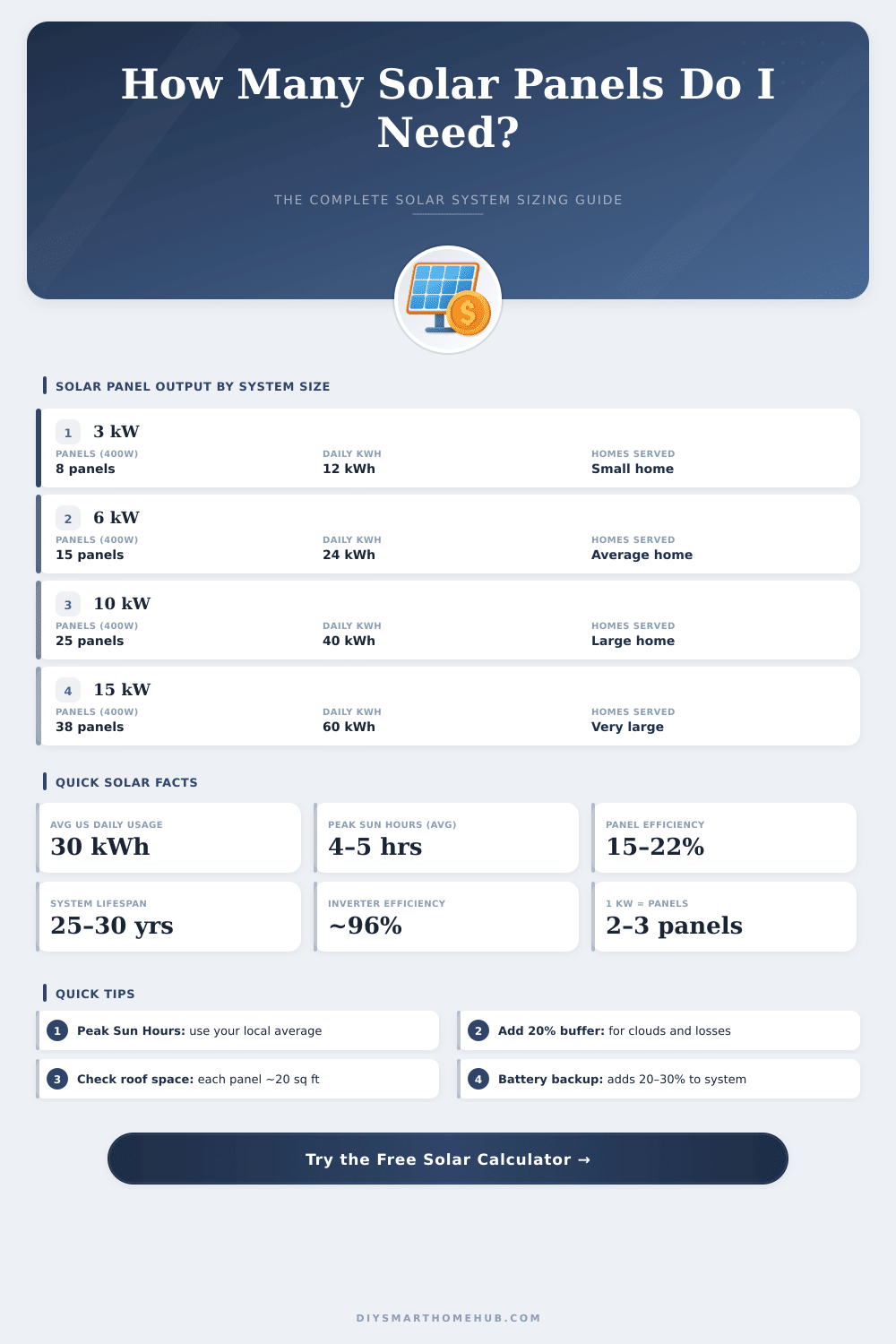
☀️ Solar Panel System Size Calculator
Find how many solar panels you need based on your energy usage, location, and system goals
| Region | States (examples) | Peak Sun Hrs/Day | Annual kWh/kW |
|---|---|---|---|
| Southwest Desert | AZ, NM, NV, S.CA | 6.0 – 7.5 | 1,800 – 2,200 |
| Pacific Coast | CA, OR, WA | 4.5 – 6.5 | 1,400 – 1,900 |
| Mountain West | CO, UT, ID, MT | 5.0 – 6.5 | 1,500 – 1,900 |
| South / Southeast | TX, FL, GA, AL | 4.5 – 5.5 | 1,400 – 1,700 |
| Midwest | IL, OH, IN, MO | 4.0 – 5.0 | 1,200 – 1,500 |
| Northeast | NY, PA, MA, CT | 3.5 – 4.5 | 1,100 – 1,400 |
| Pacific Northwest | WA, OR, AK | 3.0 – 4.5 | 900 – 1,300 |
| US Average | — All States — | 4.0 – 5.0 | 1,200 – 1,500 |
| System Size (kW) | Panels (400W) | Daily Output (kWh) | Monthly Output (kWh) | Roof Area Needed |
|---|---|---|---|---|
| 2 kW | 5 | 8 – 12 | 240 – 360 | ~85 sq ft |
| 3 kW | 8 | 12 – 18 | 360 – 540 | ~136 sq ft |
| 5 kW | 13 | 20 – 30 | 600 – 900 | ~221 sq ft |
| 6 kW | 15 | 24 – 36 | 720 – 1,080 | ~255 sq ft |
| 8 kW | 20 | 32 – 48 | 960 – 1,440 | ~340 sq ft |
| 10 kW | 25 | 40 – 60 | 1,200 – 1,800 | ~425 sq ft |
| 12 kW | 30 | 48 – 72 | 1,440 – 2,160 | ~510 sq ft |
| 15 kW | 38 | 60 – 90 | 1,800 – 2,700 | ~646 sq ft |
| Panel Wattage | Panel Size (approx) | Area (sq ft) | Panels per kW | Output/Day (5 hrs) |
|---|---|---|---|---|
| 250W | 65 x 39 in | 17.6 sq ft | 4.0 | 1.25 kWh |
| 300W | 65 x 39 in | 17.6 sq ft | 3.3 | 1.50 kWh |
| 350W | 67 x 40 in | 18.6 sq ft | 2.9 | 1.75 kWh |
| 400W | 79 x 40 in | 21.9 sq ft | 2.5 | 2.00 kWh |
| 450W | 79 x 43 in | 23.6 sq ft | 2.2 | 2.25 kWh |
| 500W | 87 x 44 in | 26.6 sq ft | 2.0 | 2.50 kWh |
| Battery System | Capacity (kWh) | Usable (kWh) | Covers (avg home) |
|---|---|---|---|
| Single Battery (e.g. 10 kWh) | 10 kWh | 8–9 kWh | 8–12 hours |
| Dual Battery (e.g. 20 kWh) | 20 kWh | 17–18 kWh | 16–24 hours |
| Triple Battery (e.g. 30 kWh) | 30 kWh | 25–27 kWh | 24–36 hours |
| Whole-Home Stack (40+ kWh) | 40+ kWh | 34+ kWh | 2+ days |
The prices of Solar Panel systems sank quickly, truly surprisingly, if one observes the change. Ten years ago one had to spend around 40 000 dollars to install a typical solar System in a home. Today the same installation costs only around 25 000 dollars.
During the past twenty years, the Cost of the panels dropped to almost a third of the prior levels. That trend lasts without stop. The prices for storage in batteries now fall below 100 dollars each kWh, and for a Solar Panel itself one can pay only 0,20 dollar each watt, if one ignores the other parts.
How Much Does a Home Solar System Cost?
The whole install Cost for a home solar System usually falls between 2,74 and 3,30 dollars each watt. It includes the panels, the work and all other parts. The most common installers cited around 3 to 4 dollars each watt for the whole service.
Getting under 3 dollars each watt is the main goal for floks, because here it starts to become attractive. Even so, bigger setups commonly result in lower price each watt. For instance, a 4 kW System would Cost 3,00 dollars each watt, while a 15 kW version of the same company would drop to 2,20 dollars each watt.
For the most common home owners in 2026, the expense for a full solar System, clear and working, moves between 12 600 and 33 376 dollars. The national average stays around 19 873 dollars, before one considers possible discounts. A typical 7,2 kW System costs around 21 816 dollars for cash payment, or 26 004 dollars if one funds it by means of a loan.
Many folks are surprised by the breakdown of costs… It does not entirely match there expectations. The hardware part itself, made of panels, inverters and extra tools, involves only around 40 percent of the total amount.
The soft costs, like permits, work and supply chain causes, form the bigger part. If one adds all required devices together with supply chain expenses and sales tax, one finds around 14 055 dollars, what is almost 46 percent of the whole Cost.
The final amount in your calculation depends on some factors. Premium panels, inverters or batteries cost more, but they commonly give better output. Complex roof shapes or old roof can expand the installation.
Micro inverters are not much more cheap than string inverters, but they are worth the expense in cases with shade or unusual roof setups. The fees for permits and checks change a lot based on the region. Also, there are extra payments for the connection to the grid.
Tax credits and discounts can lower your expenses by 30 to 50 percent. Take Texas as a sample, after the 30 percent federal solar tax credit, a typical 7,2 kW System results in around 14 314 dollars. One DIY builder assembled an 11,2 kW System with 26 panels and micro inverters for around 19 000 dollars, buying everything themselves.
Another person bought a System with 20 panels, charge controls, inverter, battery and gear for around 9 000 dollars, later doing the whole installation with own hands. Your method really changes, howmuch you must really spend.