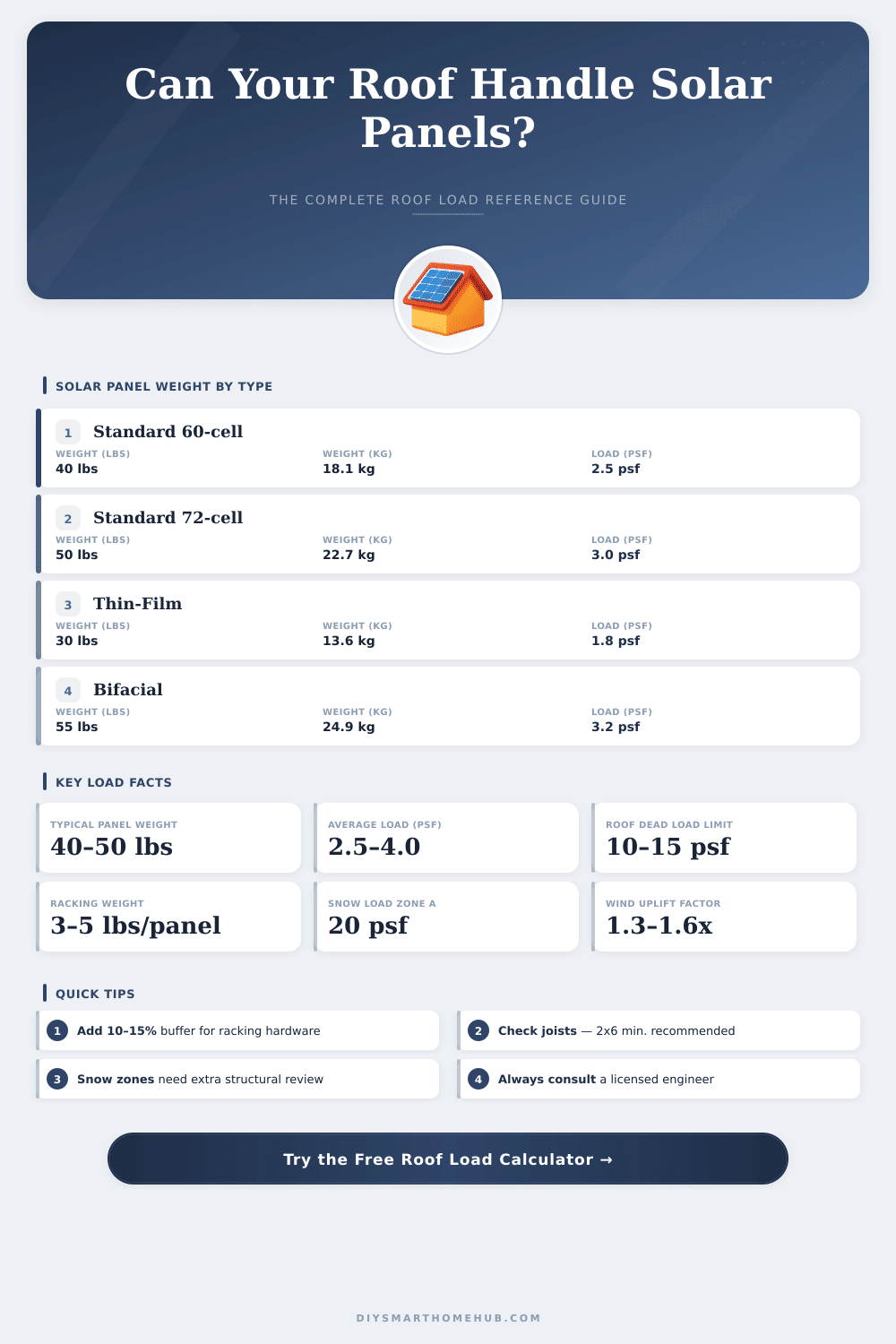
☀️ Solar Panel Roof Load Calculator
Calculate the structural load your solar panels will place on your roof & check if your roof can handle the weight
18.1 kg
22.7 kg
13.6 kg
24.9 kg
20.4 kg
27.2 kg
0.9–2.3 kg
1.64 m²
| Roof Construction | Dead Load Cap (psf) | Live Load Cap (psf) | Total Safe Capacity |
|---|---|---|---|
| Wood Truss (standard) | 10–15 psf | 20 psf | 30–35 psf |
| Engineered Wood Truss | 15–20 psf | 20 psf | 35–40 psf |
| Rafter / Stick-Built | 10–20 psf | 20 psf | 30–40 psf |
| Flat Concrete | 30–50 psf | 40 psf | 70–90 psf |
| Steel Frame | 20–40 psf | 40 psf | 60–80 psf |
| Region / State | Ground Snow Load | Roof Snow Load (0.7x) | Notes |
|---|---|---|---|
| Southern States (FL, TX, CA coast) | 0 psf | 0 psf | No snow concern |
| Mid-Atlantic (VA, NC, TN) | 15–20 psf | 10.5–14 psf | Low snow |
| Midwest (OH, IN, IL) | 20–30 psf | 14–21 psf | Moderate snow |
| Northeast (NY, PA, MA) | 30–50 psf | 21–35 psf | Heavy snow |
| Mountain West (CO, MT, UT) | 50–100+ psf | 35–70+ psf | Engineer required |
| Pacific Northwest (WA, OR) | 20–40 psf | 14–28 psf | Moderate–heavy |
| Panel Count | System Size (kW) | Panel Weight (lbs) | Dead Load Added (psf on 1000 sqft) |
|---|---|---|---|
| 6 panels | ~2 kW | 240–330 lbs | 0.24–0.33 psf |
| 12 panels | ~4 kW | 480–660 lbs | 0.48–0.66 psf |
| 18 panels | ~6 kW | 720–990 lbs | 0.72–0.99 psf |
| 24 panels | ~8 kW | 960–1320 lbs | 0.96–1.32 psf |
| 30 panels | ~10 kW | 1200–1650 lbs | 1.20–1.65 psf |
| 36 panels | ~12 kW | 1440–1980 lbs | 1.44–1.98 psf |
Solar Panel lay weight on the Roof, so it matters to understand the burden before installing them. Usually the panels together with the assembly add around 2 to 4 pounds for every square foot of Roof. If one shares the whole mass of the panels and the mount system by the covered surface, the average commonly reaches 3 to 4 pounds each square foot.
Here that is almost 10 to 20 kilos each square metre.
How Much Weight Do Solar Panels Add to Your Roof
Modern Solar Panel from companies like Tesla are relatively thin and light. They help to keep the extra burden low. For instance, one installation had spread weight at around 3.33 pounds per square foot.
Hence, each covered square foot of Roof must handle that extra mass.
Most houses built after 1970 were designed to last burdens, that works for adding Solar Panel well. If a house was built less than 15 years ago, the Roof probably has only one layer of cover. That results in lower current dead burden, which gives more space for panels.
For instance, a 16-foot long rafter can bare around 240 pounds of dead burden, before even thinking about Solar Panel.
Spots of burden are also important. Installers commonly want to lower the number of such spots, because that focuses more weight on fewer places. It is good to remember that.
Wind burdens are another part to check. Panels near the edges of Roof commonly are more exposed to wind. For instance, one system on Roof with 100 mph wind speed had designed wind lift of 26 pounds each square foot and down press of 19 pounds each square foot.
Programs from companies like Unirac can count those values, but making sure that the seals and the whole Roof structure lasts them stays the task of the homeowner.
Snow load also matters. Solar Panel can cause snow drifts on the Roof. The building code, for instance Section 1607.13.5 of the 2018 IBC, sets rules for Roof buildings backing Solar Panel systems, including dead burdens, live burdens and snow drift burdens.
Installing panels on an older house, that was not planned for extra weight, can be more difficult. A structural engineer can check the situation and figure out how much burden the Roof can safely bear. Yes, Roof widely handles Solar Panel, but checking thatfirst is a wise idea.
One downside worth knowing is that during replacing of the Roof later, the panels must be removed and later put back.