☀️ Solar Panel Payback Calculator
Estimate how long until your solar investment pays off — enter your system details below
| Region | State Examples | Peak Sun Hrs/Day | Annual kWh per kW |
|---|---|---|---|
| Southwest (Sunny) | AZ, NM, NV, CA (South) | 5.5 – 7.0 | 2,000 – 2,555 |
| Southeast | FL, TX, GA, SC | 4.5 – 5.5 | 1,640 – 2,000 |
| Mid-Atlantic | VA, MD, NC, DC | 4.0 – 5.0 | 1,460 – 1,825 |
| Midwest | OH, IL, IN, MO | 3.5 – 4.5 | 1,277 – 1,640 |
| Northeast | NY, MA, CT, PA | 3.5 – 4.5 | 1,277 – 1,640 |
| Northwest (Cloudy) | WA, OR, ID | 3.0 – 4.0 | 1,095 – 1,460 |
| Mountain West | CO, UT, WY | 5.0 – 6.5 | 1,825 – 2,372 |
| Hawaii | HI | 5.5 – 6.5 | 2,000 – 2,372 |
| System Size | Est. System Cost | After 30% Tax Credit | Avg Payback (yrs) |
|---|---|---|---|
| 3 kW | $9,000 – $12,000 | $6,300 – $8,400 | 6 – 9 |
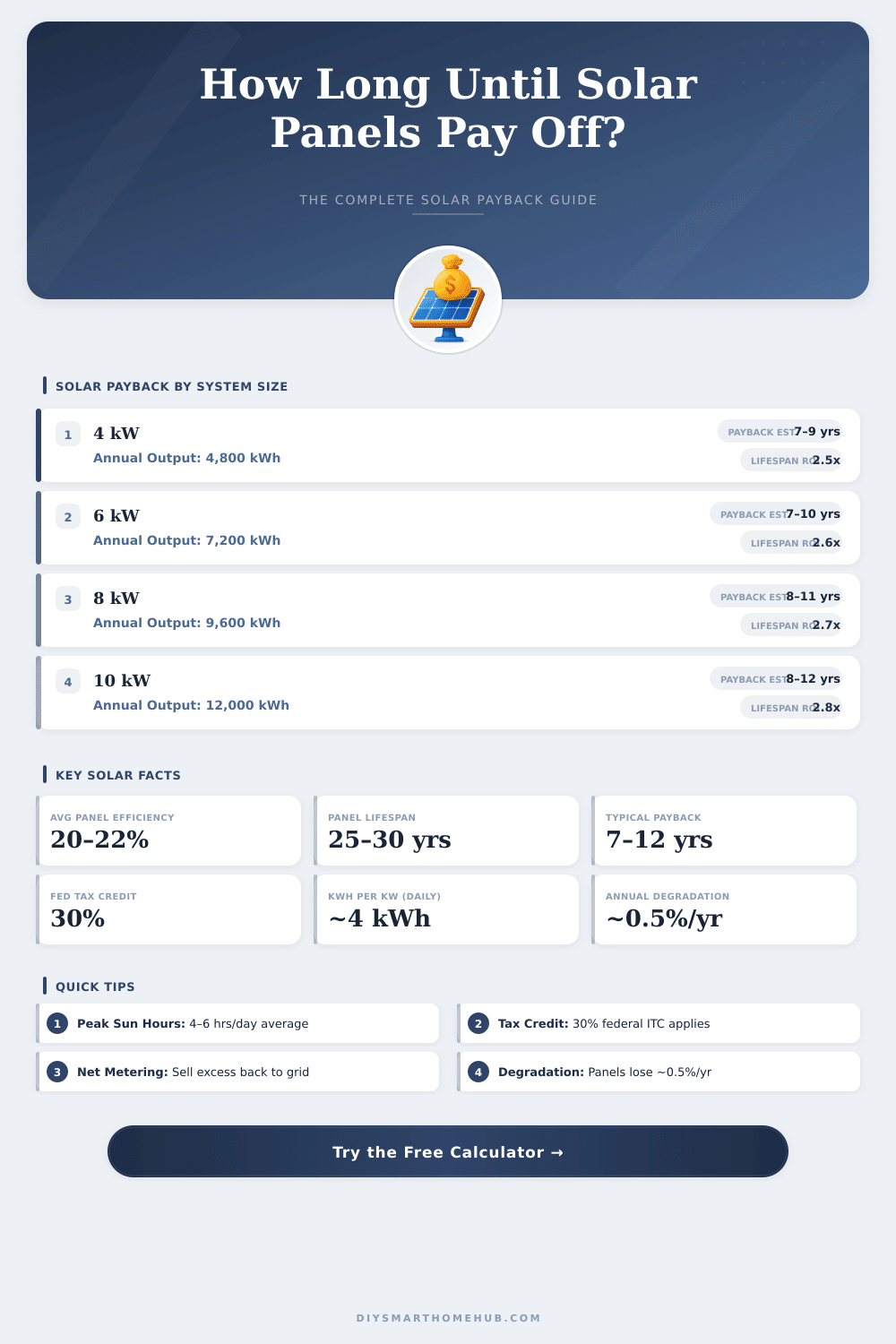
| 4 kW | $11,000 – $15,000 | $7,700 – $10,500 | 7 – 10 |
| 6 kW | $15,000 – $21,000 | $10,500 – $14,700 | 7 – 11 |
| 8 kW | $20,000 – $28,000 | $14,000 – $19,600 | 8 – 11 |
| 10 kW | $25,000 – $35,000 | $17,500 – $24,500 | 8 – 12 |
| 12 kW | $30,000 – $42,000 | $21,000 – $29,400 | 9 – 13 |
| 20 kW | $50,000 – $70,000 | $35,000 – $49,000 | 8 – 12 |
| Metric | Value | Notes | Source |
|---|---|---|---|
| US Avg Electricity Rate | 14¢ – 16¢/kWh | Residential, 2024 | EIA |
| Avg US Monthly Usage | 886 kWh/month | Average household | EIA |
| Federal Solar Tax Credit | 30% (ITC) | Through 2032 | IRS |
| Avg Panel Efficiency | 20 – 22% | Standard monocrystalline | NREL |
| Avg Panel Wattage | 350 – 420 W | Per panel (residential) | Industry |
| System Output Formula | kW x hrs x eff = kWh | Daily production estimate | NREL |
| Typical Inverter Efficiency | 95 – 98% | String & microinverters | Industry |
| CO2 Offset per kWh | 0.855 lbs (0.39 kg) | US average grid | EPA |
The payback for solar panel simply comes down to this: how many years must pass until your savings from it repay the cost through savings on electricity? For most home owners, it falls between 7 and 10 years. In United States the average is almost 10 years, although some calculations show something near 11 years before you truly start to benefit.
What decides your own payback time? Many factors play a role. Your local prices for electricity are very important, also the size of your system and whether you finance it, pay cash or rent.
How Long Until Solar Panels Pay Themselves?
Because each setup fits the particular energy use of each home and its budget, no two are identical. The math goes more quickly if you have high bills for electricity and a lot of sunshine hits your roof. On the other hand, low prices for energy or shady trees can stretch the process.
Good advice is: gather a whole year of electrical bills before sizing your setup. This way you plan based on real yearly use, not only the big summer spikes.
Location causes big differences here. In Hawaii and California the payback can happen already after 3 years, perfect situation. On the other hnad, regions with dirty and cheap electricity maybe need up to 15 years to break even.
In Australia it goes more quickly, usually 2 to 4 years. But in the Pacific Northwest some areas show 20 to 22 years. One home owner in New Hampshire reached near 6 years for his special case.
Here is how you count that. First start with your real cost for the setup after taking out credits or rebates. Then divide that amount buy how much you save yearly on electricity.
Take a real example: system costs 25 000 dollars upfront. You subtract 6 500 dollars in federal credits, leaving 18 500 dollars from pocket. If you save around 2 000 dollars yearly on energy bills, that gives 9,25 years until payback.
One home owner that I counted spent 65 000 dollars after including site prep and tax credits. Their payback reaches 10 years, but here it gets interesting (after 25 years they look at only 0),094 dollars per kilowatt-hour against the 0,177 dollars that they paid before. The typical solar panel customer can save around 61 093 dollars in total savings over two and a half decades.
Also, prices for electricity always grow, so the payback shrinks over time. Rising costs for energy help you.
After you get back your investment, you simply receive free electricity for another 16 years or more (based on panel warranties). The return on investment for longer payback periods sits around 6 percent, without counting the protection against future price increases. One DIY fan cut his time to just above 4 years after the solartax credit.
Most folks see 6 to 10 years, which is honestly quite a wise longinvestment for many.