💡 Kasa Smart Bulb Lifespan Calculator
Estimate exactly how long your Kasa LED smart bulbs will last based on your real daily usage habits
Rated Hours
Rated Hours
Rated Hours
Rated Hours
Rated Hours
Rated Hours
Rated Hours
at 3 hrs/day
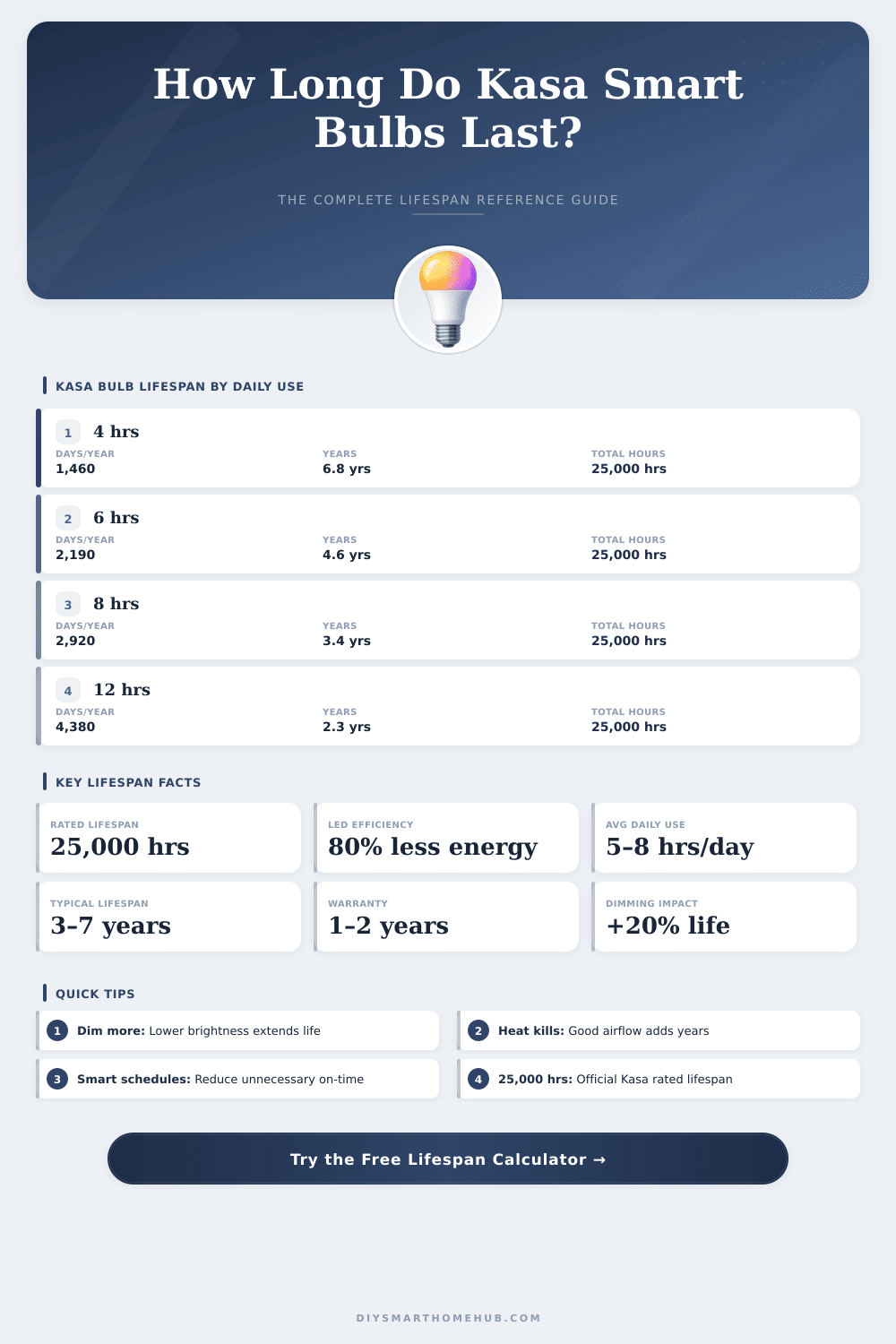
| Hours Per Day | Days Per Year | Years (25,000 hr bulb) | Years (15,000 hr bulb) |
|---|---|---|---|
| 2 hrs/day | 730 | 34.2 years | 20.5 years |
| 3 hrs/day | 1,095 | 22.8 years | 13.7 years |
| 4 hrs/day | 1,460 | 17.1 years | 10.3 years |
| 6 hrs/day | 2,190 | 11.4 years | 6.8 years |
| 8 hrs/day | 2,920 | 8.6 years | 5.1 years |
| 10 hrs/day | 3,650 | 6.8 years | 4.1 years |
| 12 hrs/day | 4,380 | 5.7 years | 3.4 years |
| 16 hrs/day | 5,840 | 4.3 years | 2.6 years |
| 24 hrs/day | 8,760 | 2.9 years | 1.7 years |
| Factor | Condition | Life Adjustment | Example Impact (25k bulb, 6 hrs) |
|---|---|---|---|
| Fixture Type | Open / standard | — (baseline) | 11.4 years |
| Fixture Type | Enclosed globe | –15% | 9.7 years |
| Fixture Type | Hot attic / no vent | –25% | 8.5 years |
| Brightness | 100% full brightness | — (baseline) | 11.4 years |
| Brightness | 50% dimmed | +20% | 13.7 years |
| Brightness | 25% low mode | +35% | 15.4 years |
| Switching | 1–3 cycles/day | — (baseline) | 11.4 years |
| Switching | 16+ cycles/day | –10% | 10.3 years |
| Bulb Type | Rated Hours | At 6 hrs/day | vs. Incandescent |
|---|---|---|---|
| Kasa LED Smart (25k) | 25,000 hrs | 11.4 years | 25x longer |
| Kasa LED Basic (15k) | 15,000 hrs | 6.8 years | 15x longer |
| Standard LED | 10,000–15,000 hrs | 4.6–6.8 years | 10–15x longer |
| CFL Bulb | 6,000–10,000 hrs | 2.7–4.6 years | 6–10x longer |
| Halogen | 2,000–4,000 hrs | 0.9–1.8 years | 2–4x longer |
| Incandescent | 750–1,000 hrs | 0.3–0.5 years | baseline |
Kasa Smart Bulbs are a good choice for those that want to add a bit of smartness to their home without spending too much money. They connect directly through Wi-Fi, so they do not need a separate hub to work. That simple setup makes them easier than many options available in the stores.
Multi-color models, like the KL125, are Wi-Fi LED bulbs with light equal to 60 watts. Each of them gives up to 800 lumens. One can buy them alone or in packages of up to four pieces.
Kasa Smart Bulbs: Easy, Cheap and Colorful
The skill to change colors allows one to set the light for any occasion. For instance one can set the lights to colors of the favorite team or dim them to a soft purple tone for a romantic dinner.
One can freely change the brightness and the color temperature. There is even a rule that automatically adapts to the natural light cycles of the day, from dawn until evening, a truly new idea. Also voice control wroks well.
With simple orders by voice, one can change colors through the whole color range inside the house. Kasa Smart Bulbs work with Alexa and Google Assistant, and they respond well to Google Home orders.
The Kasa app offers simple buttons for presets of color temperature and many possible programs for schedules. Even so, sometimes the navigation in the app seems a bit complex. With Smart Actions, one can tie the bulbs with Kasa switches, so that turning on or off the switch also affects the bulbs as well.
One important thing to no are that Kasa switches do not have an overnight rule. When one turns off a smart switch, it fully cuts the energy to the bulbs. Because of that, the bulbs disappear from the network until someone turns the switch back on.
Some other smart switches find a way around that, but the Kasa switches cannot.
The connection can sometimes create glitches. The bulbs sometimes appear as offline or unreachable, even on a 2.4 GHz Wi-Fi channel. That seemingly depends on the devices themselves, because they also show themselves offline in the Kasa app.
Even so, the bulbs use little energy without losing quality. And the balance between quality and price stays good. For instance, a system with around ten bulbs, thirty switches and ten outlets ran for more than five years with only one bulb failing.
Kasa does not offer a dimmer switch fit for low-voltage lighting. For such a setup, something like an Otter ELV dimmer switch would be better. Also, Kasa Smart Bulbs need constant energy, so that schedules or automations work.
Use outside is possible, with existing outdoor lighting controlled by Kasa Smart Bulbs or switches, althoughone must care about weather protection and temperatures.