🔋 SimpliSafe Base Station Battery Life Calculator
Estimate how long your SimpliSafe base station will run on backup battery power based on your system configuration.
| Mode | WiFi + Cellular | Cellular Only | No WiFi/Cell |
|---|---|---|---|
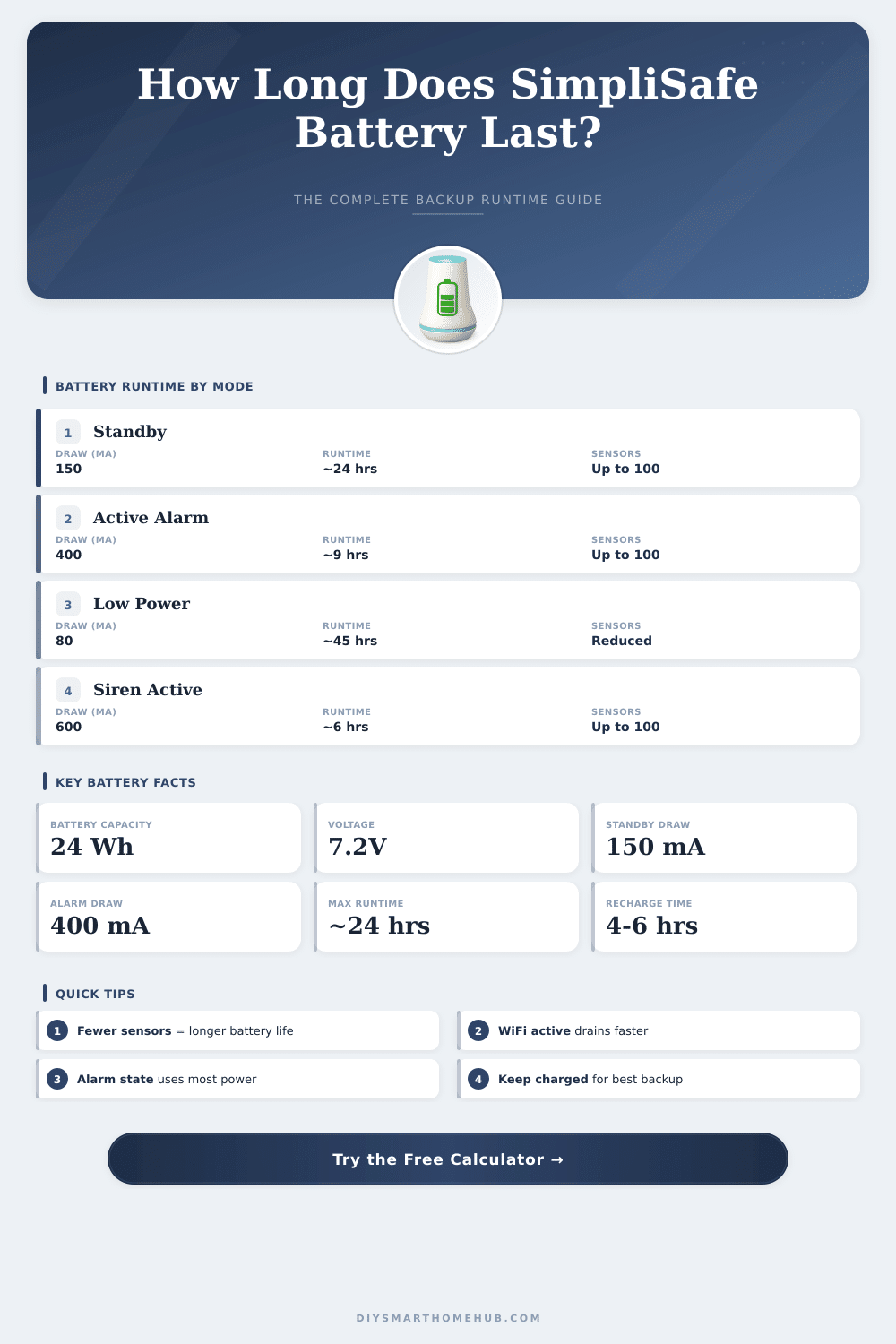
| Standby (5 sensors) | ~18 hrs | ~20 hrs | ~22 hrs |
| Standby (15 sensors) | ~15 hrs | ~17 hrs | ~19 hrs |
| Standby (30 sensors) | ~12 hrs | ~14 hrs | ~16 hrs |
| Active Alarm (no siren) | ~8.5 hrs | ~9.5 hrs | ~10 hrs |
| Active Alarm + Siren | ~5.5 hrs | ~6 hrs | ~6.5 hrs |
| Low Power Mode | ~38 hrs | ~42 hrs | ~48 hrs |
| Generation | Battery Capacity | Voltage | Max Standby Runtime |
|---|---|---|---|
| SimpliSafe Gen 3 (SS3) | 24 Wh | 7.2V Li-ion | ~24 hrs (ideal) |
| SimpliSafe Gen 2 (SS2) | 16 Wh | 7.2V Li-ion | ~16 hrs (ideal) |
| Battery Age | Capacity Factor | Effect on Runtime | Recommendation |
|---|---|---|---|
| 0–6 months | 100% | Full rated runtime | No action needed |
| 6–18 months | ~90% | Slight reduction | Monitor charge level |
| 18–36 months | ~75% | Noticeable reduction | Plan replacement |
| 3–5 years | ~55% | Significant reduction | Replace soon |
| 5+ years | ~35% | Severe reduction | Replace immediately |
| Temperature Range | Capacity Factor | Approx. Runtime Impact |
|---|---|---|
| Below 32°F (0°C) – Very Cold | ~65% | Loses up to 35% runtime |
| 32–60°F (0–15°C) – Cold | ~85% | Loses up to 15% runtime |
| 60–85°F (15–29°C) – Normal | 100% | No impact |
| 85–100°F (29–38°C) – Warm | ~90% | Loses up to 10% runtime |
The Simplisafe Base Station works as the center of the whole security system. It connects to all sensors and controls the whole system. That device is plug-and-play, so you simply plug it in the outlet and it finds your sensors.
Like this it becomes one of the simplest safe systems to install.
Simplisafe Base Station Battery Guide
The Simplisafe Base Station uses four NiMH rechargeable AA batteries. They are 1.2V batteries with a capacity of 1300 mAh. Know that because the station will not work well with normal AA batteries of 1.5V.
Putting normal alkaline batteries can cause beeps and mistakes. As soon as you put 1.2V rechargeable batteries, the beeping will end.
That back-up Battery helps when the main power goes out. Usually the Simplisafe Base Station gets power from the adapter, but during a power outage it switches to the rechargeable batteries. It switches also to the internal cellular connection in such moments.
Even so, the life of the back-up Battery often disappoitns. Some users noticed that the batteries last only some hours during a power outage, much less than the promised “up to 24 hours.” SimpliSafe often sends back-up NiMH batteries when that happens.
The batteries that come with the Simplisafe Base Station often have weak quality. The original NiMH batteries have low mAh rating and can fail after a year. Many folks replace them with better NiMH batteries, like Eneloop, to settle the problem.
When one Battery dies after some years, it is best to replace all four together.
If you worry about long power outages, it is better to get a UPS for the Simplisafe Base Station than replace batteries when they end. A portable power bank with 25,000 mAh and USB output at 5 volts and 0.5 amps could serve as the back-up Battery four the station. Even so, note that the plug of the Simplisafe Base Station needs 6.5V DC, so you need a DC adapter to lower standard 12V to that level.
The state of the batteries can be checked through the SimpliSafe app. When the batteries get empty, the system shows an error on the keyboard. Lowering the sound of the Simplisafe Base Station helps against stressful overnight warnings about low batteries.
After replacing the back-up Battery, fully charging the station helps to reset the warnings.
In the Gen 3 Simplisafe Base Station, the batteries are not placed in the same spot as in old models. To replace them, the power adapter always must be connected before putting in the batteries. After closing and snapping theBattery cover, wait one to two minutes to allow the new connection to settle.