🔥 Room Heater Size Calculator
Find the exact BTU & wattage needed to heat any room — just enter your dimensions and room details.
Avg Standard
Cold Climate
Warm Climate
Electric Rule
Electric
Propane
Natural Gas
over 8 ft
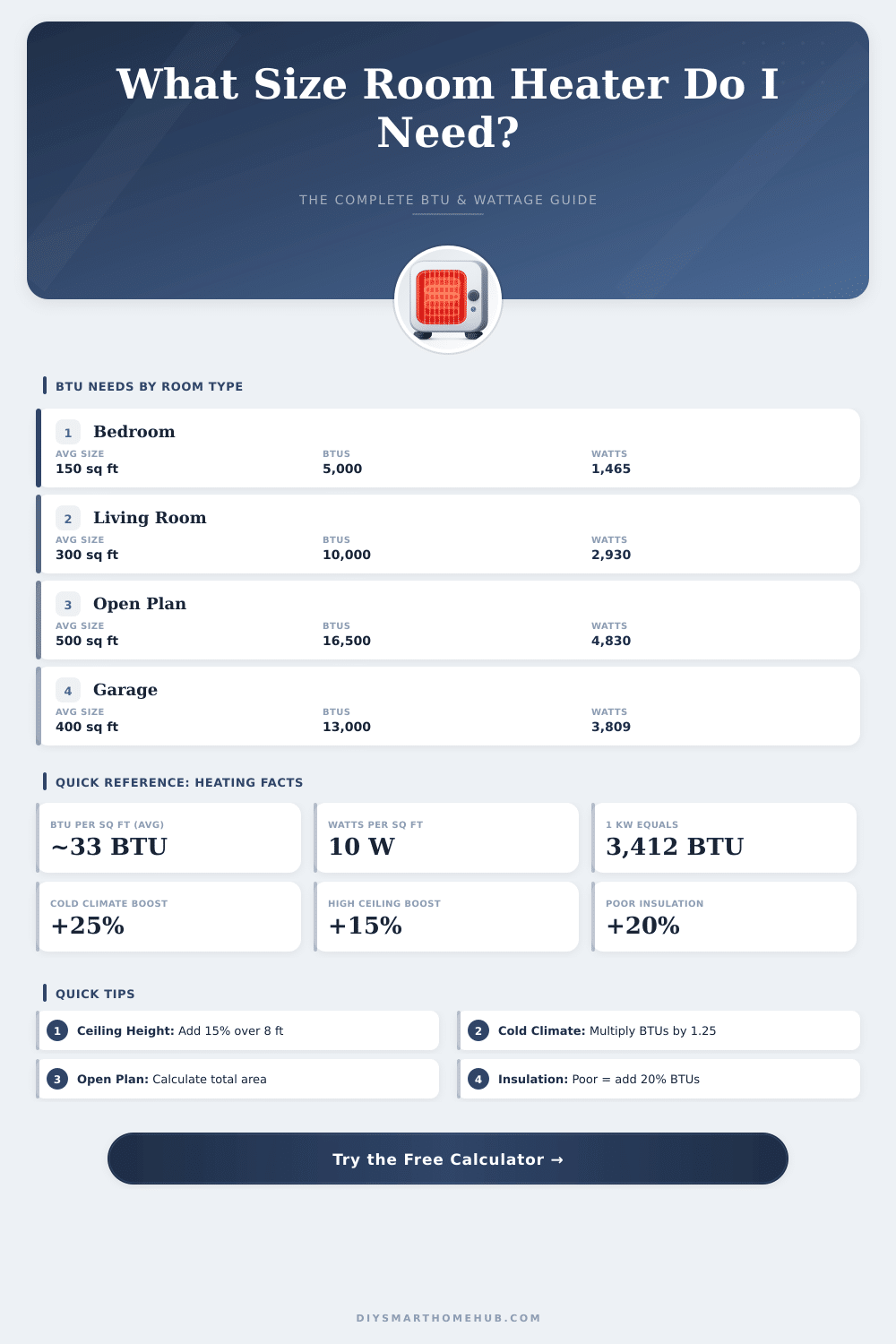
| Room Size (sq ft) | Room Size (m²) | BTU Needed | Watts Needed | kW Needed |
|---|---|---|---|---|
| 100 sq ft | 9.3 m² | 3,300 BTU | 968 W | 0.97 kW |
| 150 sq ft | 13.9 m² | 4,950 BTU | 1,451 W | 1.45 kW |
| 200 sq ft | 18.6 m² | 6,600 BTU | 1,935 W | 1.94 kW |
| 300 sq ft | 27.9 m² | 9,900 BTU | 2,902 W | 2.90 kW |
| 400 sq ft | 37.2 m² | 13,200 BTU | 3,870 W | 3.87 kW |
| 500 sq ft | 46.5 m² | 16,500 BTU | 4,837 W | 4.84 kW |
| 750 sq ft | 69.7 m² | 24,750 BTU | 7,256 W | 7.26 kW |
| 1,000 sq ft | 92.9 m² | 33,000 BTU | 9,675 W | 9.68 kW |
| Climate Zone | Region Examples | BTU Multiplier | BTU per sq ft |
|---|---|---|---|
| Warm (Zone 1–2) | Florida, Southern TX, AZ | 0.75x | ~25 BTU |
| Moderate (Zone 3–4) | Mid-Atlantic, Tennessee, OR Coast | 1.00x | ~33 BTU |
| Cold (Zone 5–6) | Chicago, Denver, Boston | 1.25x | ~41 BTU |
| Very Cold (Zone 7–8) | Minnesota, Alaska, Northern Canada | 1.50x | ~50 BTU |
| Heater Type | Typical BTU Range | Efficiency | Best For |
|---|---|---|---|
| Electric Space Heater | 750 – 5,000 BTU | 100% (resistive) | Small rooms, spot heat |
| Infrared Heater | 5,000 – 10,000 BTU | 90–95% | Garages, outdoor |
| Baseboard Heater | 500 – 4,000 BTU | 100% (electric) | Zone heating |
| Propane Heater | 4,000 – 30,000 BTU | 80–99% | Garages, workshops |
| Natural Gas Heater | 10,000 – 100,000 BTU | 80–97% | Whole house, large areas |
| Pellet Stove | 8,000 – 90,000 BTU | 70–90% | Main living areas |
Choose the right size for room heater are more serious than one commonly thinks. When your room heater are too little, it hardly will succeed to preserve the needed heat in the space. On the other hand, if it too big, you simply waste energy uselessly, creating warm places and cold corners.
To reach the right choice you must a bit think, but the investment certainly pays itself.
Choose the Right Size Heater for Your Room
Trust you to measurement of the room. Take the length and width, multiply them, and you have the square surface. For more precise calculation, include also the height: length multiplied by width and height gives the cubic volume.
Assume that you have room of 300 square feet with ceiling of 9 feet; that matches to 2,700 cubic feet entirely. Because electrical room heater models usually are rated according to watts, those codes help a lot for choose the best model.
For typical usage, one considers around 10 watts each square foot. Like this, for 150-square-foot space, one requires somethign in the range of 1,500 watts. Room heater of 1,500 watts usually cover of 100 until 140 square feet, so think about room of 10×10 or 12×12. Little bedrooms commonly have around 168 square feet, so one must adapt the calculation.
But here the key: the wattage alone do not show everything. The impact of room heater depend on several factors. Good insulation play big role.
Consider also the number of windows, your place in the world and does the room heater must cover everything itself or only help other source. Bigger model no always is the best choice. Even if 2,000-watt version costs likewise as 750-watt, that must not mean that it answers more four your case.
Various kinds of room heater spread heat according to their own modes. Radiator models are quiet, safer to touch and heat the room equally. Infrared room heater operate otherwise.
They directly warm your skin, what feels nice when one seats before them. Fan room heater blow hot air with force. All give same heat in equal wattage, but the size of the fan affect, as far as long the heat spreads.
Some models make a lot of heat that simply does not go away from the device itself.
For small spaces as bedrooms or mantles, little table room heater with regular settings provide intended heat without warming everything too. For bigger areas, for instance 1,400 square feet spread in several rooms, two or three medium units commonly beat one enormous. Use two of 750 watts each instead of one maximum of 1,500 watts help to keep the heat more even and effectively.
Circuits in typical homes anyhow limit to around 1,500 watts, so theelectrical setup itself stand that.