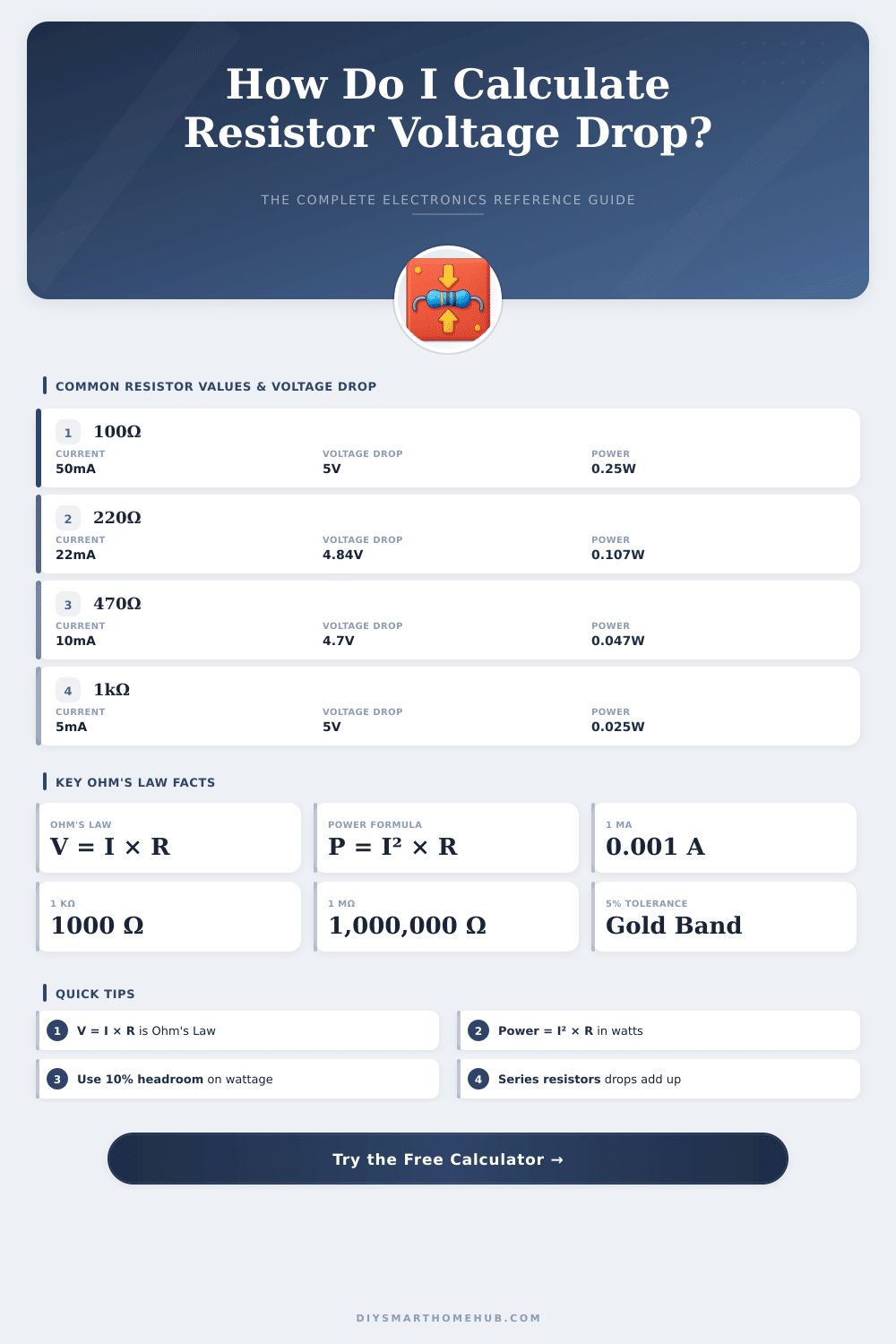
⚡ Resistor Voltage Drop Calculator
Calculate voltage drop, current, power & resistance using Ohm’s Law — enter any two known values
| Resistance (Ω) | Current (mA) | Voltage Drop (V) | Power (mW) | Resistor Rating Needed |
|---|---|---|---|---|
| 47 | 106.4 | 5.0 | 531 | 1W |
| 100 | 50.0 | 5.0 | 250 | 1/2W |
| 220 | 22.7 | 5.0 | 114 | 1/4W |
| 330 | 15.2 | 5.0 | 76 | 1/8W |
| 470 | 10.6 | 5.0 | 53 | 1/8W |
| 1,000 | 5.0 | 5.0 | 25 | 1/8W |
| 4,700 | 1.06 | 5.0 | 5.3 | 1/8W |
| 10,000 | 0.50 | 5.0 | 2.5 | 1/8W |
| 47,000 | 0.106 | 5.0 | 0.53 | 1/8W |
| 100,000 | 0.050 | 5.0 | 0.25 | 1/8W |
| Color | Digit Value | Multiplier | Tolerance |
|---|---|---|---|
| Black | 0 | ×1 | — |
| Brown | 1 | ×10 | ±1% |
| Red | 2 | ×100 | ±2% |
| Orange | 3 | ×1k | — |
| Yellow | 4 | ×10k | — |
| Green | 5 | ×100k | ±0.5% |
| Blue | 6 | ×1M | ±0.25% |
| Violet | 7 | ×10M | ±0.1% |
| Grey | 8 | — | ±0.05% |
| White | 9 | — | — |
| Gold | — | ×0.1 | ±5% |
| Silver | — | ×0.01 | ±10% |
| Config | Total Resistance | Voltage Across Each | Current Through Each |
|---|---|---|---|
| 2 × 100Ω Series | 200Ω | Splits (V/2 each) | Same through all |
| 2 × 100Ω Parallel | 50Ω | Same across all | Splits (I/2 each) |
| 3 × 330Ω Series | 990Ω | ~V/3 each | Same through all |
| 3 × 330Ω Parallel | 110Ω | Same across all | ~I/3 each |
| 4 × 220Ω Series | 880Ω | ~V/4 each | Same through all |
| 4 × 220Ω Parallel | 55Ω | Same across all | ~I/4 each |
| Rating | Max Power | Typical Use | Safe Operating Power |
|---|---|---|---|
| 1/8W (0.125W) | 125 mW | Signal / logic circuits | Up to 62 mW (50% rule) |
| 1/4W (0.25W) | 250 mW | General purpose | Up to 125 mW |
| 1/2W (0.5W) | 500 mW | LED drivers, sensors | Up to 250 mW |
| 1W | 1000 mW | Power circuits | Up to 500 mW |
| 2W | 2000 mW | High current paths | Up to 1000 mW |
| 5W | 5000 mW | Power supplies | Up to 2500 mW |
When current passes through a Resistor, the voltage at one side becomes higher than at the other. That voltage difference? It is the voltage fall that happens in almost every circuit that really works.
Here where it becomes interesting, a Resistor does two tasks at once. It limits the amount of flow that can run, and at the same time creates a voltage fall across itself. Both these work together, because the main role of a Resistor is simply to resist.
Voltage Drop Across a Resistor
It slows the move of the charge according to its value, what naturally lowers the current flow through it. The link between those three things (voltage), flow and resistance, follows the law of Ohm: V = I × R.
Want to easily describe that? Think about kids sliding. The voltage fall is like the height difference between the top and bottom.
Flow could be the speed by which children slip down. Here is the key difference: voltage does not flow somewhere. Only current flows.
Only current moves through the circuit. Use a fall as another way to see it: the straight height shows your voltage fall, and the energy that is lost here, ties to teh height… That is your resistance.
The voltage fall across a Resistor is simply the voltage that you would measure if you lay a meter across both sides of it. When flow really runs, potential energy turns into heat. You can check that, touching the probes of the meter to every end.
But hear is the side-effect (nothing happens without flow). No current flow causes no voltage fall, regardless of the resistance.
When in a circuit is only one Resistor, the whole voltage of the source falls exactly across it. Assume that your source gives 4.5 volts. Those whole 4.5 volts disappear across that alone Resistor.
The math works perfectly. If you know the source voltage and the resistance, you can find the flow by dividing voltage by resistance. Later, multiplying the current by resistance, you find the original voltage fall.
Now add a second Resistor in series, and the results change. A bit of voltage falls on the first, a bit on the second. Apply the law of Ohm to every separate one to count the separate falls.
Assume that your numbers give 12 volts across one and 18 volts across the other. When Resistors are same in a serial circuit, they share the voltage equally, because the same current flow passes through everything.
The size of any voltage fall depends on the amount of flow through it and on the resistance that it finds. A bad connection adds extra resistance, that grows the voltage fall under the same load. A weaker tie causes a bigger fall.
Here is really what Resistors do. They push back the current flow, and the voltage fall is only the result of that resistance. Recall, voltage always measures between two different spots, and one of them usually is theground of your circuit as reference.