⚡ Residential Electrical Load Calculator
Calculate your home’s total electrical load, recommended panel size, and circuit requirements
Check the appliances in your home and adjust quantities or wattages as needed.
| ☑ Include | Appliance | Watts (each) | Qty | Voltage | Running Watts |
|---|
| Panel Size | Max Load (W) | Typical Use | Circuits | EV Ready? |
|---|---|---|---|---|
| 60A | 14,400W | Small older home, basic loads | 12–16 | No |
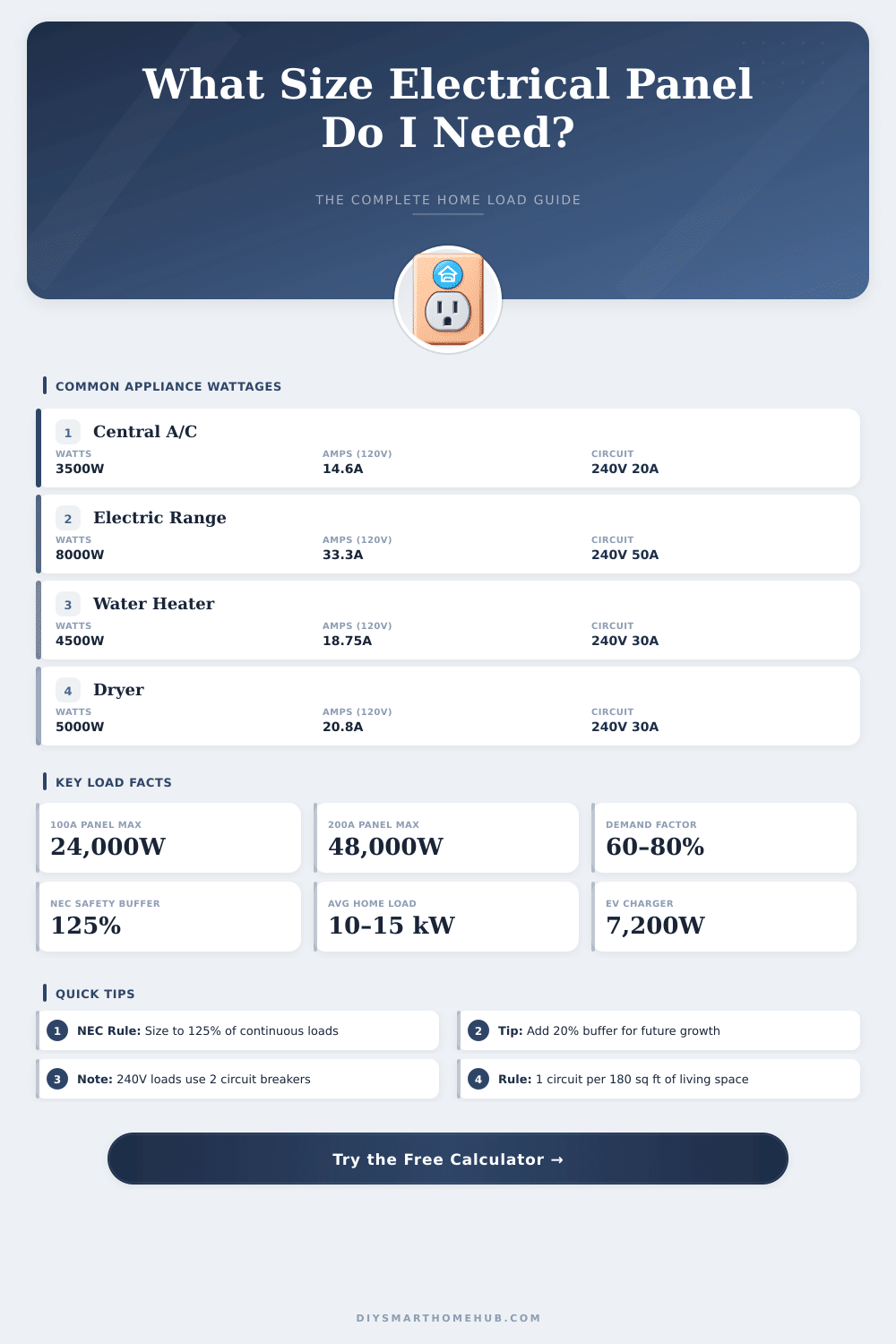
| 100A | 24,000W | 1,000–1,500 sq ft, gas appliances | 20–24 | Marginal |
| 150A | 36,000W | 1,500–2,500 sq ft, mixed | 24–30 | Possible |
| 200A | 48,000W | 2,000–3,500 sq ft, all-electric | 40–42 | Yes |
| 320A | 76,800W | Large home, EV + solar + pool | 42+ | Yes |
| 400A | 96,000W | Very large / dual-panel homes | 84+ | Yes |
| Load Type | NEC Method | Demand Factor | Notes |
|---|---|---|---|
| General Lighting | 3 VA per sq ft | 100% | First 3,000 VA |
| Small Appliance Circuits | 1,500 VA each (min 2) | 100% | Kitchen & dining |
| Laundry Circuit | 1,500 VA minimum | 100% | Required by NEC |
| Electric Dryer | 5,000W or nameplate | 100% | 240V/30A circuit |
| Electric Range | 8,000W (per NEC 220) | 80% | Column C table |
| A/C vs Heat | Larger load only | 100% | Do not add both |
| EV Charger (L2) | 7,200W continuous | 125% | Continuous load rule |
| Motors / Pumps | Nameplate x 1.25 | 125% | Continuous duty |
| Appliance | Breaker Size | Wire Gauge | Voltage | Max Load |
|---|---|---|---|---|
| Lighting / Outlets | 15A | 14 AWG | 120V | 1,800W |
| Kitchen Circuits | 20A | 12 AWG | 120V | 2,400W |
| Dishwasher | 20A | 12 AWG | 120V | 2,400W |
| Microwave (dedicated) | 20A | 12 AWG | 120V | 2,400W |
| Electric Dryer | 30A | 10 AWG | 240V | 7,200W |
| Water Heater | 30A | 10 AWG | 240V | 4,500W |
| A/C Unit (3.5 ton) | 40A | 8 AWG | 240V | 9,600W |
| Electric Range | 50A | 6 AWG | 240V | 12,000W |
| EV Charger (L2) | 50A | 6 AWG | 240V | 9,600W |
| Hot Tub / Spa | 60A | 4 AWG | 240V | 14,400W |
The electrical load of your home is basically what you get if you would switch every device on at the same time, lamps, machines, the television, the washing machine, everything that uses energy. However the electrical capacity represents the real maximum that your service panel can last in this moment. Here are two different ideas that even so are clearly bound between them.
To estimate the electrical load one must add the power in watts of all your devices. Most of them bear that information printed directly on them or hidden in the manual. Lamps, radios, air conditioners, refrigerators, everything this affects the calculation.
How to Find Your Home’s Electrical Load
When you have the whole amount of watts, share it by 240 volts (the usual voltage for American houses), and that will show the needed amps to back your whole setup.
Here the main spot: most of the outlets in American homes run on 120 volts, while the whole net works on 240 volts. The biggest users, boilers, heating and cooling systems, dryers, water heaters, those already are spread evenly through the whole net. But for usual lamps and outlets?
They use energy as you wish, so here lacks natural swing. Every home system in United States has a full neutral wire, that is able to control anything that does not pass the flow form the main lines.
Why does it matter to know about your electrical load? Well, during planning of fixes or improvements, such calculation points the smallest service size that you truly need. Here it helps to work with a contractor or electrician, they take the numbers and check whether you need 100 amps, 125, 150 or 200.
After cleanup, the power company comes to check whether real improvement is needed.
A service panel of 100 amps usually works for small to mid homes, especially if they have only basic energy needs, simple climate control, electrical or gas kitchen, limited water heating, little use of machines. For many houses 200 amps do the task perfectly. Even so some cases need upgrades, especially when one installs something like a charger for an electric car.
Old homes are those where everything gets tricky. Through decades folks lay more devices in their electrical nets. If your house has a smart meter, the power company can get real data about usage, very useful, if one watches the whole year to catch both summer and winter peaks.
Free online calculators for electrical load and pages based on codes like the NEC-Article 220 also help with the math. The climate plays a role; in warmer areas one commonly gets by with 100 amps without problem, while cold regions need more. The typical family through United States uses around 1.2 to 1.5 kilowatts a day, give or take.
One final note: the electrical load of a home is measured inkilowatts, not in ohms.