⚡ Power Factor Correction Calculator
Calculate the exact capacitor size (kVAR) needed to improve your electrical system's power factor
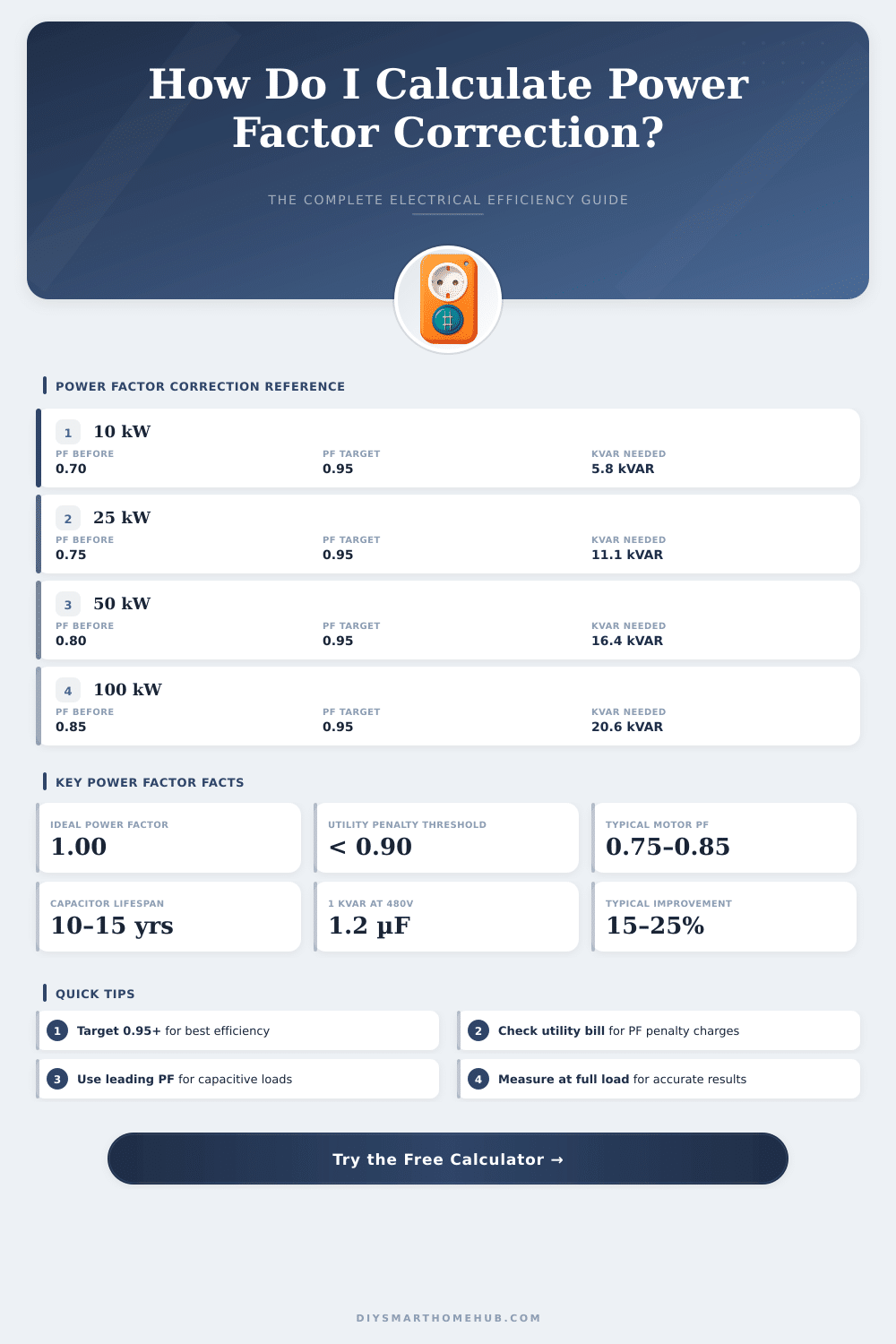
| Active Power (kW) | PF: 0.70 → 0.95 | PF: 0.75 → 0.95 | PF: 0.80 → 0.95 | PF: 0.85 → 0.95 |
|---|---|---|---|---|
| 10 kW | 5.80 kVAR | 4.44 kVAR | 3.27 kVAR | 2.06 kVAR |
| 25 kW | 14.49 kVAR | 11.10 kVAR | 8.17 kVAR | 5.15 kVAR |
| 50 kW | 28.98 kVAR | 22.19 kVAR | 16.35 kVAR | 10.30 kVAR |
| 75 kW | 43.47 kVAR | 33.29 kVAR | 24.52 kVAR | 15.45 kVAR |
| 100 kW | 57.97 kVAR | 44.39 kVAR | 32.70 kVAR | 20.60 kVAR |
| 200 kW | 115.93 kVAR | 88.77 kVAR | 65.40 kVAR | 41.20 kVAR |
| Capacitor Rating | 120 V / 1Φ | 240 V / 1Φ | 480 V / 3Φ | 415 V / 3Φ |
|---|---|---|---|---|
| 5 kVAR | 1,105 µF | 276 µF | 69 µF | 92 µF |
| 10 kVAR | 2,210 µF | 553 µF | 138 µF | 184 µF |
| 25 kVAR | 5,526 µF | 1,381 µF | 345 µF | 460 µF |
| 50 kVAR | 11,052 µF | 2,763 µF | 691 µF | 921 µF |
| 100 kVAR | 22,105 µF | 5,526 µF | 1,381 µF | 1,842 µF |
| Power Factor | kVA per kW | kVAR per kW | Efficiency Class |
|---|---|---|---|
| 0.60 | 1.667 kVA | 1.333 kVAR | Poor |
| 0.70 | 1.429 kVA | 1.020 kVAR | Below Average |
| 0.75 | 1.333 kVA | 0.882 kVAR | Below Average |
| 0.80 | 1.250 kVA | 0.750 kVAR | Average |
| 0.85 | 1.176 kVA | 0.620 kVAR | Good |
| 0.90 | 1.111 kVA | 0.484 kVAR | Good |
| 0.95 | 1.053 kVA | 0.329 kVAR | Excellent |
| 0.99 | 1.010 kVA | 0.142 kVAR | Optimal |
Power factor in short words estimates how well one uses the whole power. It considers the ratio between real power and apparent power. If the power factor matches one, then the provided energy is useful to the max. Correction of power factor, or KPF, means the methods that help to reach a value closer to one.
Inductive loads, like for example electrical engines, cause mostly bad power factor. Truly engines commonly are the main problem. For instance, an engine has power factor only 0.1 or 0.2 during no load, but it climbs to 0.7 or 0.8 under full load.
What Power Factor Means and How to Improve It
Like this the power factor changes all the time. In a setup with many engines, that not all work at once, one best arranges the daily tasks to improve it.
The main idea of power factor correction is to add capacitors or inductors, to balance the inductive or capacitive effects of the load. Like this one syncs the current and the voltage wave forms. For instance in welders, a bank of capacitors balance the inductive load of the converter.
One can install capacitors directly at separate engines, so that they turn on and off together with the devices. Besides that, automatic correctors of power factor switch and turn capacitors, too stop the value between 0.95 and 0.97.
In distribution nets they tend to combine fixed and switched capacitor banks. Fixed units care about the basic balancing of load. The switched units adapt to seasons or days with different loads.
Fully automatic capacitors and filters react right away to changes in supply, ensuring continuous correctionthrough the whole net.
What does this truly do for the folks? Correction of power factor lowers the current flow from the supply. Smaller flow reduces copper losses in devices like converters and power cables.
It allows to use smaller cables, what saves money for the wiring. In some factories one pays for the apparent power, so reducing the flow by means of power factor correction cuts also those costs. When the power supply or safety circuit is limited, then KPF helps to reach bigger output from the same source.
Power companies sometimes punish, if the power factor falls under a fixed level. It concerns mostly industrial users. For average houses the power factor usually stands well, and home clients do not pay for reactive power anyhow.
Those plug-in home devices for power factor correction, that promise to lower bills by thirty percent, do not deserve the money. Home clients pay only for real power, not for apparent, so correction does not help them save.
Changing an engine to work with varying speed, one also can improve the power factor, raising it from around 0.85 to almost 0.99. The best reachable power factor in practice is around 0.8 or 0.9, because actual inductors are never perfect.