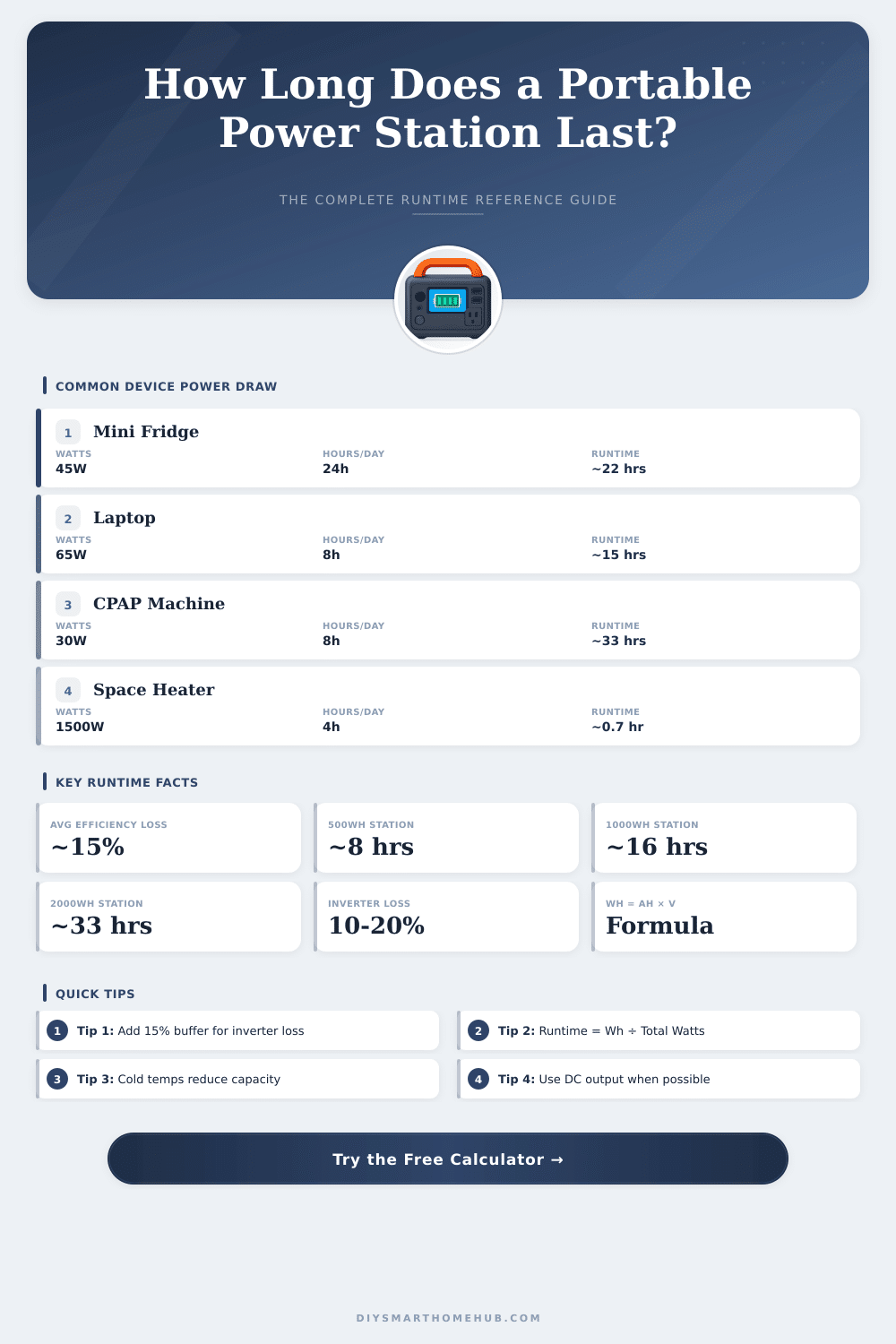
⚡ Portable Power Station Runtime Calculator
Enter your battery capacity and connected devices to calculate exact runtime hours
| Station Size | Phone (18W) | Laptop (65W) | Mini Fridge (45W) | CPAP (30W) | TV 55" (120W) |
|---|---|---|---|---|---|
| 300 Wh | 14.9 hrs | 4.1 hrs | 6.0 hrs | 9.0 hrs | 2.3 hrs |
| 500 Wh | 24.9 hrs | 6.9 hrs | 10.0 hrs | 15.0 hrs | 3.8 hrs |
| 1000 Wh | 49.8 hrs | 13.8 hrs | 20.0 hrs | 30.0 hrs | 7.5 hrs |
| 1500 Wh | 74.7 hrs | 20.8 hrs | 30.0 hrs | 45.0 hrs | 11.3 hrs |
| 2000 Wh | 99.6 hrs | 27.7 hrs | 40.0 hrs | 60.0 hrs | 15.0 hrs |
| 3000 Wh | 149 hrs | 41.5 hrs | 60.0 hrs | 90.0 hrs | 22.5 hrs |
| Station Size | Usable Wh (80% DoD) | Ah at 12V | Ah at 24V | Weight Range |
|---|---|---|---|---|
| 300 Wh | 240 Wh | 20 Ah | 10 Ah | 6–10 lbs (2.7–4.5 kg) |
| 500 Wh | 400 Wh | 33 Ah | 17 Ah | 10–15 lbs (4.5–7 kg) |
| 1000 Wh | 800 Wh | 67 Ah | 33 Ah | 20–30 lbs (9–14 kg) |
| 1500 Wh | 1200 Wh | 100 Ah | 50 Ah | 30–45 lbs (14–20 kg) |
| 2000 Wh | 1600 Wh | 133 Ah | 67 Ah | 40–55 lbs (18–25 kg) |
| 3000 Wh | 2400 Wh | 200 Ah | 100 Ah | 60–80 lbs (27–36 kg) |
| Use Case | Devices Used | Total Draw | Recommended Station | Expected Runtime |
|---|---|---|---|---|
| Weekend Camping | Lights, phone, fan | ~80W | 500 Wh | ~5.5 hrs continuous |
| CPAP One Night | CPAP only | 30–50W | 300 Wh | 8+ hrs (1 night) |
| Home Office Day | Laptop, monitor, router | ~150W | 1000 Wh | ~6 hrs |
| Power Outage Basics | Fridge, lights, phone | ~100W | 1500 Wh | ~13 hrs |
| Tailgate / Party | Speaker, TV, grill | ~800W | 2000 Wh | ~2.5 hrs |
| Van Life Daily | Fridge, laptop, lights, fan | ~250W | 2000 Wh | ~7 hrs |
| Construction Site | Power tools, lighting | ~600W | 3000 Wh | ~4.5 hrs |
portable power station is simply a battery with a built-in inverter. The inverter absorbs the energy from the battery and changes it from direct electricity to alternating electricity, so that various devices can work normally. Those devices are compact, rechargeable and simple to use.
They charge themselves by means of wall outlets or solar panels and give enough power for devices almost everywhere. They work quietly, without any exhaust gases, and work plug-and-play style… Only attach and go.
What is a portable power station and how does it work?
The most common portable power stations come with AC outlets, USB ports, USB-C ports DC output spots and occasionally even wireless charging pads. Having at least two USB ports helps for charging phones, tablets and Bluetooth speakers. Like this one freely leaves the AC outlets for devices that need more energy.
USB-C ports work well for fast charging, while automatic power adjusting means they connect to even more devices.
Compatibility with solar panels, app functions and expandable battery capacity are other important features that one should remember. Some models can recharge by means of a DC adapter. For instance, the model Anker Solix C1000 charges itself from a wall outlet in only 49 minutes.
It also works well for urgent situations or short journeys. Moreover, it charges in around two hours by means of solar panels, when one wants to fully disconnect form the grid.
Those units enjoy popularity for camping under the sky, power outages, remote work and similar job settings. Some use them on ships instead of starting noisy generators in the morning only for coffee. Others use them during RV journeys or in off-grid life.
Commonly one uses them for keeping phones charged, running LED lights and fans or even CPAP devices during the night.
A 1000Wh portable power station reaches ideal balance between portability and power for camping. Bigger systems exist, but for whole-home backup power, one needs a different kind of gear. Like a separate inverter, expandable battery bank and separate solar setup.
That means a totally different price level and grade of trouble.
Known brands include Ecoflow, Jackery, Bluetti, Anker, Goal Zero, Biolite and Pecron. Pecron usually costs less, while Jackery and Goal Zero sometimes seem too costly. Factory-built units are widely easier than homemade builds, although building yourself can give more power for the money.
Making a self-built portable power station that works like a factory-built one for less money is almostimpossible.
Lithium Iron Phosphate batteries are the best chemistry for batteries that one should choose. They have around five times longer life than average lithium-ion and offer faster charging and more safety. Before buying, using a watt meter to check how much energy devices truly use is a wise idea.
Space heaters especially use reliably much energy.