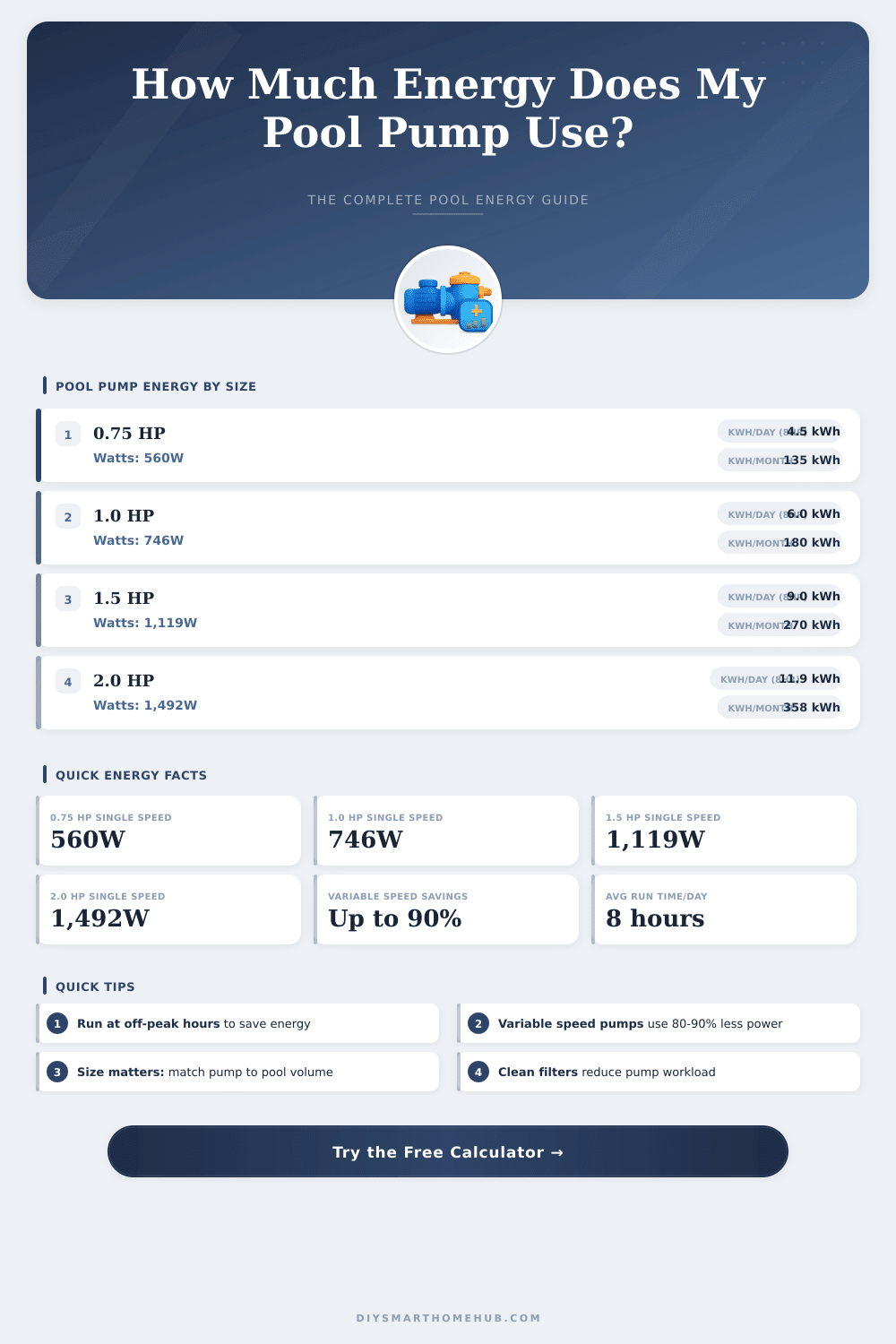
🏊 Pool Pump Energy Usage Calculator
Calculate your pool pump's daily, monthly & annual energy consumption based on pump size, type, and run time.
| Pump Type | Typical Watts | kWh / Day | kWh / Month | kWh / Year (8 mo) |
|---|---|---|---|---|
| Single Speed (1.5 HP) | 1,119W | 8.95 | 268.6 | 2,149 |
| Two Speed — High | 1,119W | 8.95 | 268.6 | 2,149 |
| Two Speed — Low | 280W | 2.24 | 67.2 | 537 |
| Variable Speed (mid) | 400W | 3.20 | 96.0 | 768 |
| Variable Speed (low) | 200W | 1.60 | 48.0 | 384 |
| ENERGY STAR VSP | 150W | 1.20 | 36.0 | 288 |
| Pool Volume | Pool Size (approx) | Min Run Time / Day | Recommended (Single Speed) | Recommended (VSP) |
|---|---|---|---|---|
| 5,000 gal | Small Above-Ground | 4 hrs | 6 hrs | 8 hrs (low speed) |
| 10,000 gal | 12x24 In-Ground | 5 hrs | 7 hrs | 10 hrs (low speed) |
| 15,000 gal | 14x28 In-Ground | 6 hrs | 8 hrs | 12 hrs (low speed) |
| 20,000 gal | 16x32 In-Ground | 7 hrs | 9 hrs | 14 hrs (low speed) |
| 30,000 gal | 20x40 In-Ground | 9 hrs | 12 hrs | 16 hrs (low speed) |
| 50,000+ gal | Large / Commercial | 12 hrs | 16-24 hrs | 24 hrs (low speed) |
| Pump HP | Approx GPH | Pool Vol for 1 Turnover (8hr) | Turnovers/Day (20,000 gal) |
|---|---|---|---|
| 0.5 HP | ~1,500 GPH | 12,000 gal | 0.6x |
| 0.75 HP | ~2,000 GPH | 16,000 gal | 0.8x |
| 1.0 HP | ~2,500 GPH | 20,000 gal | 1.0x |
| 1.5 HP | ~3,500 GPH | 28,000 gal | 1.4x |
| 2.0 HP | ~4,500 GPH | 36,000 gal | 1.8x |
| 3.0 HP | ~6,500 GPH | 52,000 gal | 2.6x |
A pool pump commonly ranks between the biggest energy users in the house. It can take second place for energy use after the air conditioner or heater what costs between 270 and 310 dollars yearly according to the electric bill. Typical pool pumps use 1,500 to 2,500 watts of electricity.
That results in 30 to 150 dollars monthly to run. They represent 20 to 30 percent of the whole home electric use, what truly surprises when you think about that.
Save Energy and Money with Your Pool Pump
An average pool pump normally runs at least eight hours daily to move and clean the water. Assuming a motor of 2,000 watts working eight hours a day, the amount grows quickly. During a whole year, such a pump uses between 3,000 and 5,000 kWh of electricity, according to how much it runs.
Cheaper pool setups sometimes work all the tiem, using at least 1 kWh each hour or almost 2 kWh.
Pumps with variable speed change everything. A variable-speed pool pump can save up to 90 percent of energy costs compared to a single-speed or two-speed model. They usually pay for themselves in two years or even sooner.
For instance, an old single-speed pump of 1 horsepower used 1,776 watts during 16 hours a day, all year. Switching too a variable-speed version, the use heavily drops.
Here is a fresh rule of thumb. If you cut the speed of the pump in half, the power use drops to almost one-eighth of the prior amount. So, running a variable-speed pump at 3,450 rpm does not just double the electricity compared to 1,725 rpm, it increases it eight times.
For instance, a Pentair variable-speed pump at max speed of 3,450 rpm uses around 2,700 watts. Dropping it to 3,000 rpm, the use falls to 1,500 to 1,600 watts. At low speed of 750 rpm, the energy use is much less than at the max.
Pool pumps commonly are too big, just like heaters. One person switched from a 1.5 horsepower pump to a three-quarter horsepower one, what cut the watts in half and still kept full water flow in 6 to 8 hours. Faster running of the pump uses power much more, so slowing it down is always worth trying.
Energy Star rated pool pumps run more quietly and can extend the life of the pool filter system. They get special marks for energy savings and can save more than 2,800 dollars during thewhole life span. Variable-speed pumps also stay quiet during running and many have built-in programs along with more efficient filtering.
Most owners of a variable-speed pump can reach 80 to 90 percent of energy savings without loss of water quality compared to single-speed models. Some electric companies offer discounts for certain energy efficient pumps.