⚡ Parallel Circuit Voltage Drop Calculator
Calculate voltage, current, and power across each branch in a parallel circuit
| Branch Resistance (Ω) | Voltage Across Branch | Branch Current (A) | Power Dissipated (W) |
|---|---|---|---|
| 1 Ω | 12 V | 12.000 A | 144.0 W |
| 5 Ω | 12 V | 2.400 A | 28.8 W |
| 10 Ω | 12 V | 1.200 A | 14.4 W |
| 25 Ω | 12 V | 0.480 A | 5.76 W |
| 50 Ω | 12 V | 0.240 A | 2.88 W |
| 100 Ω | 12 V | 0.120 A | 1.44 W |
| 250 Ω | 12 V | 0.048 A | 0.58 W |
| 1000 Ω | 12 V | 0.012 A | 0.14 W |
| Each Branch R (Ω) | Equivalent R (Ω) | 12V Total Current (A) | 120V Total Current (A) |
|---|---|---|---|
| 10 Ω | 5.0 Ω | 2.40 A | 24.0 A |
| 20 Ω | 10.0 Ω | 1.20 A | 12.0 A |
| 50 Ω | 25.0 Ω | 0.48 A | 4.80 A |
| 100 Ω | 50.0 Ω | 0.24 A | 2.40 A |
| 200 Ω | 100.0 Ω | 0.12 A | 1.20 A |
| 1000 Ω | 500.0 Ω | 0.024 A | 0.24 A |
| Device / Load | Typical Resistance (Ω) | Voltage Rating | Typical Current (A) |
|---|---|---|---|
| LED Strip (1m) | 14.4 Ω | 12 V | 0.83 A |
| Car Headlight (H4) | 0.92 Ω | 12 V | 13.0 A |
| USB Charger Port | 5.0 Ω | 5 V | 1.0 A |
| 60W Incandescent Bulb | 240 Ω | 120 V | 0.5 A |
| 100W Incandescent Bulb | 144 Ω | 120 V | 0.83 A |
| Small DC Motor | 4.0 Ω | 12 V | 3.0 A |
| Resistive Heater (small) | 24 Ω | 120 V | 5.0 A |
| Sensor Module | 100 Ω | 5 V | 0.05 A |
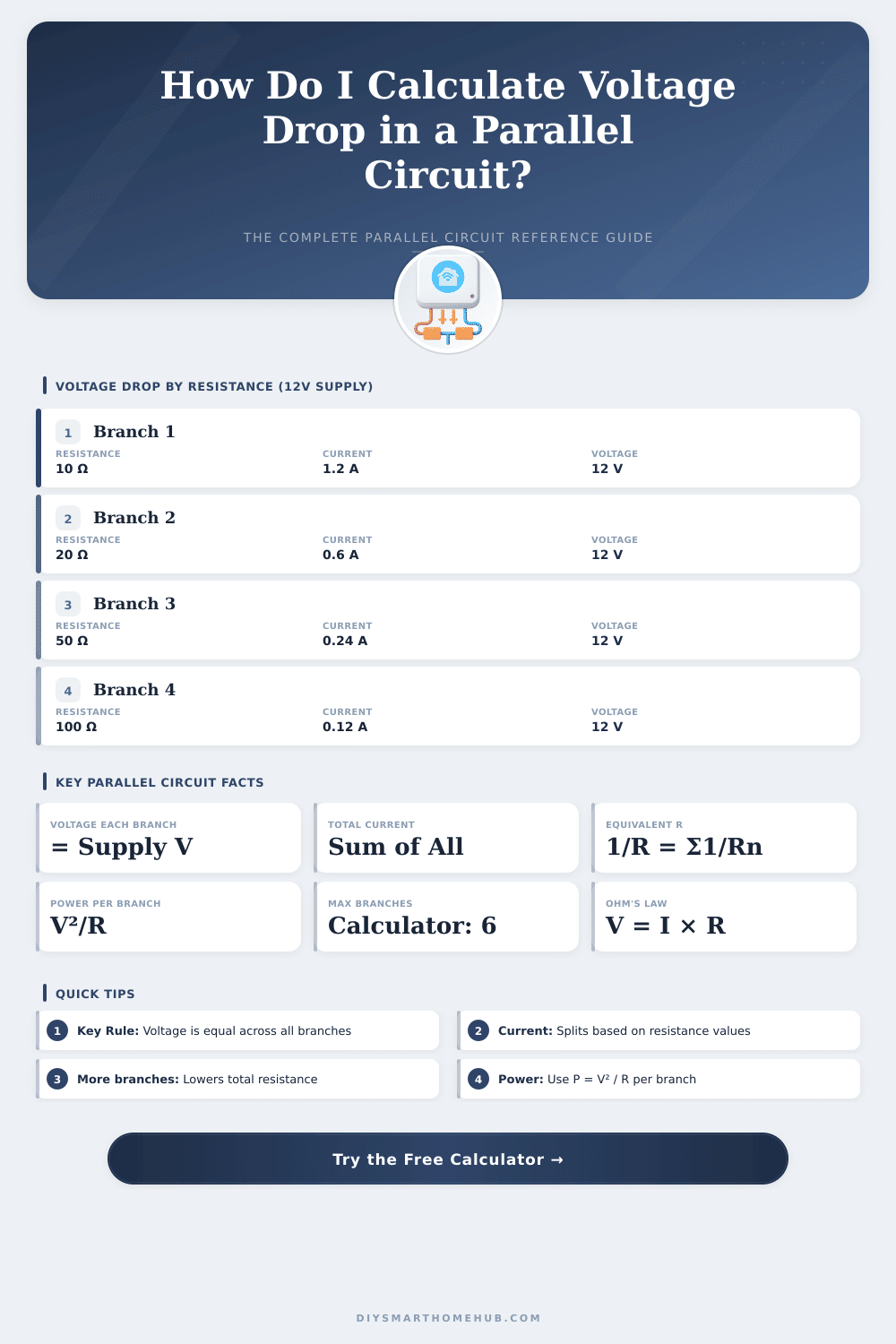
In a parallel circuit, the voltage drop through every resistance stays the same, no matter its resistance value. This is one of the main points for understanding how such circuits work. When three resistances connect in parallel and receive energy from a 12-volt battery then each of them has a 12-volt voltage drop.
The voltage drop across all those resistances matches the total provided voltage.
Voltage Is the Same in Every Branch of a Parallel Circuit
Why does this happen? Every branch in a parallel circuit uses the same two cables. The first ends of the branches connect to one cable, while the other ends connect to other shared cables.
Because of that setup, every branch has the same voltage. That comes from basic rules of circuit theory. A short circuit, a cable without resistances or other parts, keeps steady voltage.
In a parallel circuit, the ends of the resistances are shorted together, so that the upper ends stay at one same level of voltage, and the botom at another.
This differs from series circuits. Here the voltage drop spreads between the parts. If two same parts stand in sequence, the provided voltage splits equally between them.
In parallel on the other hand, the voltage stays the same through every branch. On the contrary, the flow is what spreads.
The Law of Ohm counts also for resistances in parallel. The flow through each of them matches the whole voltage drop divided by the resistance of that bit. So, if two parallel resistances have different values, they carry different amounts of flow, but the voltage across both stays the same.
The flow in the circuit passes only threw one of the resistances.
To count the whole flow in a parallel circuit, one simplifies it to one equal resistance, then applies the formula of voltage divided by resistance to find the current. Later one can go back and multiply each resistance value by the flow, which gives the voltage drop, that matches the provided voltage.
When two resistances in parallel match, the flow spreads equally between them. If they differ, the same voltage drop across both forms the base for counting the split of flows. The resistance with smaller value carries more flow.
There is one practical reason why the voltage could a bit fall in a parallel circuit. If the power source is not perfect, it has internal resistance. When more flow passes, the voltage drops because of that internal resistance.
Cables themselves have resistance in real circuits, so one expects a bit of voltage fall along them. Using good cables and thicker wires, one keeps thatfall small and almost unnoticed.
A voltmeter, that measures voltage, always connects in parallel with the part that one measures. This makes sense, because the voltage is the same across parallel branches.