🌡 Manual J Heat Load Calculator
Calculate residential heating & cooling loads using ACCA Manual J methodology
| Zone | Region Example | Winter Design (°F) | Summer Design (°F) | Annual HDD | Annual CDD |
|---|---|---|---|---|---|
| Zone 1 | Miami, FL | 35°F | 92°F | ~200 | ~4,000 |
| Zone 2 | Houston, TX | 25°F | 95°F | ~1,500 | ~2,800 |
| Zone 3 | Atlanta, GA | 18°F | 93°F | ~3,000 | ~1,800 |
| Zone 4 | Kansas City, MO | 6°F | 96°F | ~4,800 | ~1,200 |
| Zone 5 | Chicago, IL | -4°F | 91°F | ~6,500 | ~700 |
| Zone 6 | Minneapolis, MN | -16°F | 89°F | ~8,200 | ~500 |
| Zone 7 | Fairbanks, AK | -47°F | 82°F | ~14,200 | ~100 |
| Component | Poor R-Value | Standard R-Value | Good R-Value | Heat Loss Factor |
|---|---|---|---|---|
| Exterior Walls | R-11 | R-13 to R-15 | R-21+ | 0.09 – 0.06 BTU/hr·sqft·°F |
| Attic/Ceiling | R-19 | R-30 to R-38 | R-49 to R-60 | 0.05 – 0.02 BTU/hr·sqft·°F |
| Floor/Crawlspace | R-11 | R-19 to R-25 | R-30+ | 0.09 – 0.03 BTU/hr·sqft·°F |
| Single Pane Window | R-1 | — | — | 1.0 BTU/hr·sqft·°F |
| Double Pane Low-E | — | R-3 to R-4 | — | 0.30 BTU/hr·sqft·°F |
| Triple Pane | — | — | R-5 to R-8 | 0.18 BTU/hr·sqft·°F |
| Exterior Door | R-2 | R-5 to R-6 | R-10+ | 0.50 – 0.10 BTU/hr·sqft·°F |
| Home Size | Heating Load (BTU/hr) | Cooling Load (BTU/hr) | Furnace Size | AC Tons |
|---|---|---|---|---|
| 500 sq ft | 15,000 – 25,000 | 10,000 – 15,000 | 40,000 BTU | 1.0 ton |
| 800 sq ft | 24,000 – 36,000 | 16,000 – 24,000 | 40,000 BTU | 1.5 ton |
| 1,200 sq ft | 36,000 – 54,000 | 24,000 – 36,000 | 60,000 BTU | 2.0 ton |
| 1,500 sq ft | 45,000 – 67,500 | 30,000 – 45,000 | 80,000 BTU | 2.5 ton |
| 2,000 sq ft | 60,000 – 90,000 | 40,000 – 60,000 | 100,000 BTU | 3.0 ton |
| 2,500 sq ft | 75,000 – 112,500 | 50,000 – 75,000 | 120,000 BTU | 4.0 ton |
| 3,000 sq ft | 90,000 – 135,000 | 60,000 – 90,000 | 140,000 BTU | 5.0 ton |
| 4,000 sq ft | 120,000 – 180,000 | 80,000 – 120,000 | 180,000 BTU | 6.0+ ton |
When deal about the size of HVAC systems, the calculation of Heat Load according to Manual J is that on that the branch fully stands itself. This method details all factors that decide how much heating and cooling truly must have the house, such as the floor area of the building, the insulation of it, the windows the climate zone in that one lives, and many others. The main goal here is simple: ensure that the gear for heating, ventilation and cooling answer exactly to the needs of the home.
If one errs about that, will result or too big or too little unit, and both options end bad.
How to Find Your Home Heat Load Using Manual J
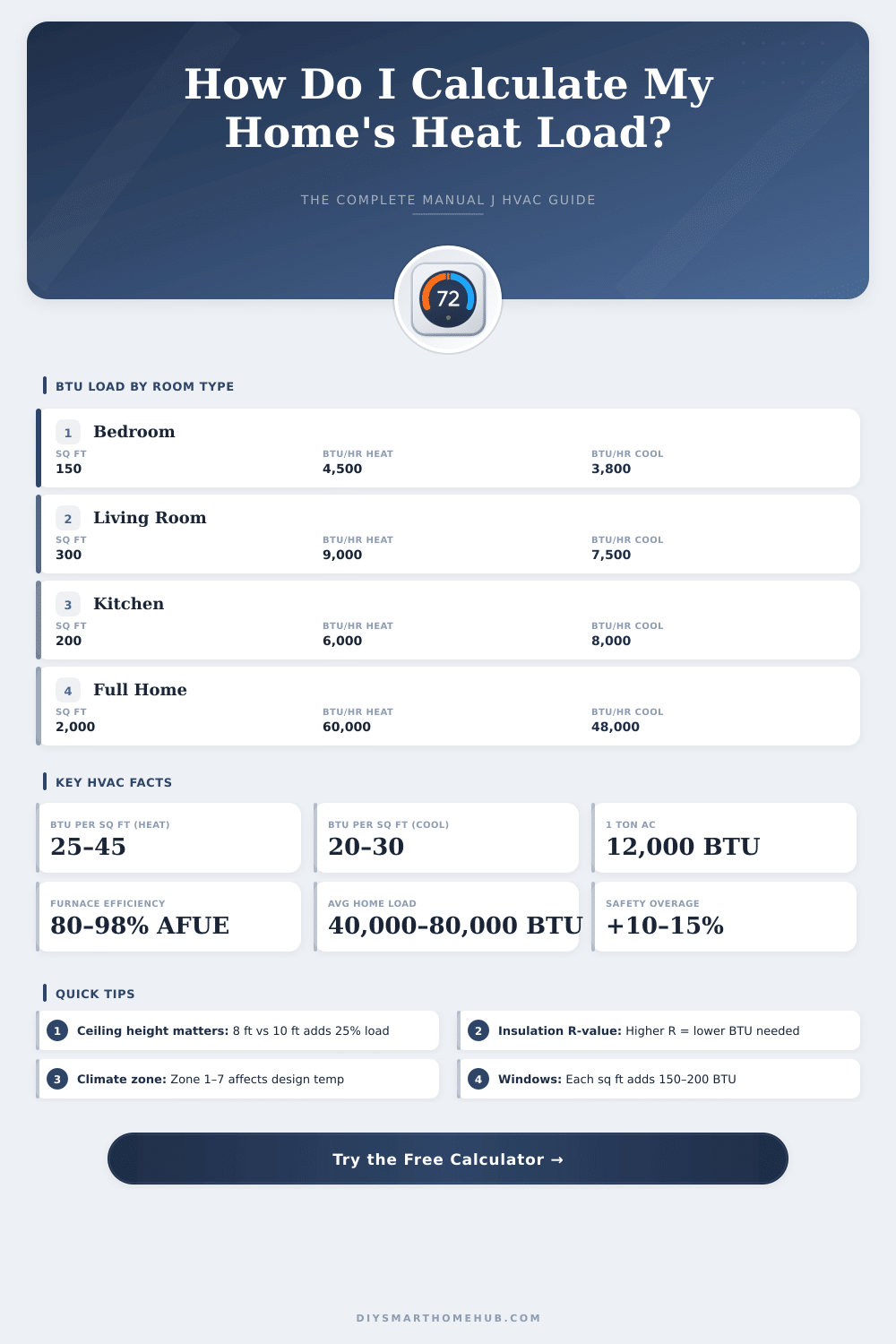
The calculation combined several main elements. It takes in thought the surface area of the building, the height of ceilings, the number of windows, the number of doors and the inhabitants. For a home of 2 000 square feet with ceilings at 10 feet, six inhabitants, twenty-two widnows and three doors, one likely finds around 35 600 BTU.
That corresponds to about 2,97 tons of capacity for cooling and warming.
Big value rests in the insight of that. “Loads” point how much heating and cooling the building truly requires. “Capacity” rather shows what the gear can indeed give.
Both measure in British thermal units each hour. When specialists check reports of Manual J, they focus on the load side.
Manual J of ACCA is considered the standard according to ANSI for planning HVAC systems in homes. It defines exactly how to determine the Heat Load of heating and cooling, so that the right size of gear follow according to Manual S. Start with Manual J is the first step in any design of residential HVAC system. It is also the only officially accepted method for finding the size of air conditioner four particular home.
The famous reputation around that process points that it requires much time, although partly because of its fullness and solid accuracy. Software changed the game, programs like CoolCalc and Wrightsoft a lot rush the work. Who well knows CoolCalc, can end solid calculation of Heat Load in around 20 minutes.
Loadcalc is other option, based on ideas of Manual J and meant to be even faster. The process starts simply: one chooses his state or province, later the city.
Calculations room by room give real benefits, because they separate the heat and cooling loads for every space. Such info is useful, if one room does not receive the right heat or cold. The method shines especially in new building drafts.
For already existing homes with working systems, exists other way: estimate the Heat Load according to actual use of natural gas, that commonly is the most reliable data that one has. Compare the use of gas inwinter against summer show roughly how much gas burned for heating targets.