💡 Low Voltage Lighting Transformer Calculator
Calculate the correct transformer VA rating for your 12V landscape or deck lighting system
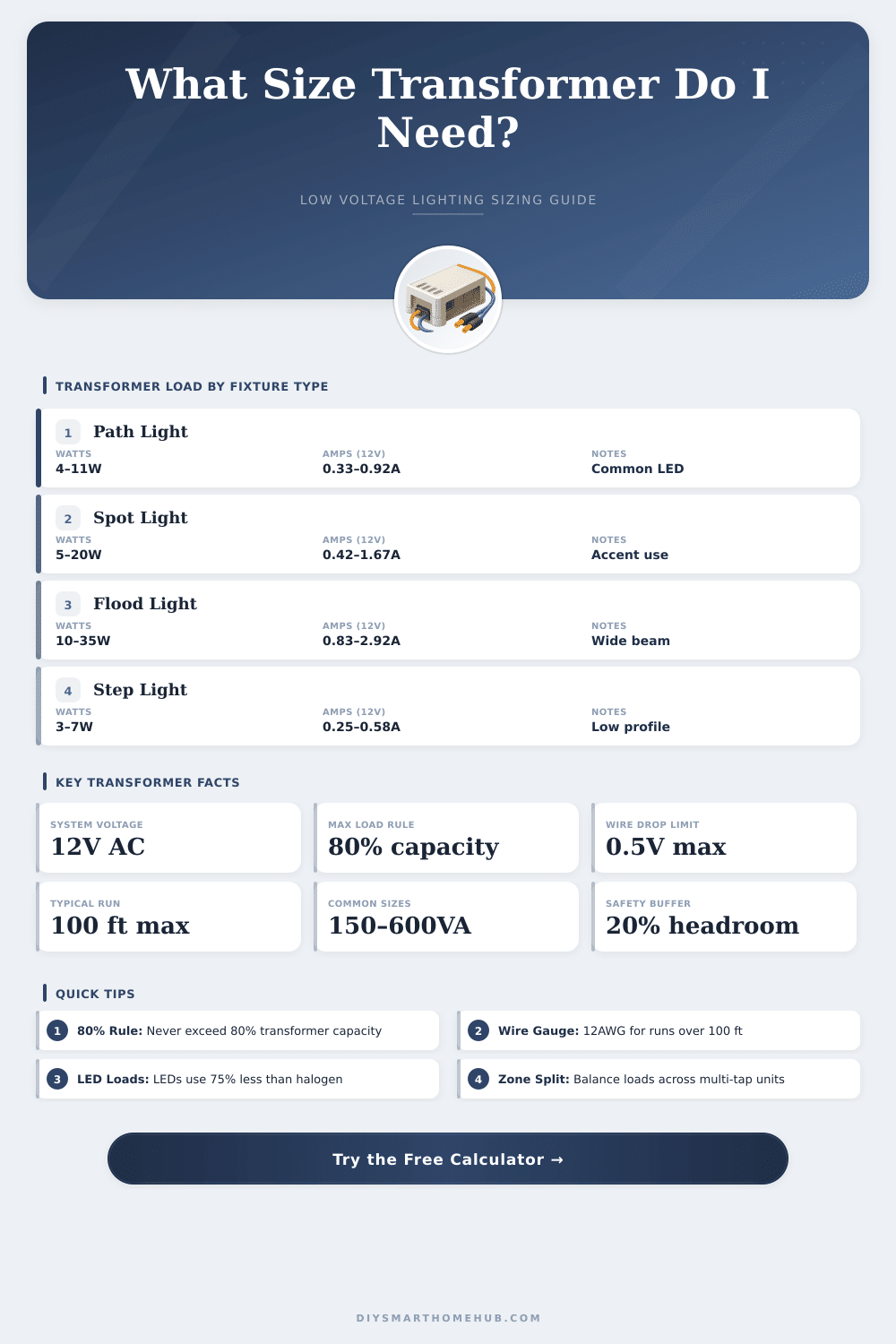
| Transformer VA | Max Load (80%) | LED Fixtures (8W avg) | Halogen Fixtures (35W avg) | Best For |
|---|---|---|---|---|
| 150 VA | 120W | ~15 fixtures | ~3 fixtures | Small path / accent |
| 200 VA | 160W | ~20 fixtures | ~4 fixtures | Front yard |
| 300 VA | 240W | ~30 fixtures | ~6 fixtures | Medium landscape |
| 400 VA | 320W | ~40 fixtures | ~9 fixtures | Large yard |
| 600 VA | 480W | ~60 fixtures | ~13 fixtures | Estate / commercial |
| 900 VA | 720W | ~90 fixtures | ~20 fixtures | Large estate |
| 1200 VA | 960W | ~120 fixtures | ~27 fixtures | Commercial / resort |
| Wire Gauge | Max Run (ft) | Max Run (m) | Max Load (W) | Notes |
|---|---|---|---|---|
| 16 AWG | 50 ft | 15 m | 150W | Short runs only |
| 14 AWG | 100 ft | 30 m | 200W | Standard residential |
| 12 AWG | 150 ft | 46 m | 250W | Recommended for most |
| 10 AWG | 200 ft | 61 m | 350W | Long runs, heavy loads |
| 8 AWG | 300 ft | 91 m | 500W | Commercial / estate |
| Run Length | Load (W) | 14 AWG Drop | 12 AWG Drop | 10 AWG Drop |
|---|---|---|---|---|
| 50 ft (15m) | 100W | 0.7V | 0.4V | 0.3V |
| 100 ft (30m) | 100W | 1.4V | 0.8V | 0.5V |
| 100 ft (30m) | 200W | 2.8V | 1.6V | 1.0V |
| 150 ft (46m) | 150W | 3.1V | 1.8V | 1.1V |
| 200 ft (61m) | 200W | 5.6V | 3.2V | 2.0V |
A low voltage lighting transformer is the basic element in any system of landscape lighting. It receives the usual 120-volt energy from the home and converts it to much safer low voltage, normally between 12 and 15 volts AC. The way it does that change determines how much energy the device can use and how stable the produced voltage stays.
Those transformers come in various sizes. Some have 60 watts, while others reach 300 watts or even bigger power. The right size depends on the number of lights that will be used, and on the total power that they need when one turns them on at the same time.
What a Low Voltage Lighting Transformer Does
It helps to leave a bit of back-up capacity because that protects against voltage drops, overheating, and fast wear of the transformer.
Some of those devices include practical built-in features, like timers and light-sensor detectors. Light-sensor strips, when it gets dark, automatically turn on the lights. That kind of automation works very well for landscape lighting, because the lamps simply must turn on every evening.
Also some versions offer multi-voltage output optoins, that help to keep the brightness even when many lamps work, especially on long cable runs.
About long cable distances, those really can create troubles. Cable that runs long from the transformer can make the lights very dim. One long chain link for the whole net causes bigger voltage drop then sharing the installation in several shorter branches from the transformer.
Thicker gauge cable, for instance 10/2 instead of 12/2, also helps to stop voltage drop on big distances.
One must know that LED lights and old-style bulbs mostly work differently. LED strips usually need a DC power supply, while traditional landscape lighting normally works by means of AC from the low voltage lighting transformer. Basically match the output of the transformer with the needs of the gear.
Using the wrong kind can lead to various problems.
Adding smart home control with those transformers can be hard. Many of them reset to default settings after power loss, instead of staying in the turned-on state. A common fix is to put a regular transformer in a smart plug, like a Z-Wave switch, and use it to control the on and off of the power.
Some users install smart switches on the cables to control separate low-voltage sections of one single transformer.
Even the cost of connections can matter. Most low-voltage lamps connect by means of snap-on connections that install easily, but often fail in the first three years. Weather-resistant covers help to protect the transformer itself outside.
Brands of high quality that have been around for decades tend to make more lasting stuff, although they cost more. A low voltage lighting transformer of 300 watts, that canbe buried directly, from a well known brand, can cost around 300 dollars.
Low-voltage transformers also serve for other uses than landscape lighting, including pools and hot tubs, doorbells, control signals, and industrial lighting jobs.