💡 LED Lighting Calculator
Calculate lumens, wattage, and number of LED fixtures needed for any room or space
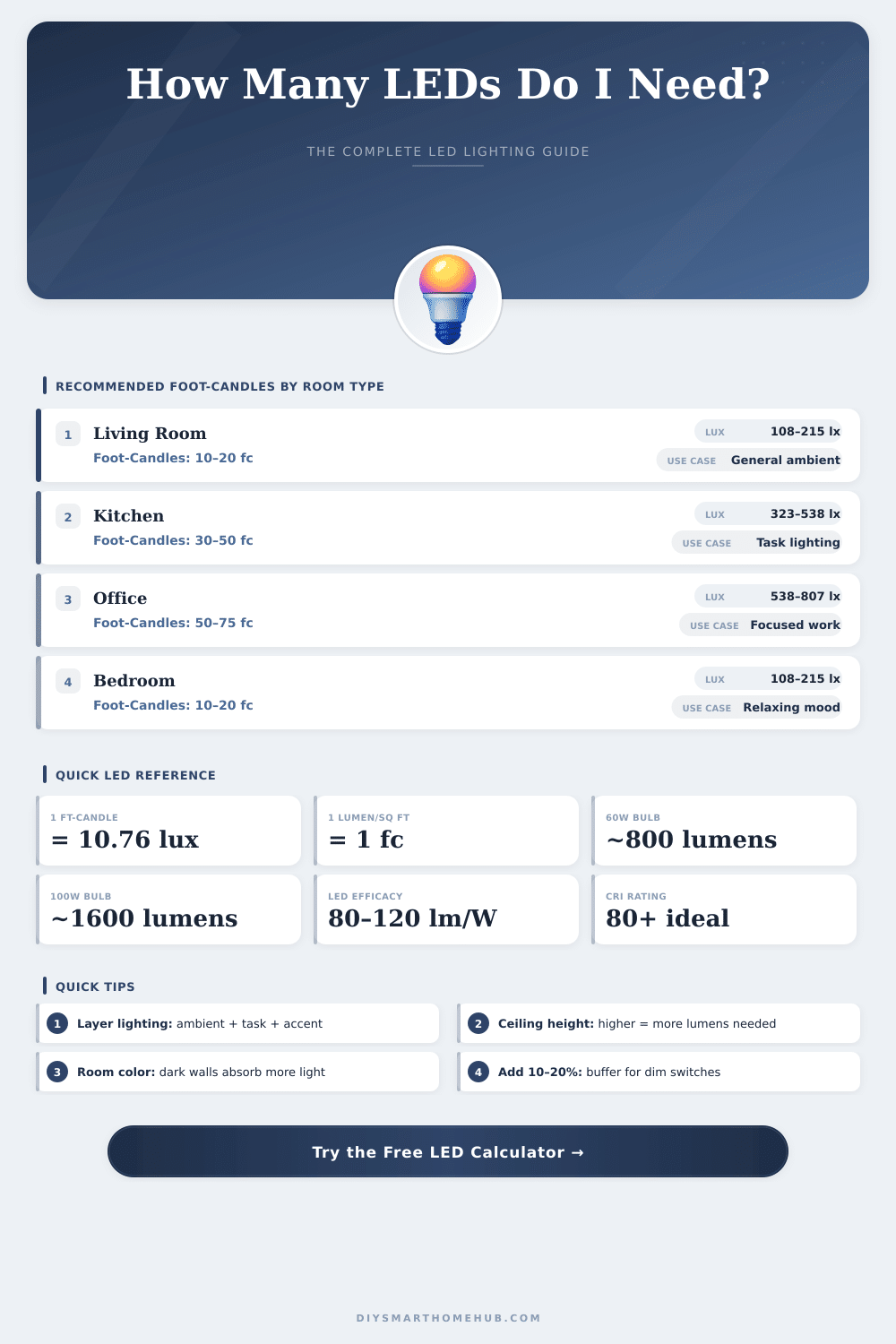
| Room Type | Foot-Candles (fc) | Lux (metric) | Lumens per 100 sq ft | Lumens per 10 m² |
|---|---|---|---|---|
| Bedroom | 10–20 | 108–215 | 1,000–2,000 | 1,076–2,153 |
| Living Room | 10–20 | 108–215 | 1,000–2,000 | 1,076–2,153 |
| Dining Area | 20–30 | 215–323 | 2,000–3,000 | 2,153–3,229 |
| Kitchen | 30–50 | 323–538 | 3,000–5,000 | 3,229–5,382 |
| Bathroom | 50–75 | 538–807 | 5,000–7,500 | 5,382–8,073 |
| Home Office | 50–75 | 538–807 | 5,000–7,500 | 5,382–8,073 |
| Garage | 30–50 | 323–538 | 3,000–5,000 | 3,229–5,382 |
| Workshop | 50–100 | 538–1076 | 5,000–10,000 | 5,382–10,764 |
| Warehouse | 20–30 | 215–323 | 2,000–3,000 | 2,153–3,229 |
| Studio / Showroom | 75–100 | 807–1076 | 7,500–10,000 | 8,073–10,764 |
| LED Wattage | Lumens Output | Incandescent Equiv. | Efficacy (lm/W) | Coverage at 15 fc (sq ft) |
|---|---|---|---|---|
| 4W | 450 lm | 40W | 112 lm/W | ~30 sq ft |
| 8.5W | 800 lm | 60W | 94 lm/W | ~53 sq ft |
| 12W | 1,100 lm | 75W | 92 lm/W | ~73 sq ft |
| 15W | 1,600 lm | 100W | 107 lm/W | ~107 sq ft |
| 23W | 2,600 lm | 150W | 113 lm/W | ~173 sq ft |
| 30W | 4,000 lm | 200W | 133 lm/W | ~267 sq ft |
| 60W LED shop | 8,000 lm | 400W | 133 lm/W | ~533 sq ft |
| Project | Area (sq ft) | Total Lumens Needed | Fixtures (800 lm) | Estimated Wattage |
|---|---|---|---|---|
| Small Bedroom 10×10 | 100 | 1,500 | 2 | 19W |
| Living Room 12×14 | 168 | 2,520 | 4 | 32W |
| Kitchen 10×12 | 120 | 6,000 (50fc) | 8 | 75W |
| Home Office 10×10 | 100 | 7,500 (75fc) | 10 | 94W |
| Garage 20×20 | 400 | 16,000 (40fc) | 20 | 200W |
| Open Plan 20×30 | 600 | 12,000 (20fc) | 15 | 150W |
| Warehouse 50×30 | 1,500 | 37,500 (25fc) | 47 | 469W |
LED lighting is based on diodes that give off light. They use much less energy to produce equally much light compared to old tubes or compact fluorescent lamps. Electrical current passes through a microchip that turns on little light sources.
Those LED lighting units make light up to 90 percent more efficiently than old tubes. Regarding fluorescent lamps, LED lighting beats them by around 25 percent in turning electrical energy to light.
Why Use LED Lights
Switching to LED lighting can reduce the energy cost by up to 50 percent compared with old light fixtures. The running costs are almost ten times less than for old lamps. LED lighting runs cooler and needs less care over time.
This is important when one has many old tubes in a house or car.
The lifetime is the area where LED lighting truly shines. They usually last between 20 000 and 25 000 hours. Some professional LED lighting devices reach 15 to 20 years of use.
Compare that with only around 1 000 hours for average old tubes. One LED tube can repay its purchase price many times through savings on electrical costs over its whole life. The initial cost is a bit higher, but the saving adds up soon.
LED lighting shows up everywhere now. Street lights, parking garages, sidewalk lighting, light in refrigerators and desk lamps all benefit from them. Because of there small size and directional light, LED lighting works well for long surfaces like kitchen counters, used for cooking and reading recipes.
Devices with high brightness and color changing strips are available for garages, stores and decorative setups. Efficient LED lighting can be put under kitchen shelves, in backyards and inside homes, and they work also for small industrial uses.
LED strips come in a great range of kinds. There are COB LED strips, addressable LED strips and flexible neon LED lighting. They come in 12V and 24V, with waterproof and non-waterproof options, including nearly submersible models with IP68 rating.
Use of 24V strip allows longer setups without problems. For good light output, strips with 300 to 500 lumens each metre work well on dimmers.
The color temperature matters a lot. Between 2700K and 3000K one gets a warm tone, similar to old bulbs. Around 3000 to 3500K gives warm white, which seems natural.
Bright white is at 5000K to 6000K, and some folks find it too harsh indoors. Even so, bright white lamps do light more strongly than warm. The higher the brightness, the more intense the light.
Owners of camper vans often replace old and halogen tubes with LED lighting. Direct replacements come in warm white, and LED pucks along with ceiling dome fixtures make popular updates. LED strip lighting works also under cabinets and inside shelves.
Besides that, solar charged LED lanterns and USB powered tubesbid handy portable light solutions.