💡 Landscape Lighting Voltage Drop Calculator
Calculate voltage drop across your low-voltage lighting runs — ensure every fixture receives optimal voltage for full brightness.
| Wire Gauge | Ohms/ft (x2 for run) | 50W Load – Max Run | 100W Load – Max Run | 150W Load – Max Run | 200W Load – Max Run |
|---|---|---|---|---|---|
| 8 AWG | 0.001252 Ω/ft | 228 ft (70 m) | 114 ft (35 m) | 76 ft (23 m) | 57 ft (17 m) |
| 10 AWG | 0.001990 Ω/ft | 144 ft (44 m) | 72 ft (22 m) | 48 ft (15 m) | 36 ft (11 m) |
| 12 AWG | 0.003176 Ω/ft | 90 ft (27 m) | 45 ft (14 m) | 30 ft (9 m) | 23 ft (7 m) |
| 14 AWG | 0.005050 Ω/ft | 57 ft (17 m) | 28 ft (9 m) | 19 ft (6 m) | 14 ft (4 m) |
| 16 AWG | 0.008032 Ω/ft | 36 ft (11 m) | 18 ft (5 m) | 12 ft (4 m) | 9 ft (3 m) |
| 18 AWG | 0.012770 Ω/ft | 22 ft (7 m) | 11 ft (3 m) | 8 ft (2 m) | 6 ft (2 m) |
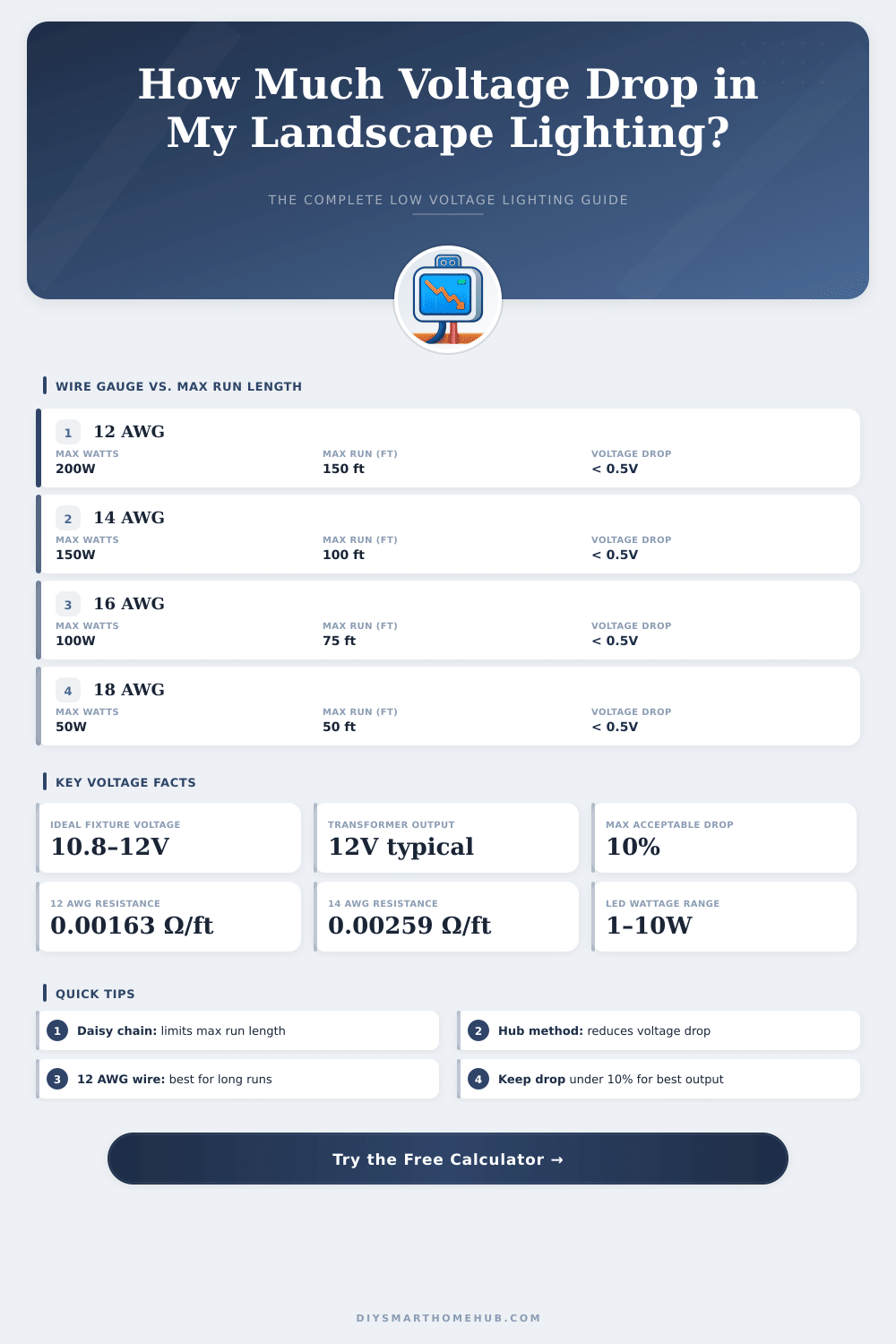
ℹ️ Max run calculated for <10% voltage drop (1.2V) at 12V. Actual run = one-way distance; total wire = 2x run length.
| Run Length (ft) | Run Length (m) | Total Load 50W | Total Load 100W | Total Load 150W | Status |
|---|---|---|---|---|---|
| 25 ft | 7.6 m | 11.80V | 11.61V | 11.41V | ✅ Excellent |
| 50 ft | 15.2 m | 11.61V | 11.21V | 10.82V | ✅ Good |
| 75 ft | 22.9 m | 11.41V | 10.82V | 10.23V | ⚠ Marginal |
| 100 ft | 30.5 m | 11.21V | 10.42V | 9.64V | ❌ Too Low |
| 150 ft | 45.7 m | 10.82V | 9.64V | 8.46V | ❌ Too Low |
| Fixture Type | Typical Wattage (LED) | Halogen Equivalent | Best Wire Gauge | Notes |
|---|---|---|---|---|
| Path Light | 1–5W | 10–20W | 14–16 AWG | Low draw, long runs OK |
| Spotlight / Uplight | 5–15W | 20–50W | 12–14 AWG | Use 12 AWG for trees |
| Flood Light | 10–20W | 50–75W | 10–12 AWG | High wattage; limit fixtures per run |
| Deck / Step Light | 1–3W | 5–10W | 16 AWG | Very low draw |
| Well Light | 3–10W | 10–35W | 12–14 AWG | In-ground; sealed fixture |
| Bullet / Accent | 3–8W | 10–25W | 12–14 AWG | Directional spot |
| Strip Light (per ft) | 1.5–4W/ft | N/A | 12 AWG | Calculate total strip wattage |
| Transformer Tap | Fixture Receives (at 50 ft, 50W, 12 AWG) | Compensates Drop | Typical Use Case |
|---|---|---|---|
| 12V | ~11.6V | Baseline | Short runs (<50 ft) |
| 13V | ~12.6V | +1V buffer | Medium runs (50–100 ft) |
| 14V | ~13.6V | +2V buffer | Long runs (100–150 ft) |
| 15V | ~14.6V | +3V buffer | Very long runs (>150 ft) |
The voltage fall can affect landscape lighting if one does not care about it right. It presents the toll of voltage because of the resistance in cables during the energy move of the converter until the lamps. When the fall too weighs, the lights die in the most distant spots from the source.
Various things affect the voltage fall. Between them presents the distance of the cable way, the use in watts of the lamps the spacing of the fixtures and the skill of the converter itself. Although LED lamps use fewer energy than old model, always worth to estimate the fall before install the whole setup.
Why Garden Lights Go Dim and How to Fix Them
landscape lighting in low voltage usually operates in 12 AC volts, what limits some risks, but also cause fast toll, especially because of high currents. For instance, 300 watts in 12 DC volts match 25 amps, what requires quite a lot thick cable for long runs. Thin wire answers for not too long ways, even so during the lenght grow, the fall expands.
For bigger distances one choose thicker cable.
In the final lamp of way the voltage should reach at least 10 volts, but 10.5 are better. The fall do not pass 5 percent, and under 3 percent are even more helpful. For long life of the lamps, the voltage under load at fixture sits between 10.8 and 11.3 volts.
One can control the fall by means of converter with several outputs. Such devices bid various higher voltages. If one chooses stronger output, the energy starts strongly and shrinks slowly, sew that it stay stable at the lamps.
Expand the size of cables, strain several lines in ground or choose stronger output all help to fight the problem.
The design of cable net is also important. Increase direct branches in different directions, add T shaped links or form closed circuit all reduce the fall. Closed circuit imply to add cable of the last lamp back to the converter, what creates closed net.
One advises start with the converter centered. The goal is that all lamps on branch stay almost equally distant of the center, for alike voltages. Like this the changes donot cause too high or low energy for any light.
Sometimes problems with voltage fall seem strange. Happen situations, when one attaches tester to way and the voltage of 12 volts drops to 2 or 5, even if all lamps are disconnected. Buried cables can worsen such troubles.