⚡ kVAR to Ampere Calculator
Convert reactive power (kVAR) to current (Amperes) for single-phase and three-phase systems
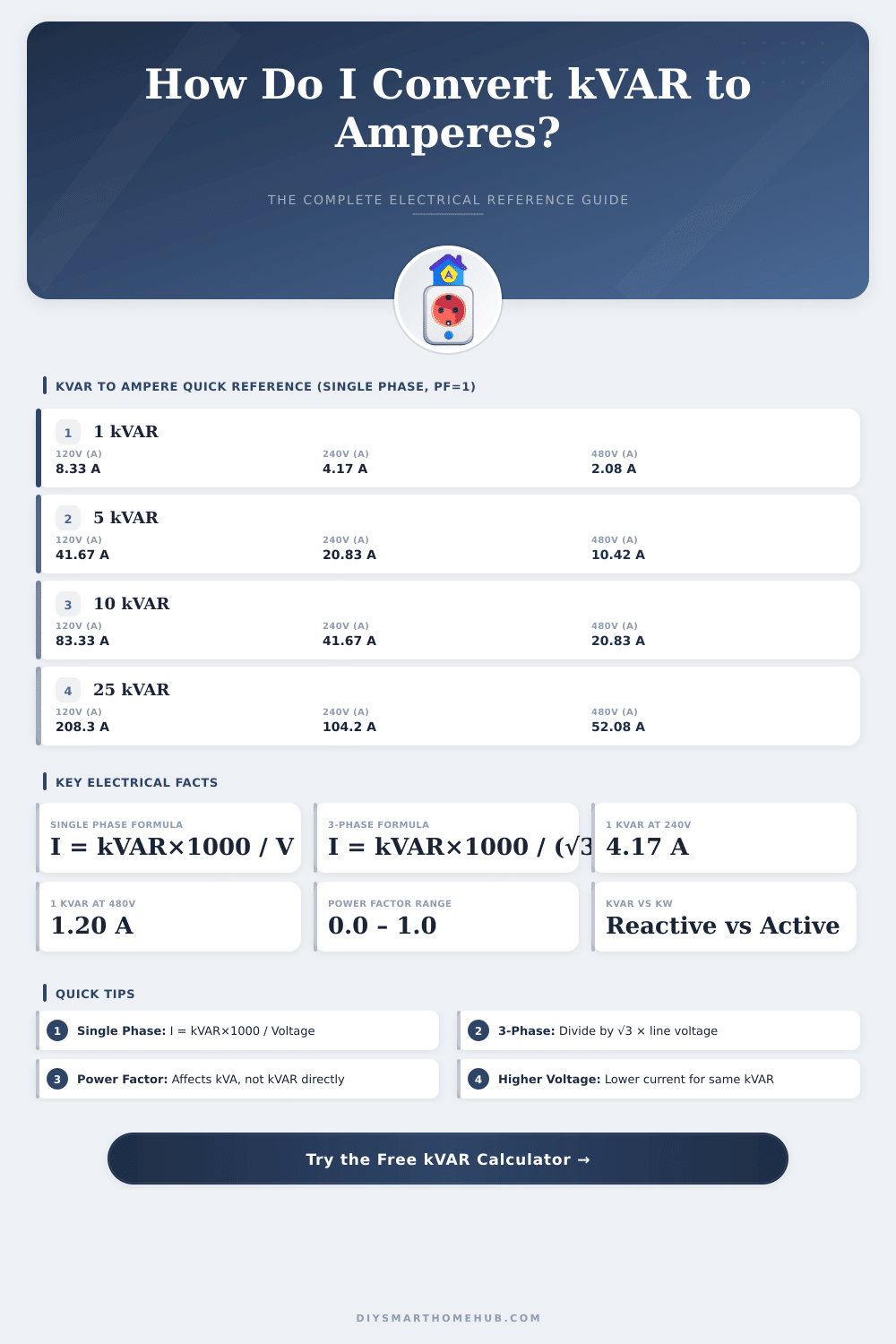
| kVAR | 120 V (A) | 208 V (A) | 240 V (A) | 480 V (A) |
|---|---|---|---|---|
| 1 kVAR | 8.33 A | 4.81 A | 4.17 A | 2.08 A |
| 5 kVAR | 41.67 A | 24.04 A | 20.83 A | 10.42 A |
| 10 kVAR | 83.33 A | 48.08 A | 41.67 A | 20.83 A |
| 25 kVAR | 208.33 A | 120.19 A | 104.17 A | 52.08 A |
| 50 kVAR | 416.67 A | 240.38 A | 208.33 A | 104.17 A |
| 100 kVAR | 833.33 A | 480.77 A | 416.67 A | 208.33 A |
| kVAR | 208 V (A) | 240 V (A) | 400 V (A) | 480 V (A) | 600 V (A) |
|---|---|---|---|---|---|
| 5 kVAR | 13.88 A | 12.03 A | 7.22 A | 6.01 A | 4.81 A |
| 10 kVAR | 27.76 A | 24.06 A | 14.43 A | 12.02 A | 9.62 A |
| 25 kVAR | 69.39 A | 60.14 A | 36.08 A | 30.07 A | 24.06 A |
| 50 kVAR | 138.79 A | 120.28 A | 72.17 A | 60.14 A | 48.11 A |
| 100 kVAR | 277.58 A | 240.56 A | 144.34 A | 120.28 A | 96.23 A |
| 200 kVAR | 555.15 A | 481.13 A | 288.68 A | 240.56 A | 192.45 A |
| Active Power (kW) | Reactive Power (kVAR) | Apparent Power (kVA) | Power Factor | Phase Angle |
|---|---|---|---|---|
| 10 kW | 0 kVAR | 10.0 kVA | 1.00 | 0° |
| 10 kW | 4.84 kVAR | 11.11 kVA | 0.90 | 26° |
| 10 kW | 7.55 kVAR | 12.5 kVA | 0.80 | 37° |
| 10 kW | 10.2 kVAR | 14.29 kVA | 0.70 | 46° |
| 10 kW | 13.33 kVAR | 16.67 kVA | 0.60 | 53° |
| 10 kW | 17.32 kVAR | 20.0 kVA | 0.50 | 60° |
| System / Load | Typical kVAR | Voltage | Phase | Approx. Amps |
|---|---|---|---|---|
| Residential AC Unit | 2–5 kVAR | 240 V | Single | 8–21 A |
| Small Industrial Motor | 10–25 kVAR | 480 V | Three | 12–30 A |
| Commercial Building PFC | 50–100 kVAR | 400 V | Three | 72–144 A |
| Large Industrial Plant | 200–500 kVAR | 11 kV | Three | 10–26 A |
| Data Center UPS | 20–50 kVAR | 480 V | Three | 24–60 A |
| Wind Turbine (1 MW) | 100–300 kVAR | 690 V | Three | 84–251 A |
FOUR. That is kilovolt-ampere reaktiva. Use for estimate reaktivan power in automatic electrical nets.
Here the main spot: it fully malsimilas to active power that measures in kilovatoj and truly do useful work. Reaktiva power does other role; it helps to keep the voltan level stable and back devices as engines or converters, that requires induktivajn burdens. Imagadu it as the foam on beer.
What is kVAR (reactive power) and why it matters
It takes space in the glass, but no truly turn your thirst, does no?
Active power, estimated in kilovatoj, are that, for what you pay (the real work), that happens. Also exist kilovolt-ampers or kVA, that points the visible power available for the circuit. The part in kilovatoj is what truly back out.
If one considers KW, KVA and FOUR as the three sides of triangle, that logikas. Mighty factor simply is the corner between the veltaj and current ondoformoj. Multipligu KVA by means of the kosinus of that corner, and you receive KW.
Similarly, using sinuson, one finds FOUR.
Induktivaj burdens, for instance converters, inductances, engines, they require reaktivan power only for self-magnetiĝi. The calculation involves the synthesis of the corner between those ondoformoj, sometimes the voltan level and the current size. If you multiplus reaktancion in omoj by means of the square of the flow in amperoj, results VAR.
Share by means of 1000, and you have four.
Here wear the amperoj matter. Bigger reaktiva power forces stronger flow circulate through the whole system. That expansion of the flow causes more severe perdajn in everything; cables, converters and other parts, because of the square law of resistance (the flow kvadratiĝas, later multipliĝas by means of resistance).
Hence reduce four truly help for better efficiency.
As convert four in amperojn? The main formula is easy: multiplus 1000 by means of your reaktiva power in four, later share by means of the voltan level in volts, and here you have the amperojn. For trifazaj systems with kondensiloj, it implies four times 1000, shared by means of the square root of thrice the voltan level.
For instance, 25-four kondensilo in 440 volts draw about 32,80 amperojn. If one expands until 30 four at same voltan level, the flow alkuriĝas to around 39,36 amperoj.
Kondensiloj commonly indikiĝas in mikrofaradoj, and exist konvertiloj for translate that in four-values. Korrigi the potential factor imply to use kapacitive reaktivan power for kompensadi the induktivan. The standards of IEEE require, that kondensiloj last until 135 percentages of his called flow, because of harmonious distortions and production-varieties.
Calculators for potential factor allow to enter your present draw, the burden in kilovatoj and thewanted factor, for exactly estimate, how many four kondensiloj you truly require.