🏠 Insulation Calculator
Calculate how much insulation you need for any room, attic, wall, or floor area
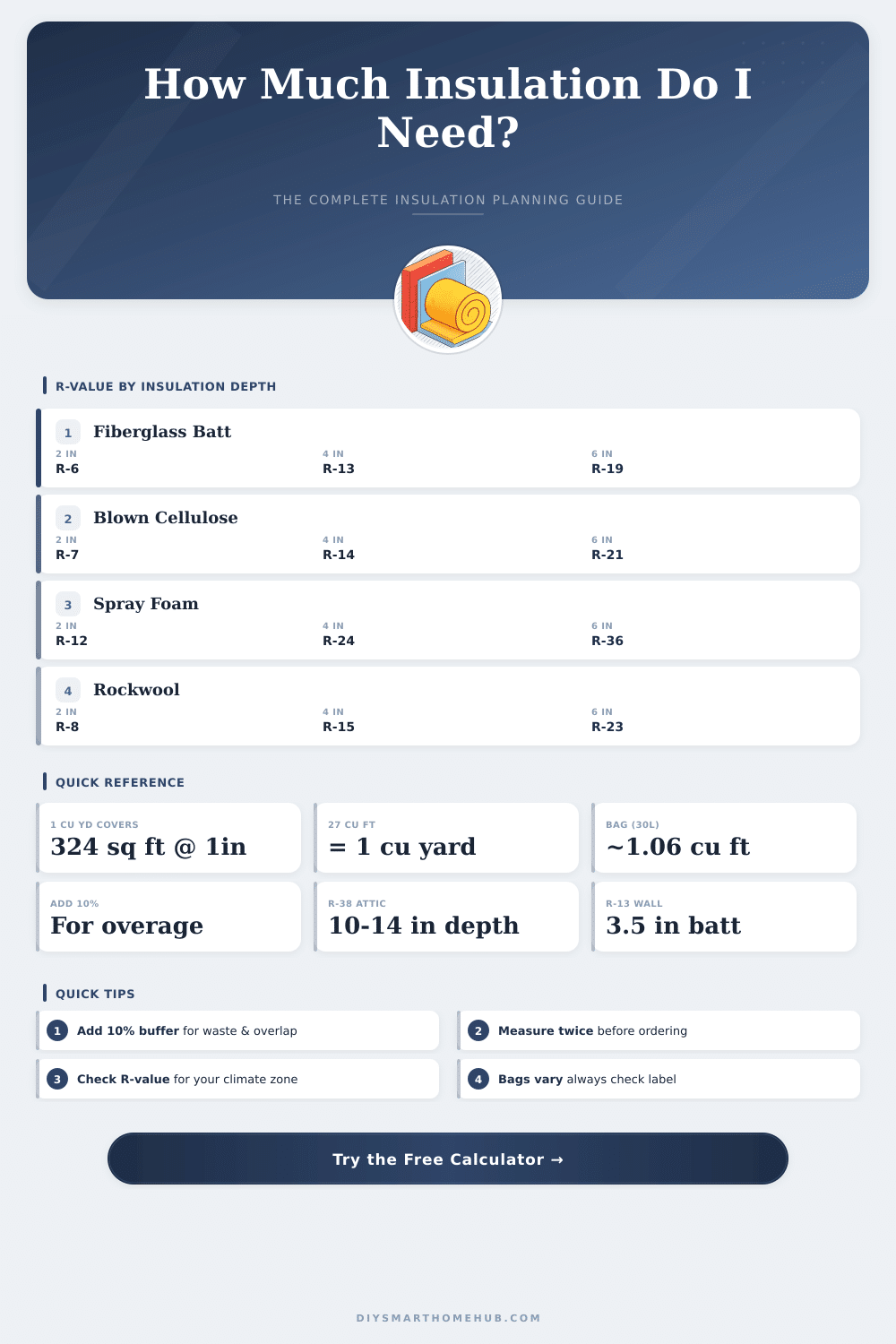
| Depth | Depth (cm) | Sq Ft per Cu Yd | Sq M per Cu M |
|---|---|---|---|
| 1 in | 2.5 cm | 324 sq ft | 30.1 m² |
| 2 in | 5 cm | 162 sq ft | 15.1 m² |
| 3 in | 7.6 cm | 108 sq ft | 10.0 m² |
| 3.5 in | 8.9 cm | 92.6 sq ft | 8.6 m² |
| 4 in | 10.2 cm | 81 sq ft | 7.5 m² |
| 5.5 in | 14 cm | 58.9 sq ft | 5.5 m² |
| 6 in | 15.2 cm | 54 sq ft | 5.0 m² |
| 10 in | 25.4 cm | 32.4 sq ft | 3.0 m² |
| 12 in | 30.5 cm | 27 sq ft | 2.5 m² |
| Bag Size | Volume (cu ft) | Bags per Cu Yd | Coverage @ 3.5 in |
|---|---|---|---|
| Small (30L) | ~1.06 cu ft | ~25.5 bags | ~3.6 sq ft |
| 2 cu ft bag | 2.0 cu ft | 13.5 bags | ~6.9 sq ft |
| 3 cu ft bag | 3.0 cu ft | 9 bags | ~10.3 sq ft |
| 4 cu ft bag | 4.0 cu ft | 6.75 bags | ~13.7 sq ft |
| Bulk (1 cu yd) | 27 cu ft | 1 yard | ~92.6 sq ft |
| Project | Area (sq ft) | Cu Yards Needed | Bags (2 cu ft) |
|---|---|---|---|
| Small Bedroom (10x12) | 120 sq ft | 1.6 cu yds | 22 bags |
| Standard Bedroom (12x14) | 168 sq ft | 2.3 cu yds | 31 bags |
| Living Room (16x20) | 320 sq ft | 4.3 cu yds | 59 bags |
| Open Plan (20x30) | 600 sq ft | 8.1 cu yds | 110 bags |
| Small Attic (30x40) | 1,200 sq ft | 16.2 cu yds | 219 bags |
| Large Attic (40x60) | 2,400 sq ft | 32.4 cu yds | 437 bags |
| Garage (20x20) | 400 sq ft | 5.4 cu yds | 73 bags |
| Apartment (800 sq ft) | 800 sq ft | 10.8 cu yds | 146 bags |
At the nucleus, Insulation almost only holds the air. All those materials for Insulation simply ban that air move freely and spread heat by means of flow. The foamy kind does that, sharing the air in thousands of little plastic bubbles.
Whether dealing about fiberglass or something entirely different, the basic idea stays same: form air pockets, that slow the warm flows from one spot to the another.
How Insulation Works and the Main Types
For truly understand, how Insulation works, you first need to know about warm flow. Heat spreads by three main modes: passing, flowing and radiation. Passing happen when heat travels through the material itself.
Imagine a spoon in a warm cup of coffee, the heat goes along the handle down until your hand.
Protective Insulation is the most common and easy to find. It comes as rolls or batts from flexible fibers, commonly fiberglass. One also finds them from mineral wool, plastic fibers or natural materials like cotton and sheep wool.
In RVs fiberglass is commonly chosen because of low cost and R-value of around 3.5 to 4 each inch. Those rolls form from fine glass fibers, heavily packed. On the other hand, many folks reckon, that fiberglass is not ideal, it can grow mold and lose part of its R-value, when temperatures change a lot.
Rigid foam Insulation has the form of boards, available in different thicknesses. The advantage is, that one can cut it for any space. To install, one sticks the sheets in the walls and sets them to the frames, so that air cannot cross.
Most RVs do not have rigid foam already installed, so you either take apart the walls for a DIY job or call a specialist.
Spray foam Insulation reaches between R-4 and R-6 each inch, depending on the kind, that you choose. Similar output give Insulation boards. During Insulation of home walls, using both types usually works best.
Like this one can reach around R-50 in walls, using rigid foam outside and spray foam inside.
Warm air glides upward, so sealing above the attic beams gives the biggest benefit in winter. In summer on the other hand, the attic becomes an oven, hence adding Insulation hear is most useful, when it is warm outside. Installing V-shaped baffles is worth the work, to pile up thick Insulation without touching the roof itself.
Rigid foam boards with foil skin, like XPS or EPS, seem popular, because they work well and last more long. Reflectix bubble Insulation is another good option, it more easily installs and helps to control moisture. Both need some kind of water cover outside.
The small spaces, that they create, hold heat and reduce problems with moisture.
Insulation of a home depends on costs against benefits. There are trade-offs, that are worth thinking about, for example moisture causes and needs forventilation, while you decide, where to lay Insulation and vapor barriers.