🏠 Home Automation Planner
Estimate devices, zones, and system capacity for any smart home setup
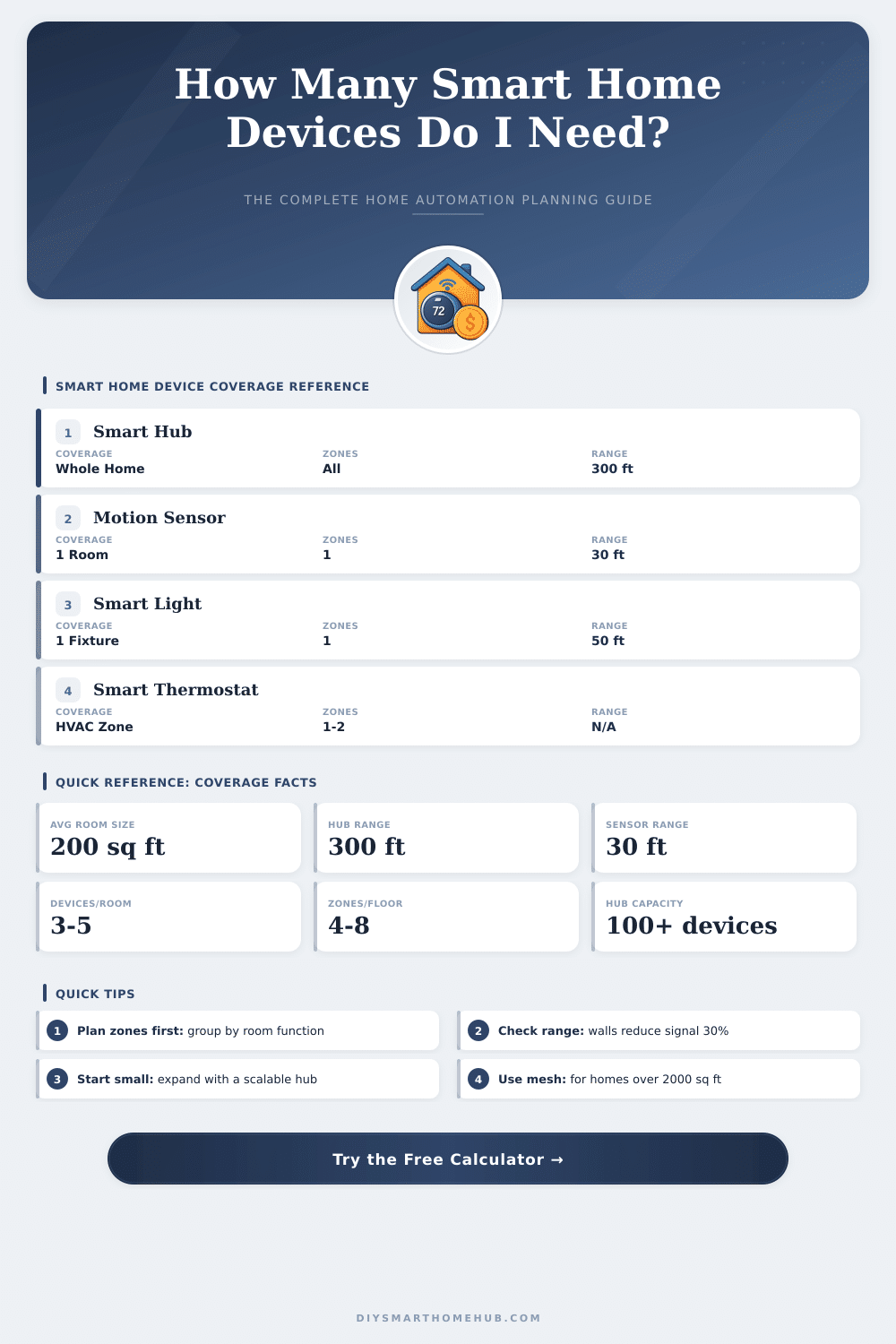
| Device Type | Per Room (avg) | Protocol | Range | Hub Required |
|---|---|---|---|---|
| Smart Light / Dimmer | 2–4 bulbs | Zigbee / Z-Wave / Wi-Fi | 50 ft (15 m) | Optional |
| Motion Sensor | 1–2 | Zigbee / Z-Wave | 30 ft (9 m) | Yes (Zigbee/Z-Wave) |
| Smart Switch | 1–3 | Z-Wave / Wi-Fi | 50 ft (15 m) | Optional |
| Smart Thermostat | 1 per HVAC zone | Wi-Fi / Z-Wave | N/A (wired) | Optional |
| Smart Lock | 1 per door | Z-Wave / Zigbee | 30 ft (9 m) | Yes (Z-Wave) |
| Security Camera | 1–2 | Wi-Fi | 150 ft (46 m) | Optional |
| Smart Plug | 2–4 | Zigbee / Wi-Fi | 50 ft (15 m) | Optional |
| Smart Hub | 1 per 1,500 sq ft | Multi-protocol | 300 ft (91 m) | N/A (is hub) |
| Home Size | Home Size (m²) | Recommended Zones | Min Devices | Hubs Needed |
|---|---|---|---|---|
| Up to 500 sq ft | 46 m² | 1–2 | 5–10 | 1 |
| 500–1,000 sq ft | 46–93 m² | 2–4 | 10–20 | 1 |
| 1,000–1,500 sq ft | 93–139 m² | 4–6 | 20–35 | 1 |
| 1,500–2,500 sq ft | 139–232 m² | 6–8 | 35–60 | 1–2 |
| 2,500–4,000 sq ft | 232–372 m² | 8–12 | 60–100 | 2 |
| 4,000+ sq ft | 372+ m² | 12+ | 100+ | 2–3 |
| Hub Type | Max Devices | Protocols | Ideal Home Size |
|---|---|---|---|
| Basic Wi-Fi Hub | 32 devices | Wi-Fi | Up to 1,000 sq ft |
| Zigbee Coordinator | 50–100 devices | Zigbee | Up to 2,000 sq ft |
| Z-Wave Controller | 232 devices | Z-Wave | Any size |
| Multi-Protocol Hub | 100–300 devices | Wi-Fi, Zigbee, Z-Wave | Any size |
| Enterprise Controller | 500+ devices | All protocols | 4,000+ sq ft |
| Project Type | Area | Zones | Est. Devices | Hubs |
|---|---|---|---|---|
| Studio Apartment | 500 sq ft / 46 m² | 1–2 | 8–12 | 1 |
| 2-Bed Apartment | 900 sq ft / 84 m² | 3–4 | 15–25 | 1 |
| 3-Bed House | 1,500 sq ft / 139 m² | 5–6 | 25–45 | 1 |
| Large Family Home | 2,500 sq ft / 232 m² | 7–9 | 45–75 | 1–2 |
| Luxury Home | 3,500 sq ft / 325 m² | 10–14 | 75–120 | 2 |
| Estate / Villa | 5,000 sq ft / 465 m² | 15+ | 120+ | 2–3 |
Installing a smart house can cost from a few hundred dollars up to more than a hundred thousand. The typical cost is around 839 dollars where most folks spend between 201 and 1 584 dollars. Some installations reach 3 000 dollars or more.
For a fully automated home with four bedrooms and three bathrooms, the price could reach up to 15 000 dollars.
How Much Does a Smart Home Cost?
Another view: the total cost for home automation ranges between 2 000 and 7 000 dollars. Many homeowners spend around 5 500 dollars for installing a smart speaker with central unit, automatic lights, door locks and thermostat for three rooms. That same range shows the national average between 2 000 and 6 000 dollars, where 4 000 dollars are usual for a smart security system, speaker, thermostat and doorbell.
On the cheap end, a simple system can cost only 65 dollars. Home-made solutions start around 250 dollars. A full system with home automation averages around 700 dollars, plus professional installation of 120 to 600 dollars.
Even so professionally installed whole-home systems can go up to 4 500 dollars.
Custom installations are a whole other thing. Most start at around 10 000 dollars and quickly climb too 100 000 dollars, depending on the size of the house and the wanted amount of automation. For a home of 5 000 square feet, worth more than 2 millions of dollars in South Florida, a whole-home automation plan starts at at least 100 000 dollars, and that does not include even the lighting.
Some high-end installers accept only big tasks with a minimal price of 50 000 dollars, requiring 5 000 dollars only for preparing the bid.
Individual devices cost less on their own. A smart central unit costs from 60 to 300 dollars. A smart thermostat averages 120 to 300 dollars each unit.
Updating a whole HVAC system for smart control costs between 2 000 and 4 000 dollars. Smoke detectors like that of Nest cost around 120 dollars each room. Smart bulbs or switches cost around 30 dollarseach.
Older houses commonly need big electrical updates and extra wireless access points, which strongly raises the cost. Houses built with smart technology in mind automate much more easily. Basic standalone devices like smart thermostats cost less than fully tied systems, where everything passes through one central unit.
Starting small is a good strategy. Smart plugs and lamps are cheap and easy to install. They help you feel the automation without big upfront cost.
Some smart devices, like certain cameras and smart lights, do not have recurring fees, which helps to keep long-term costs low. Home automation software can run on a server for only 35 dollars, with sensors and switches available at around 15 dollars each. One solution automated half of the rooms for just 220 dollars, with payback time under a year.