⚡ Electricity Usage Calculator
Calculate daily, monthly & annual kWh consumption for any appliance or your whole home
| Appliance | Typical Watts | Avg Hours/Day | kWh/Month | kWh/Year |
|---|---|---|---|---|
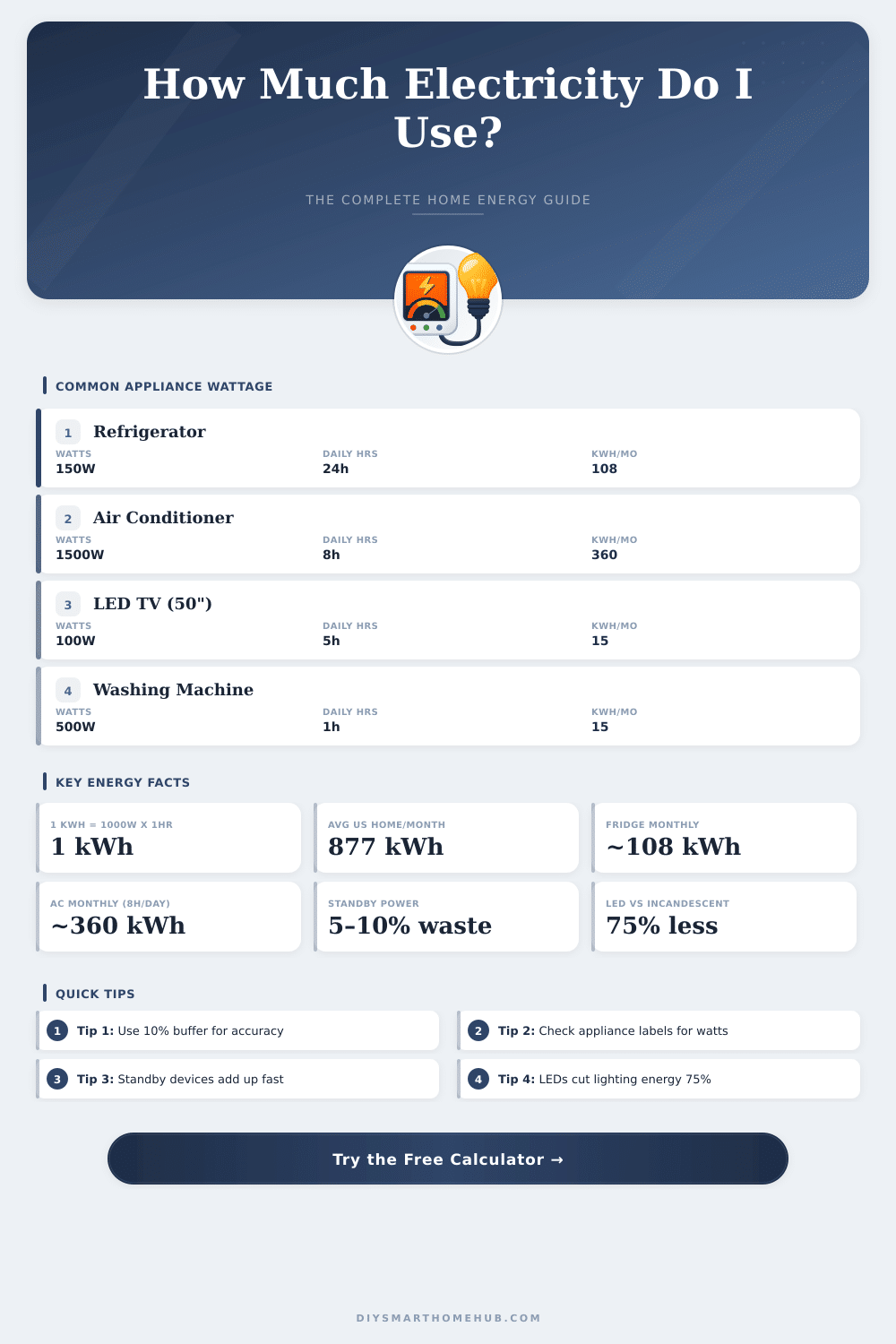
| Refrigerator (modern) | 150 W | 24 | 108 | 1,314 |
| Refrigerator (old model) | 400 W | 24 | 288 | 3,504 |
| Central Air Conditioner | 1,500 W | 8 | 360 | 4,380 |
| Window A/C Unit | 900 W | 8 | 216 | 2,628 |
| Electric Space Heater | 1,500 W | 6 | 270 | 3,285 |
| Electric Water Heater | 4,000 W | 3 | 360 | 4,380 |
| Electric Clothes Dryer | 5,500 W | 1 | 165 | 2,008 |
| Washing Machine | 500 W | 1 | 15 | 183 |
| Dishwasher | 1,200 W | 1 | 36 | 438 |
| Microwave | 800 W | 0.5 | 12 | 146 |
| Electric Range (oven) | 2,000 W | 1 | 60 | 730 |
| 50" LED Television | 100 W | 5 | 15 | 183 |
| Desktop Computer | 200 W | 8 | 48 | 584 |
| Laptop Computer | 50 W | 8 | 12 | 146 |
| LED Light Bulb (single) | 10 W | 5 | 1.5 | 18 |
| Incandescent Bulb (single) | 60 W | 5 | 9 | 110 |
| Gaming Console | 150 W | 3 | 13.5 | 164 |
| Wi-Fi Router | 10 W | 24 | 7.2 | 88 |
| Phone Charger | 5 W | 4 | 0.6 | 7.3 |
| Pool Pump | 1,500 W | 6 | 270 | 3,285 |
| Calculation | Formula | Example | Result |
|---|---|---|---|
| Daily kWh per device | (Watts × Hours) / 1,000 | 100W × 5h / 1000 | 0.5 kWh/day |
| Monthly kWh | Daily kWh × 30 | 0.5 × 30 | 15 kWh/mo |
| Annual kWh | Daily kWh × 365 | 0.5 × 365 | 182.5 kWh/yr |
| kWh to MJ (metric) | kWh × 3.6 | 10 kWh × 3.6 | 36 MJ |
| kWh to BTU | kWh × 3,412 | 10 kWh × 3412 | 34,120 BTU |
| kW to Watts | kW × 1,000 | 1.5 kW × 1000 | 1,500 W |
| Category | % of Home Use | Avg kWh/Year | Avg kWh/Month |
|---|---|---|---|
| Space Cooling (A/C) | ~17% | 1,375 | 115 |
| Space Heating (electric) | ~15% | 1,213 | 101 |
| Water Heating (electric) | ~14% | 1,133 | 94 |
| Washer & Dryer | ~13% | 1,051 | 88 |
| Lighting | ~9% | 728 | 61 |
| Refrigerator | ~7% | 566 | 47 |
| Electronics & TV | ~6% | 485 | 40 |
| Other / Miscellaneous | ~19% | 1,537 | 128 |
| Total US Average | 100% | 10,500 | 875 |
| Device | Standby Watts | kWh/Year (standby) | Note |
|---|---|---|---|
| Cable / Satellite Box | 15–30 W | 131–263 | Often always on |
| Gaming Console (off) | 1–8 W | 9–70 | Varies by model |
| Smart TV (standby) | 0.5–3 W | 4–26 | Quick-start mode |
| Microwave (display) | 2–5 W | 18–44 | Clock/display |
| Desktop PC (sleep) | 1–6 W | 9–53 | Sleep vs hibernate |
| Phone Charger (idle) | 0.1–0.5 W | 1–4 | Plugged in, no phone |
| Wi-Fi Router | 5–20 W | 44–175 | Always on |
electricity is used for a lot of different things. It can light, heat, cool, move the refrigerator, power tools and machines, and even back public transport. In United States, the whole amount of used electricity reached 4.10 trillion kilowatt-hours in 2024.
Here the biggest record until now that passes by 14 times what happened in 1950. Around the world, the use of electricity arrived to 24 398 terawatt-hours in 2022, so about threefold more than before.
How Homes Use Electricity and How to Save Energy
Home users in United States used average 10 791 kilowatt-hours of electricity in 2022. The year before, in 2021, that was around 10 632 kilowatt-hours per home, or almost 886 each month. Even so, the amount of electricity ranges a lot between different homes.
Home use makes up around 38 percent of the whole need for electricity in the land.
Air conditioning, heating space and warm water is the main cause of electricity in houses. Those three areas together involve more than 43.5 percent of the energy. Devices and electronics make up about 23 percent of average bills for electricity.
Machines for washing, refrigerators, freezers and electrical cookers use only a small bit of energy. Phones, computers, televisions and WiFi routers are not that bad usually. Lighting and charging of phones or tablets most commonly require the least.
A fan that spins in high speed requires more energy than one in low. When the power in watts is not written on the device, one can estimate it by measuring the flow in amps, that one multiplies by the voltage, that the device receives.
High bills for electricity commonly come from both visible and secret reasons. It does not matter only how much energy one uses, but how one uses it. The more gaps in the use, the more the prices can grow.
Sometimes the bill rises, and the main question is not weather one used more electricity, but what changed. Maybe a fixed-price contract ended, one reached hours of peak, the rate was adjusted, or a new price appeared.
Smart home devices help by automating energy-saving modes and showing views about usage patterns. Control of devices from away is another good benefit. Use lights that save energy, like LEDs or CFL tubes, to lower the use of electricity, because they need much less energy for the same brightness.
LEDs use up to 80 percent less energy and last much longer than old bulbs. Turn off televisions, lamps, computers, toasters and other devices, when no one needs them, also helps to lower the use. Compare labels about energy, when one buys new devices, is a clear good idea.
Refrigerators for travel vehicles, for instance, are very wasteful and can use four to seven kilowatt-hours in a day. Stuffed filters in dryers or air conditioners lower the efficiency and raise the use of electricity. Even an extra person inthe home causes more openings of refrigerator, more showers, more washing and more times, when one leaves doors open.