⚡ Demand Response Calculator
Estimate your facility’s demand response load reduction, curtailment capacity, and peak demand participation potential.
| Program Type | Notice Period | Event Duration | Typical Events/Yr | Curtailment Required |
|---|---|---|---|---|
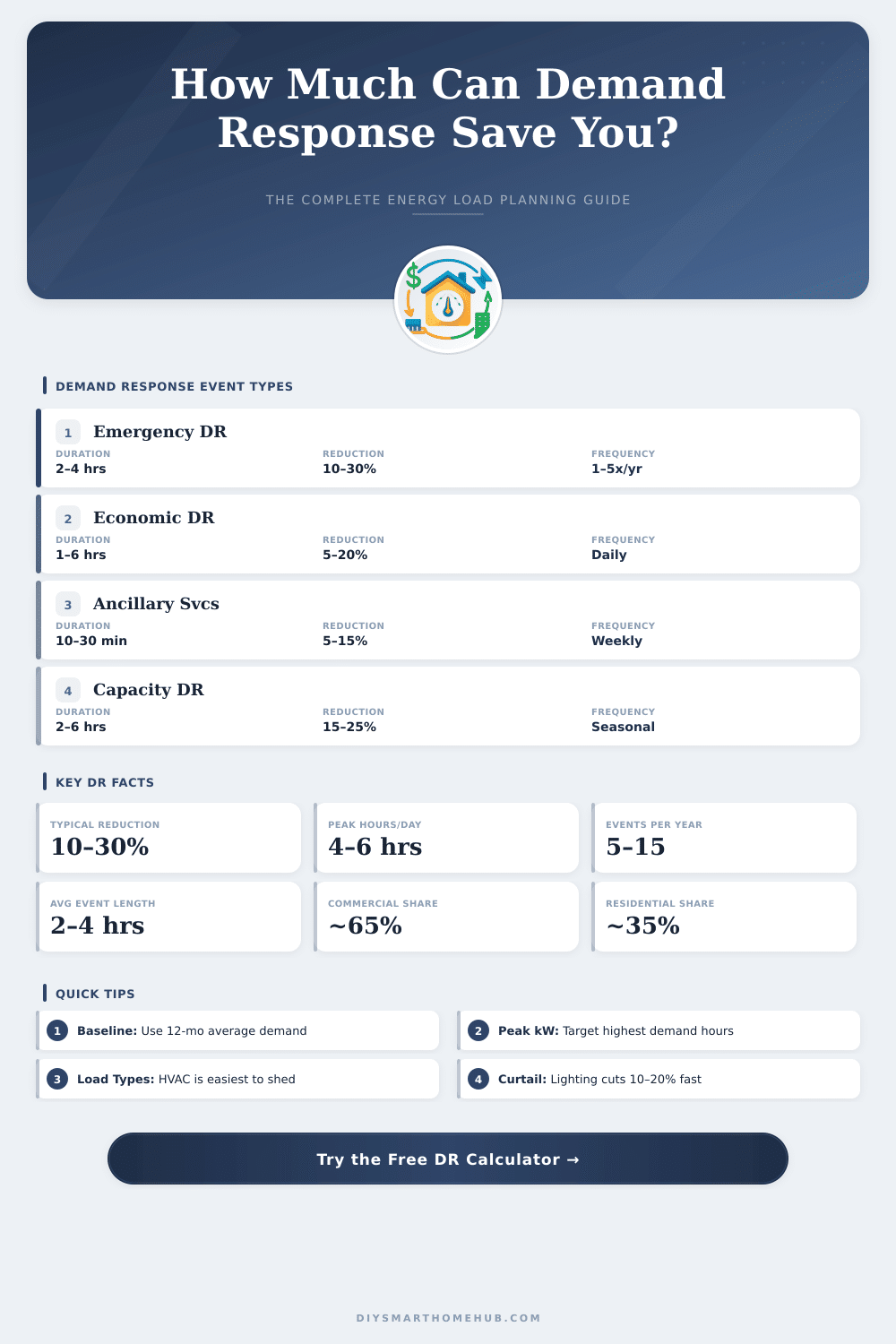
| Emergency DR | 10–30 min | 2–4 hrs | 1–5 | 10–30% |
| Economic / Price-Based | Day-ahead | 1–6 hrs | 5–30 | 5–20% |
| Capacity DR | Day-ahead | 2–6 hrs | 5–15 | 15–25% |
| Ancillary Services | Minutes | 10–30 min | 10–50 | 5–15% |
| Voluntary Curtailment | Day-ahead | 1–8 hrs | 1–20 | 5–30% |
| Building Type | Peak Demand Range | Curtailment Potential | Primary DR Load | kWh / Event (avg) |
|---|---|---|---|---|
| Small Office | 30–100 kW | 10–20% | HVAC, Lighting | 30–150 kWh |
| Large Office | 100–500 kW | 10–20% | HVAC, Lighting | 150–800 kWh |
| Retail Store | 50–300 kW | 10–25% | HVAC, Lighting, Refrig. | 100–600 kWh |
| Warehouse | 100–500 kW | 15–30% | Lighting, HVAC | 200–900 kWh |
| Hospital | 300–2,000 kW | 5–10% | HVAC, Lighting | 200–1,200 kWh |
| Hotel | 150–800 kW | 10–20% | HVAC, Lighting | 200–960 kWh |
| Data Center | 500–5,000 kW | 5–15% | IT Load, Cooling | 500–4,500 kWh |
| Manufacturing | 500–10,000 kW | 15–40% | Process, Motors | 1,000–24,000 kWh |
| Smart Home | 5–20 kW | 15–50% | HVAC, EV, Water Htr | 10–60 kWh |
| University | 300–2,000 kW | 10–25% | HVAC, Lighting | 500–3,000 kWh |
| Peak Demand | 10% Cut | 15% Cut | 20% Cut | 30% Cut |
|---|---|---|---|---|
| 50 kW (per 2hr event) | 10 kWh | 15 kWh | 20 kWh | 30 kWh |
| 100 kW | 20 kWh | 30 kWh | 40 kWh | 60 kWh |
| 200 kW | 40 kWh | 60 kWh | 80 kWh | 120 kWh |
| 500 kW | 100 kWh | 150 kWh | 200 kWh | 300 kWh |
| 1,000 kW | 200 kWh | 300 kWh | 400 kWh | 600 kWh |
Postula answer turns around the task of keep the electrical supply and the demand in balance on the mighty net. Even so the precise sense of that adjusts according to that personality listen. In 2010, the official explanation stressed the lowering of demand for cut the highest use or escape emergency in the system.
Later, until 2016, this explanation broadened a lot, for include even very big clients that can help the net when it struggles against problems as congestion or increasing prices.
What is demand response
In the core, postula answer is made up of short, sudden decline of the electricity-use at clients. Usually it happens because of weakness of the net or because of sudden rise of big prices. Like this it backs the operators of the net and escape absences of electricity or blackouts, that could create havoc for businesses and everyday folks.
Balance supply and demand are important, because blackouts and brown dimming happen when they fall out of sync.
Two mainstream modes help postula answer operate in practice. One of them are programs based on prices (sometimes called involved postula answer), where signals of prices and changes in ratings urge clients alter the time of their electricity-uses. The second type is programs based on incentive or explicit postula answer, where clients recieve money so that they move their consumption according to the plan.
Some corporations now urge domestic clients to prices according to time of usage, where the prices jump during occasions of postula answer. For instance, the electricity price could reach almost 0.95 dollars per kilowatt-hour during such event, compared to the usual 0.07 dollars. Such change certainly forces folks think, weather they genuinely need to use the dishwasher or the washing machine fairly then.
Systems of heating ventilation and cooling, together with the charging of electrical autos, give the biggest possibilities for saving by means of postula answer. Also water heaters designed for these targets deserve attention. They join in programs and pause the warming for a bit of time during the highest hours.
Currently many corporations offer devices that automatically turn water heaters when the demand reaches peak. According to the needs of the net, such occasions can last from only some minutes until several hours.
Good sample comes from New York, where both distribution corporations and the operator of the big system organise programs that allow clients to lower their electricity-use in peak moments. This help stops overloading, reduce spending amounts and escape expensive improvements of the infrastructure. In Texas, ERCOT created products for postula answer, by means of that clients can enter directly in markets or freely turn use according to signals of big prices.
Big spot for note: the net is built for the highest demand, so it usually works at only half of its skill. Lower the demand for meet the available supply help that the costs for everything stay low. Postula answer becomes always more important for the mighty system of the Northwest, and sincerely, its possibilities for the future could beeven bigger than that, what already happened.