⚡ DC Ampere to AC Ampere Calculator
Convert DC current to AC current using power, voltage, efficiency & power factor
Resistive Load
Most Inverters
HVAC Units
Induction Motor
Older Equipment
Large Motors
Premium Systems
3-Phase Calc
| DC Voltage | DC Amps | DC Power (W) | AC Amps @ 120V | AC Amps @ 230V | AC Amps @ 240V |
|---|---|---|---|---|---|
| 12V | 10A | 120W | 1.11A | 0.58A | 0.56A |
| 12V | 50A | 600W | 5.56A | 2.90A | 2.78A |
| 12V | 100A | 1200W | 11.11A | 5.80A | 5.56A |
| 24V | 50A | 1200W | 11.11A | 5.80A | 5.56A |
| 24V | 100A | 2400W | 22.22A | 11.59A | 11.11A |
| 48V | 50A | 2400W | 22.22A | 11.59A | 11.11A |
| 48V | 100A | 4800W | 44.44A | 23.19A | 22.22A |
| 120V | 50A | 6000W | 55.56A | 28.99A | 27.78A |
| 240V | 30A | 7200W | 66.67A | 34.78A | 33.33A |
| DC Power (W) | AC Amps @ 208V 3∅ | AC Amps @ 380V 3∅ | AC Amps @ 400V 3∅ | AC Amps @ 480V 3∅ |
|---|---|---|---|---|
| 1,000W | 3.07A | 1.68A | 1.60A | 1.33A |
| 2,000W | 6.15A | 3.36A | 3.19A | 2.66A |
| 5,000W | 15.37A | 8.40A | 7.98A | 6.65A |
| 10,000W | 30.74A | 16.81A | 15.95A | 13.30A |
| 20,000W | 61.47A | 33.61A | 31.91A | 26.60A |
| 50,000W | 153.68A | 84.03A | 79.77A | 66.49A |
| Efficiency | AC Power Out (W) | AC Amps @ 120V | AC Amps @ 240V | Power Loss (W) |
|---|---|---|---|---|
| 80% | 3,840W | 32.00A | 16.00A | 960W |
| 85% | 4,080W | 34.00A | 17.00A | 720W |
| 90% | 4,320W | 36.00A | 18.00A | 480W |
| 92% | 4,416W | 36.80A | 18.40A | 384W |
| 95% | 4,560W | 38.00A | 19.00A | 240W |
| 97% | 4,656W | 38.80A | 19.40A | 144W |
| Application | DC Voltage | Typical DC Amps | Typical Efficiency | Approx. AC Output |
|---|---|---|---|---|
| Car Battery Inverter | 12V | 83A | 85% | ~1000W |
| RV/Camper System | 12V–24V | 50–100A | 88–92% | 1000–2000W |
| Residential Solar | 48V | 40–80A | 93–96% | 2000–4000W |
| Golf Cart | 36–48V | 100–200A | 85–90% | 3000–9000W |
| UPS (Server Room) | 24–48V | 20–100A | 90–95% | 500–5000W |
| EV Charging Station | 400–800V | 50–200A | 95–98% | 20–160kW |
| Wind Turbine (Small) | 48–240V | 10–50A | 90–95% | 500–12000W |
| Telecom Power | –48V | 20–100A | 92–96% | 1000–5000W |
DC electricity flows only in one direction. AC, the other way around, means electricity that changes from positive to negative and back in a set time. Here the main difference between both.
Electrons of DC go simply one way on the other hand those of AC go forward and back, switching ways.
How DC and AC Are Different
Amps stay amps, whether DC or AC. Both show the amount of electrons passing a given place. The main difference is about the way.
However the tools for their rating differ, because one measures steady flow in one direction, while the other checks for electricity that quickly flips, around 50 or 60 times each second.
Steady electricity through a conductor makes a stable magnetic field. Alternating flow creates a field that chagnes according to time. That matters for certain machines and electrical nets.
In switches and breakers happens a real difference. Arcs of AC disappear on their own at the zero crossing. DC arcs stay almost the same and need much more work too stop.
Like this DC is truly harder to break. When a switch simply bears electricity without close or open net, similar to a relay or base, the rating for DC should match that of AC.
An important thing to know is, that the electricity from any source depends on the net itself. A supply of low voltage with very little resistance needs a big amount of electricity. A supply of 2 V with 0.1 ohm resistance needs 20 amps.
The same happens with AC. A supply of 2 V sine wave with the same resistance value draws 20 amps sine wave. So do not worry much about AC against DC or high against low voltage.
The actual function and need of the net decides, how much electricityindeed flows.
A machine only takes that, what the net needs according to Ohm’s law. Voltage can not simply turn into amps on its own. You need to know the resistance of the load.
Ohm’s law shows, that voltage matches electricity multiplied by resistance.
For a resistive load like a filament lamp there is no real difference between AC and DC amps. The wire warms the same and the light shines equally, either mode.
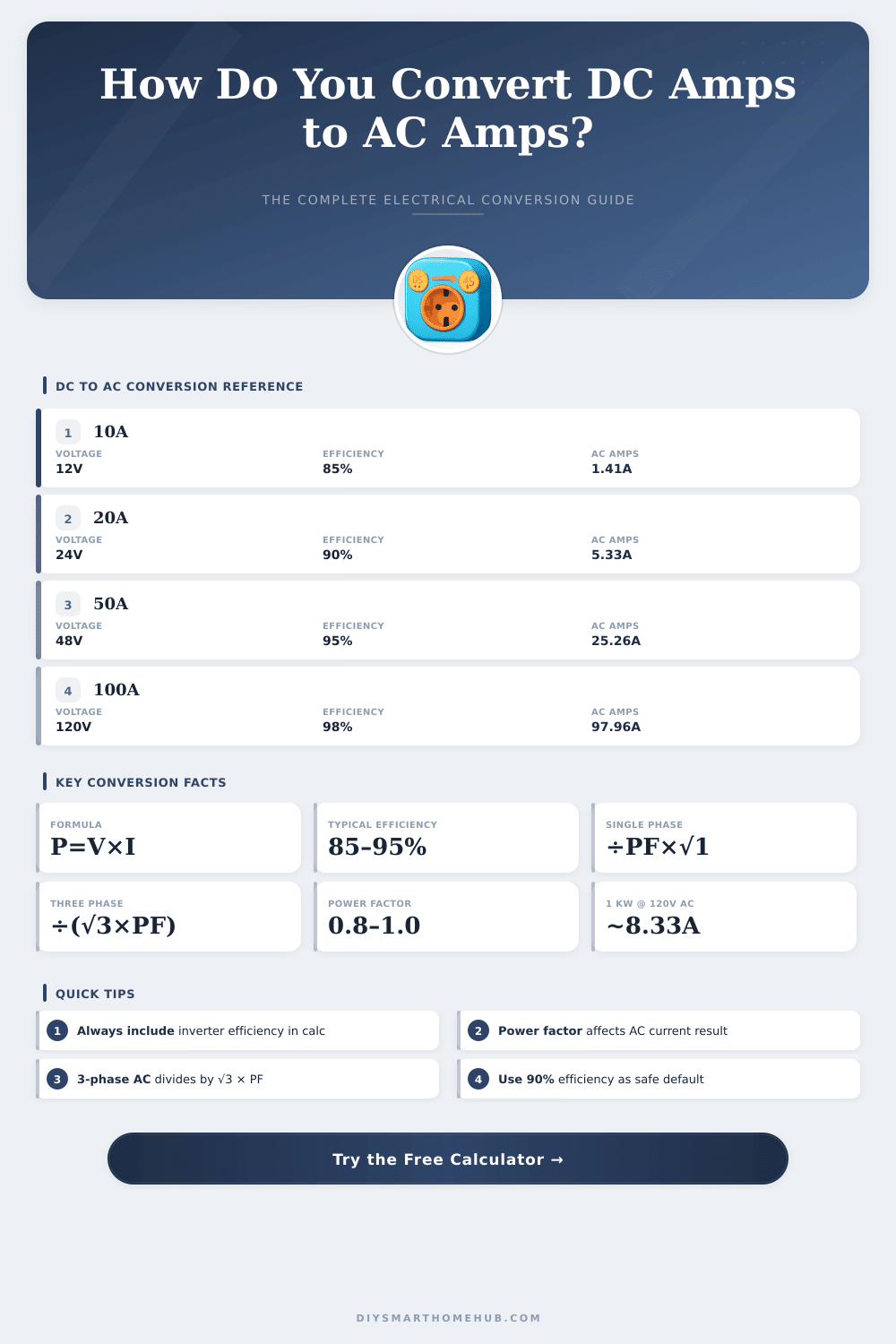
Conversion of power between AC and DC is easy. 120 volts at 10 amps AC matches 1200 watts. Same 1200 watts at 12 volts DC needs 100 amps.
At 12 volts DC the amps will be tenfold more than at 120 volts AC for the same power. Measuring DC amps with a clamp meter can be tricky. DC clamps are more rarely available and usually only in expensive models.
If the meter measures only AC amps, the DC reading will not be right. It could be off by 1 percent to 50 percent.