🚴 Cycling Wattage Calculator
Estimate your power output based on speed, weight, gradient, wind, and riding conditions
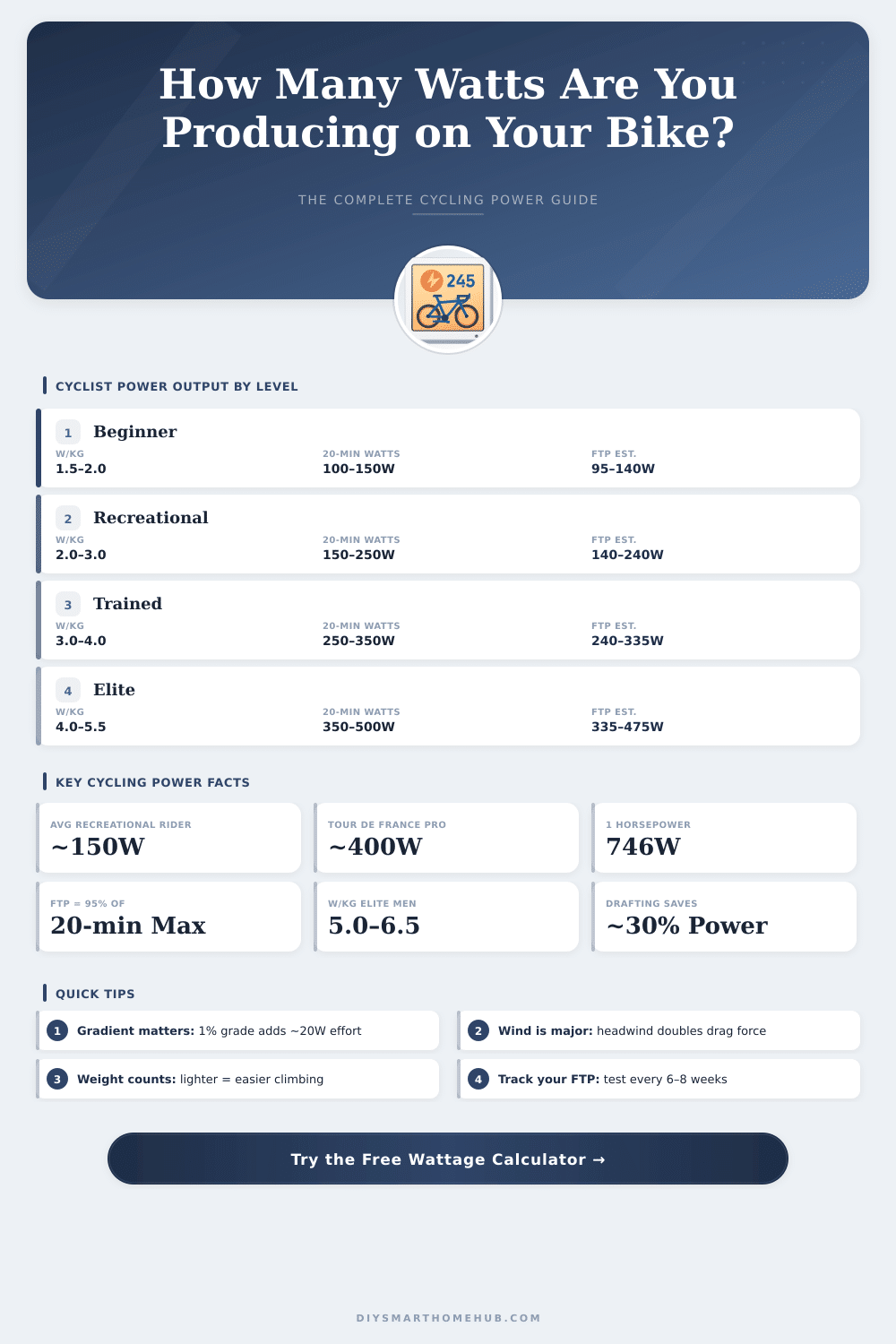
| Rider Category | W/kg (FTP) | Typical FTP (75kg) | 20-min Power Est. |
|---|---|---|---|
| Beginner (< 1 yr) | 1.5 – 2.0 | 113 – 150W | 119 – 158W |
| Recreational | 2.0 – 2.9 | 150 – 218W | 158 – 229W |
| Trained Club | 2.9 – 3.7 | 218 – 278W | 229 – 292W |
| Advanced Amateur | 3.7 – 4.4 | 278 – 330W | 292 – 347W |
| Semi-Pro / Cat 2 | 4.4 – 5.1 | 330 – 383W | 347 – 403W |
| Professional | 5.1 – 6.4 | 383 – 480W | 403 – 505W |
| Grand Tour Winner | 6.0 – 6.8 | 450 – 510W | 473 – 537W |
| Speed (mph) | Speed (km/h) | Power (Watts) | W/kg (75kg rider) |
|---|---|---|---|
| 10 mph | 16.1 km/h | ~50W | 0.67 W/kg |
| 12 mph | 19.3 km/h | ~75W | 1.00 W/kg |
| 15 mph | 24.1 km/h | ~120W | 1.60 W/kg |
| 18 mph | 29.0 km/h | ~185W | 2.47 W/kg |
| 20 mph | 32.2 km/h | ~250W | 3.33 W/kg |
| 23 mph | 37.0 km/h | ~360W | 4.80 W/kg |
| 25 mph | 40.2 km/h | ~450W | 6.00 W/kg |
| 28 mph | 45.1 km/h | ~600W | 8.00 W/kg |
| Gradient | Extra Power Needed | Total Est. Power | Perceived Effort |
|---|---|---|---|
| 0% (flat) | +0W | ~185W | Moderate |
| 2% | +65W | ~250W | Noticeable effort |
| 4% | +130W | ~315W | Hard |
| 6% | +195W | ~380W | Very Hard |
| 8% | +260W | ~445W | Extremely Hard |
| 10% | +325W | ~510W | Near Maximum |
| 12% | +390W | ~575W | Maximum Effort |
| Wind Condition | Wind Speed | Effect on Power | Total Est. Watts |
|---|---|---|---|
| Calm / No Wind | 0 mph | Baseline | ~185W |
| Light Tailwind | -10 mph | -40W savings | ~145W |
| Light Headwind | +10 mph | +75W extra | ~260W |
| Moderate Headwind | +15 mph | +130W extra | ~315W |
| Strong Headwind | +20 mph | +200W extra | ~385W |
| Drafting (Group) | varies | -25–30% savings | ~130W |
The power of cycling in watts relates to the energy that riders make during their pedal. A calculator for cycling power helps to show how the produced energy affects things like the speed, the position on the bike, the slope of hills and the kind of road. It is a helpful tool for anyone that likes to ride a bicycle.
The amount of watts depends on two main factors: how hard someone presses the pedals and how quickly they move them. Even so, not all energy from the legs of the rider reaches the wheels. The power at the wheels to beat the resistance matches the whole resisting force times the ground speed.
What Cycling Power in Watts Means
Goals for watts range for every person. There is no one number that works for all cyclists. A new rider commonly reaches an average between 75 and 100 watts during a one-hour session.
For a typical cyclist that puts average effort, around 2 watts per kilo is a usual level. Like this the weight of the body plays a big role when one estimates the potential values.
The link between power and weight is built into cycling, just like in running. It allows you to compare your energy output with that of a heavier or lighter rider, and estimate who truly makes more energy for their size. A well trained male cyclist usually can keep around 3.5 watts per kilo during one hour, while an average woman can reach about 3 watts per kilo.
Like this, a 75-kilo person with a 3.5-watt-per-kilo limit could keep around 262 watts.
Casual cyclists usually fall between 2.5 and 3.0 watts per kilo for their practical maximum power. Regular racers can reach 3.0 to 3.75. Local elites stay around 3.75 to 4.25, and anything over that enters the territory of domestic pros.
About 4 watts per kilo commonly is enough to arrive on the platform in many local races.
The link between speed and watts is funny. On flat terrain, a 70-kilo rider on a 9-kilo bicycle that goes at 19 km/h makes around 60 watts. To reach 24 km/h needs doubel the watts of 18 km/h.
The energy needed to climb quickly grows even more dramatically.
Riding behind another cyclist helps a lot. On a flat road, following someone can save around a third of the watts needed too keep the same speed. If the front rider gives 350 watts, the follower only needs around 231 watts.
Bradley Wiggins set the world record for men during one hour in 2015, covering 54.526 kilometers and making around 440 watts on average. That shows what top professional fitness looks like. Considering that 100 to 200 watts is the standard range for most folks, and those speeds are still very good compared to cars, cyclinggenuinely proves to be an efficient way to get far.