⚡ Conduit Size Calculator
Find the correct conduit trade size for your wires using NEC fill percentage rules
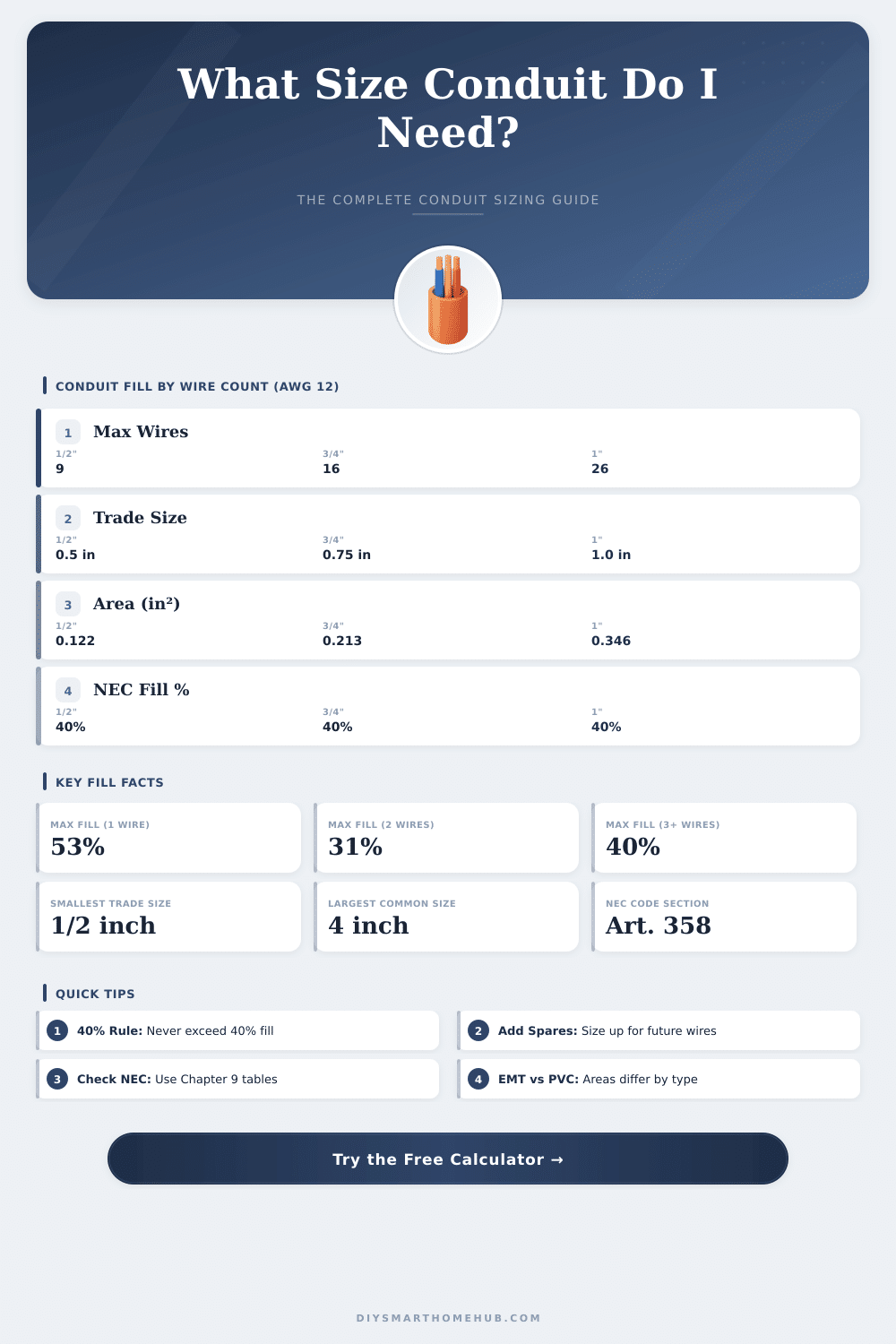
| Number of Conductors | Max Fill % | Rule | Notes |
|---|---|---|---|
| 1 conductor | 53% | Single wire | NEC 358.22 / Table 1 |
| 2 conductors | 31% | Two wires | NEC Chapter 9 |
| 3 or more | 40% | General rule | Most common scenario |
| Nipple (≤24 in) | 60% | Short nipple | NEC 310.15(B)(3)(a) |
| Wire Size (AWG/kcmil) | Area THWN (in²) | Area THHN (in²) | Area XHHW (in²) |
|---|---|---|---|
| #22 AWG | 0.0027 | 0.0021 | — |
| #20 AWG | 0.0033 | 0.0026 | — |
| #18 AWG | 0.0055 | 0.0042 | 0.0042 |
| #16 AWG | 0.0072 | 0.0054 | 0.0054 |
| #14 AWG | 0.0097 | 0.0097 | 0.0087 |
| #12 AWG | 0.0133 | 0.0133 | 0.0117 |
| #10 AWG | 0.0211 | 0.0211 | 0.0184 |
| #8 AWG | 0.0366 | 0.0366 | 0.0353 |
| #6 AWG | 0.0507 | 0.0507 | 0.0490 |
| #4 AWG | 0.0824 | 0.0824 | 0.0814 |
| #3 AWG | 0.0973 | 0.0973 | 0.0962 |
| #2 AWG | 0.1158 | 0.1158 | 0.1146 |
| #1 AWG | 0.1562 | 0.1562 | 0.1534 |
| 1/0 AWG | 0.1855 | 0.1855 | 0.1825 |
| 2/0 AWG | 0.2223 | 0.2223 | 0.2190 |
| 3/0 AWG | 0.2679 | 0.2679 | 0.2642 |
| 4/0 AWG | 0.3237 | 0.3237 | 0.3197 |
| Trade Size | #14 AWG | #12 AWG | #10 AWG | #8 AWG | #6 AWG | #4 AWG |
|---|---|---|---|---|---|---|
| 1/2" | 5 | 3 | 2 | 1 | 1 | 0 |
| 3/4" | 9 | 6 | 4 | 2 | 1 | 1 |
| 1" | 14 | 10 | 6 | 4 | 3 | 1 |
| 1-1/4" | 25 | 18 | 11 | 6 | 5 | 3 |
| 1-1/2" | 34 | 24 | 15 | 8 | 6 | 4 |
| 2" | 60 | 43 | 27 | 15 | 11 | 7 |
| 2-1/2" | 84 | 60 | 38 | 22 | 15 | 9 |
| 3" | 141 | 100 | 63 | 36 | 26 | 16 |
| Trade Size | EMT | IMC | RMC | PVC Sch 40 | PVC Sch 80 |
|---|---|---|---|---|---|
| 1/2" | 0.304 | 0.342 | 0.314 | 0.285 | 0.217 |
| 3/4" | 0.533 | 0.586 | 0.549 | 0.508 | 0.409 |
| 1" | 0.864 | 0.916 | 0.887 | 0.832 | 0.690 |
| 1-1/4" | 1.496 | 1.453 | 1.526 | 1.453 | 1.237 |
| 1-1/2" | 2.036 | 1.986 | 2.071 | 1.986 | 1.711 |
| 2" | 3.630 | 3.552 | 3.610 | 3.552 | 3.121 |
| 2-1/2" | 5.033 | 4.897 | 5.220 | 4.897 | 4.393 |
| 3" | 8.390 | 8.085 | 8.411 | 8.085 | 7.475 |
Electrical cables inside need the right size of Conduit. The right size depends on two main things: how many wires you pass through it and what thickness they have. The material of the Conduit itself matters, different kinds offer different amounts of usable inner space even though they are marked by the same trade name.
When you buy Conduit you will meet three different systems of measure: the trade name, the metric marking and the actual inner diameter. Consider for instance 1-inch Schedule 40 PVC Conduit. Its real outer diameter is around 1.315 inches.
How to Choose the Right Conduit Size
That difference between the label of trade size and the real measures in practice commonly confuses people. The fittings work similarly; for something around 1 1/4 inch or more little one adds 3/8 inches to the name. Like this, 1 3/8-inch fitting answers truly for 1-inch Conduit, even though the numbers do not seem logical.
Charts about fill of Conduit help you count the room for wiring. Here are common tables for metal options without PVC, like EMT, IMC, galvanised rigid steel tubes and flexible metal pipes. Every row details different sizes and types of Conduit, while the vertical columns point the right wire thickness.
Good practice is keeping the fill to around 40 percent, which makes senes when you actually pull the wires inside.
IMC comes in sizes of 1/2 inch up to 4 inches wide. The most common makers offer it in lengths of 10 or 21 feet, depending on access. Similarly works the galvanised rigid steel, its size depends on counting your wires and checking their thickness.
Here is the spot, where the theory faces the practice in the real world. Three wires of gauge 6 THHN fit easily in 3/4-inch Conduit. But if you use six wires of gauge 3, you need 1 1/4 inches according to the tables about fill.
Schedule 80 PVC gives less space… 1-inch tube has only 0.688 square inches inside. That is commonly two narrow.
Moving to 1 1/4 inch, the inner area grows nicely to around 1.237 square inches.
However the percent of fill does not say everything. The tension during pulling is important, especially for long runs with several curves that block the move of wiring. Calculators for wire pulls care about the troubles, considering the fill, the pull tension, the pressure on sides and the risk of blockade at the same time.
Use lubricant for wire pulling help, when you struggle with many sharp 90-degree turns.
Using a bit bigger Conduit than minimal, you always win. Install 2-inch main line and later branch through junction boxes to smaller pipes to leave space for future additions. Also the weight of the Conduit itself is worth noting, especially if the heaviestleads entered in your calculations about load according to the National Electrical Code.