⚡ Conduit Fill Calculator
Calculate NEC-compliant conduit fill percentage — know exactly how many wires fit in any conduit size
| Trade Size | Internal Dia. (in) | Total Area (in²) | 40% Fill (in²) | 53% Fill (in²) |
|---|---|---|---|---|
| 1/2" | 0.622 | 0.304 | 0.122 | 0.161 |
| 3/4" | 0.824 | 0.533 | 0.213 | 0.283 |
| 1" | 1.049 | 0.864 | 0.346 | 0.458 |
| 1-1/4" | 1.380 | 1.496 | 0.598 | 0.793 |
| 1-1/2" | 1.610 | 2.036 | 0.814 | 1.079 |
| 2" | 2.067 | 3.356 | 1.342 | 1.779 |
| 2-1/2" | 2.731 | 5.858 | 2.343 | 3.105 |
| 3" | 3.356 | 8.846 | 3.538 | 4.688 |
| 4" | 4.334 | 14.753 | 5.901 | 7.819 |
| AWG / kcmil | Wire Area (in²) | Max in 1/2" EMT | Max in 3/4" EMT | Max in 1" EMT |
|---|---|---|---|---|
| #14 AWG | 0.0097 | 12 | 21 | 35 |
| #12 AWG | 0.0133 | 9 | 16 | 26 |
| #10 AWG | 0.0211 | 5 | 9 | 16 |
| #8 AWG | 0.0366 | 3 | 5 | 9 |
| #6 AWG | 0.0507 | 2 | 4 | 6 |
| #4 AWG | 0.0824 | 1 | 2 | 4 |
| #2 AWG | 0.1300 | 1 | 1 | 2 |
| #1 AWG | 0.1590 | 0 | 1 | 2 |
| #1/0 AWG | 0.1963 | 0 | 1 | 1 |
| #2/0 AWG | 0.2367 | 0 | 0 | 1 |
| #3/0 AWG | 0.2780 | 0 | 0 | 1 |
| #4/0 AWG | 0.3237 | 0 | 0 | 1 |
| Trade Size | Internal Dia. (in) | Total Area (in²) | 40% Fill (in²) |
|---|---|---|---|
| 1/2" | 0.622 | 0.304 | 0.122 |
| 3/4" | 0.824 | 0.533 | 0.213 |
| 1" | 1.029 | 0.832 | 0.333 |
| 1-1/4" | 1.360 | 1.453 | 0.581 |
| 1-1/2" | 1.590 | 1.986 | 0.794 |
| 2" | 2.047 | 3.291 | 1.316 |
| 3" | 3.230 | 8.194 | 3.278 |
| 4" | 4.154 | 13.550 | 5.420 |
Conduit fill shows how much space in the Conduit the cables take up. One counts it based on the internal surface of the Conduit. The allowed fill relates to the outer diameter of the cables and to the internal diameter of the Conduit.
Those rules come from the National Electrical Code, also called NEC.
How to Calculate Conduit Fill and Follow the Rules
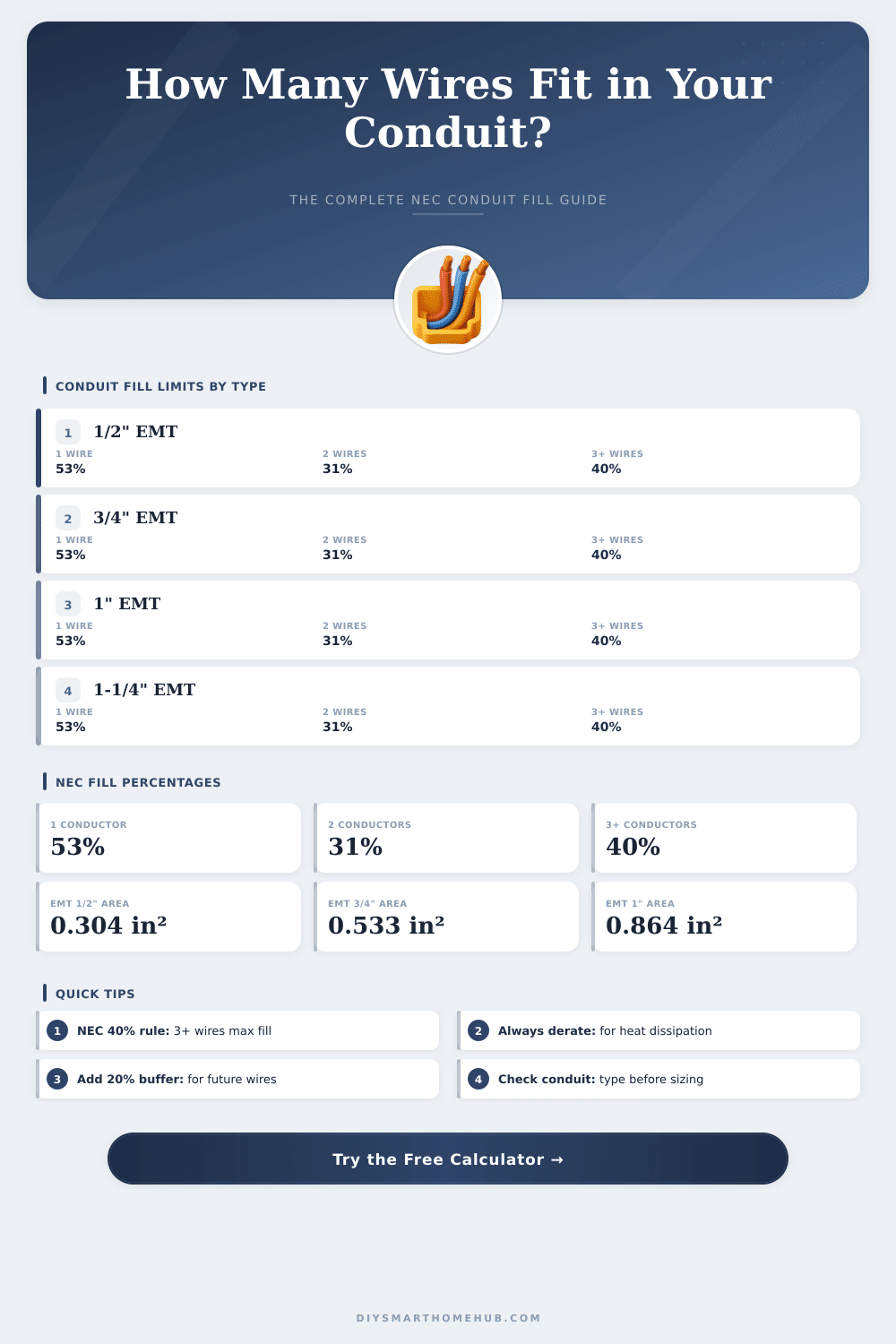
Rules about fill are fairly easy. One single conductor in a Conduit can take up to 53 percent of the cross-section. When two wires are used the limit drops to 31 percent.
For three or more wires one allows 40 percent fill. A special case happens for short parts, called nipples. If the Conduit nipple is 24 inches or less, the fill can be up to 60 percent.
To estimate the available fill area, one takes the whole internal area of the Conduit and multiplies it by the percent value. Then one compares that result with the total areas of all conductors that go inside. For instance, one could ask whether six size-12 THHN cables fit in three-quarter-inch EMT Conduit.
According to fill rules, up to 16 size-12 AWG conductors can physically fit in that size under the 40 percent rule.
Charts about Conduit fill and rules help in such choices. Simple versions of charts are useful for various wire sizes threw different Conduit sizes. Top figures point to Conduit size and type, while the ratings of wires stand in vertical columns.
Some charts stay simple, so that they only point to Conduit size without detailed breakdown by type. Websites with calculators check fill percentages for several wire sizes, including Cat6, Romex and THHN, and right away confirm the NEC rules for EMT, PVC and rigid Conduit.
Multi-conductor cables one treats as one single conductor during the calculation of fill. In cables with oval form the cross-section is based on the biggest diameter of the oval.
Ground and bonding conductors must be included in the calculation of Conduit fill. On the other hand, one does not count them for estimating the ampacity. The NEC gives special treatment for equipment ground conductors, because they do not add to the usual warming like the current-carrying wires.
Practical choice of Conduit must consider bends, pull points and future needs. Many installers choose a bigger Conduit size, if there is any chance to add moreWires later. When counting conductors of different sizes, a result with decimal 0.8 or more can be rounded upward.
Cables that flow through Conduit are harder to pull than separate THHN wires, which is worth remembering during planning of the route.