📡 Coax Cable Length Calculator
Calculate cable run length, signal loss, and maximum recommended distance for any coax type
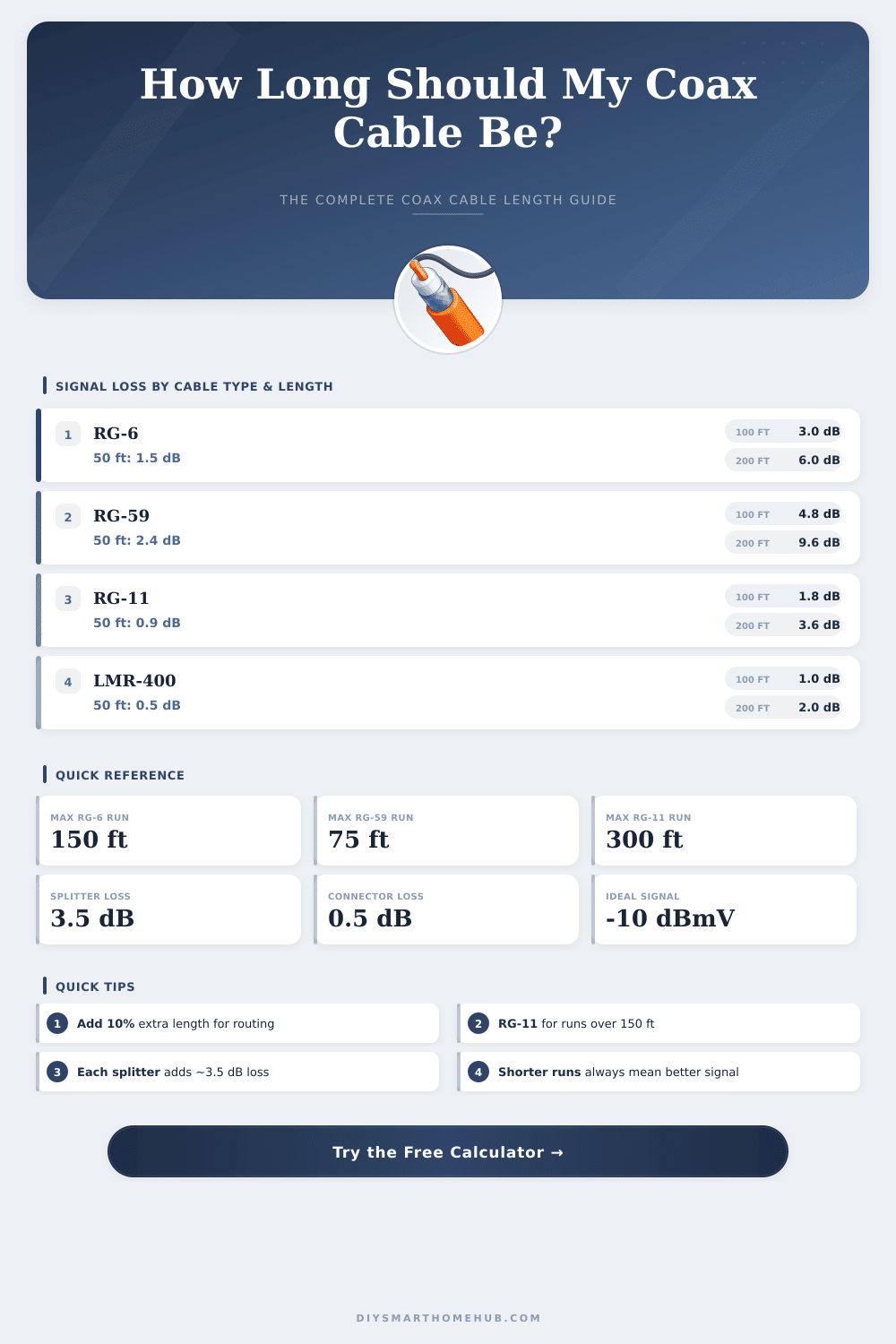
| Cable Type | 50 ft (15 m) | 100 ft (30 m) | 150 ft (46 m) | 200 ft (61 m) | Max Rec. Run |
|---|---|---|---|---|---|
| RG-6 | 1.5 dB | 3.0 dB | 4.5 dB | 6.0 dB | 150 ft (46 m) |
| RG-59 | 2.4 dB | 4.8 dB | 7.2 dB | 9.6 dB | 75 ft (23 m) |
| RG-11 | 0.9 dB | 1.8 dB | 2.7 dB | 3.6 dB | 300 ft (91 m) |
| RG-58 | 2.9 dB | 5.8 dB | 8.7 dB | 11.6 dB | 50 ft (15 m) |
| LMR-400 | 0.5 dB | 1.0 dB | 1.5 dB | 2.0 dB | 500+ ft |
| LMR-240 | 1.2 dB | 2.4 dB | 3.6 dB | 4.8 dB | 200 ft (61 m) |
| RG-213 | 1.3 dB | 2.6 dB | 3.9 dB | 5.2 dB | 175 ft (53 m) |
| Quad RG-6 | 1.5 dB | 3.0 dB | 4.5 dB | 6.0 dB | 150 ft (46 m) |
| Splitter Type | Signal Loss | Best Use | Notes |
|---|---|---|---|
| 2-Way Splitter | 3.5 dB | 2 TVs / devices | Most common type |
| 3-Way Splitter | 5.5 dB | 3 devices | One port may be 3.5 dB, others 7 dB |
| 4-Way Splitter | 7.0 dB | 4 devices | Use amplifier if signal is weak |
| 8-Way Splitter | 11.0 dB | 8 devices | Almost always requires amplification |
| F-Connector (per end) | 0.5 dB | Standard connection | Poor connection = 2+ dB loss |
| Coupler / Barrel | 1.0 dB | Extend cable | Avoid where possible |
| Project Type | Typical Run | Recommended Cable | Approx. Loss |
|---|---|---|---|
| TV in same room | 10–25 ft (3–8 m) | RG-6 | < 1.0 dB |
| TV in adjacent room | 25–50 ft (8–15 m) | RG-6 | 1.0–1.5 dB |
| Across single-story home | 50–100 ft (15–30 m) | RG-6 | 1.5–3.0 dB |
| Two-story home run | 75–125 ft (23–38 m) | RG-6 | 2.3–3.8 dB |
| Outdoor antenna to basement | 100–200 ft (30–61 m) | RG-11 | 1.8–3.6 dB |
| CCTV perimeter camera | 100–200 ft (30–61 m) | RG-59 or RG-6 | 3.0–6.0 dB |
| Satellite dish to receiver | 75–150 ft (23–46 m) | RG-6 | 2.3–4.5 dB |
| Ham radio to antenna | 30–100 ft (9–30 m) | LMR-400 | 0.3–1.0 dB |
The length of the cable is much more important than most folks imagine. The longer the cable the more the signal dies during its travel. That simple rule affects almost every decision about how much cable to buy and how long to run it.
Coax cable can reach up to around 500 metres (about 1 640 feet) before the signal loss truly shows. Because of that bigger reach and higher bandwidth, coax cable works for nets that must cover longer distances. Ethernet using twisted pair usually works only up to around 100 metres, so coax cable clearly is useful for longer runs.
Cable Length and Signal Loss
In the old days, when television had only three or four channels and the signals were low-resolution analog, one could extend coax cable for hundreds of feet, or even almost a thousand, without big problems.
Also the thickness of the cable matters. Thinner cables usually have bigger signal loss. The material inside also is important: the central core commonly is copper-coated steel or copper-coated aluminium.
Cable RG6 loses about 1 dB for every 17 to 20 feet, so the strenght of the antenna signal a lot affects how far the cable can go. For outdoor setups, common practical length is around 150 to 300 feet, depending on the use and the type of signal.
If you want to run 400 feet using low-loss coax cable like LMR-600, the cost quickly rises, commonly above three dollars per foot. And even with that better cable, 400 feet will lose more then 10 dB of signal, which can cancel almost everything the antenna wins. For cheaper options like RG58, loss calculators help to find what to expect at a set frequency and length.
Using something like LMR240 or LMR400 helps to lower loss at longer runs.
Radio waves add yet one problem. CB wavelength is around 36 feet, and some suggest using 18-foot coax cable, because that is half of the wavelength. Setting the cable at the “right” full wavelength can mess up the SWR metre.
The general rule stays: use only as much cable as needed to go from the radio to the antenna.
For use in an RV and in camping, everything is a bit simpler, but still worth thinking about. Usually one needs between 10 and 50 feet of cable to connect the RV to the cable hookup of the campground. Campgrounds normally do not provide coax cable.
A length of 30 feet of quad-shielded coax cable commonly works for most situations, and many places need only half of that. Carrying 50-foot cable works well for satellite dish setups. Barrel connectors can bring in noise, so knowingly keep connections flat andwithout too much tension.
Also some spare female-to-female F-connectors are handy to have near.