🌀 Ceiling Fan Room Size Calculator
Find the perfect ceiling fan diameter for any room size — get instant CFM & blade span recommendations
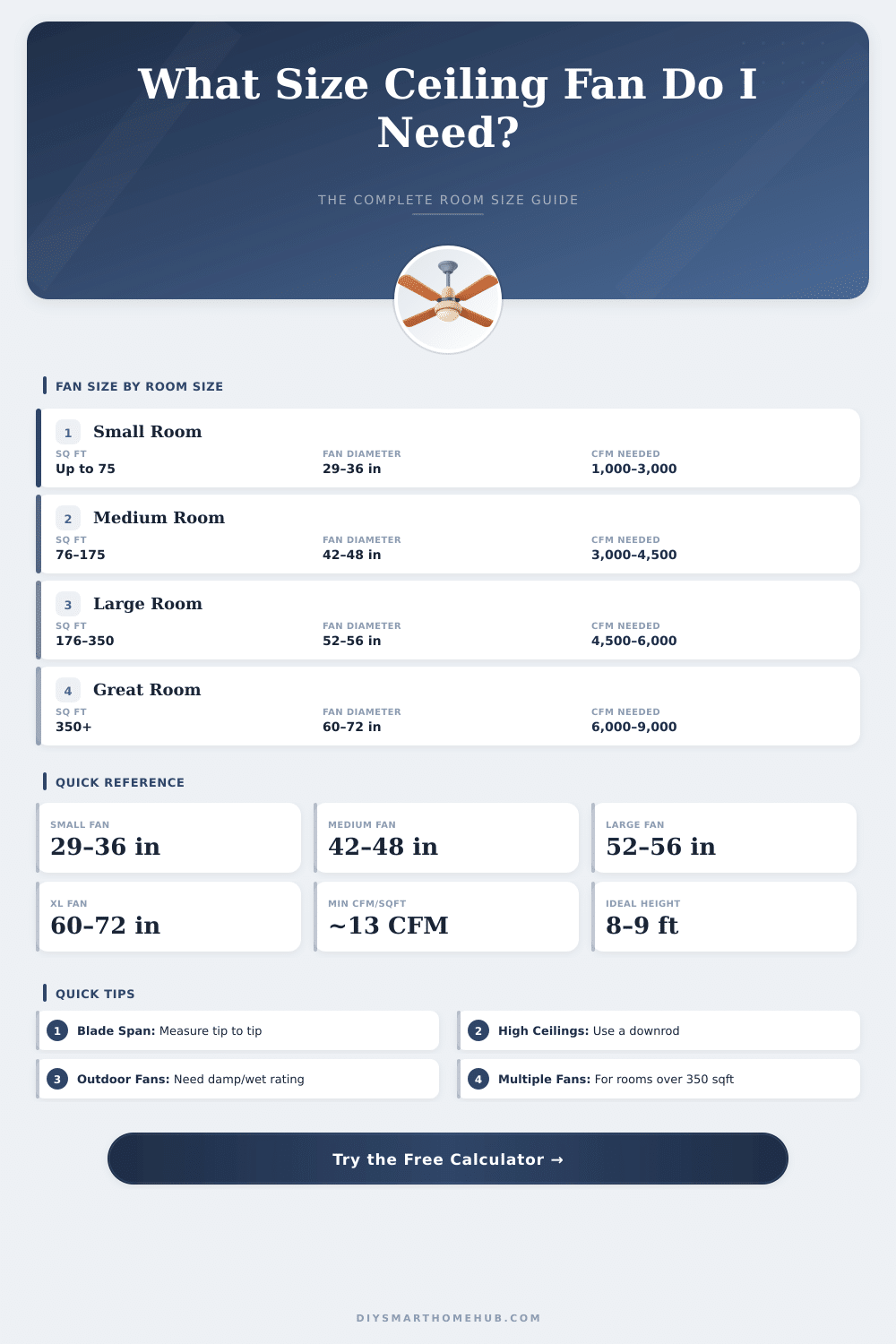
Up to 75 sq ft
76–175 sq ft
176–350 sq ft
350+ sq ft
| Room Size | Sq Ft | Sq Meters | Fan Diameter | Min CFM | Recommended Use |
|---|---|---|---|---|---|
| Extra Small | Up to 50 | Up to 4.6 | 29–32" | 1,000 | Bathroom, closet, utility |
| Small | 51–75 | 4.7–7.0 | 33–36" | 1,500 | Small bedroom, nursery |
| Medium-Small | 76–100 | 7.1–9.3 | 40–42" | 2,000 | Standard bedroom |
| Medium | 101–144 | 9.4–13.4 | 44–48" | 3,000 | Master bedroom, kitchen |
| Medium-Large | 145–225 | 13.5–20.9 | 50–52" | 4,000 | Large bedroom, family room |
| Large | 226–350 | 21.0–32.5 | 54–56" | 5,000 | Living room, great room |
| Extra Large | 351–500 | 32.6–46.5 | 60–65" | 7,000 | Open plan, loft |
| Oversized | 500+ | 46.5+ | 72"+ | 9,000+ | Commercial, barn, warehouse |
| Ceiling Height | Mounting Type | Blade Clearance | Downrod Length | Notes |
|---|---|---|---|---|
| 7–8 ft | Flush/Hugger | 7" minimum | None needed | Low-profile fan required |
| 8–9 ft | Standard mount | 8–10" | 3–5" rod | Most common setup |
| 9–10 ft | Downrod | 10–12" | 6–12" rod | Better air movement |
| 10–12 ft | Extended downrod | 12–18" | 12–24" rod | Improves circulation |
| 12–14 ft | Long downrod | 18–24" | 24–36" rod | High cathedral ceilings |
| 14 ft+ | Very long downrod | 24"+ | 36–72" rod | Custom lengths available |
| Room Type | Typical Size | CFM Needed | CFM / Sq Ft | Fan Diameter |
|---|---|---|---|---|
| Bedroom (standard) | 120–180 sq ft | 2,500–4,000 | ~18–22 | 44–52" |
| Master Bedroom | 200–300 sq ft | 4,000–5,500 | ~18–22 | 52–56" |
| Living Room | 250–400 sq ft | 4,500–7,000 | ~18–20 | 52–60" |
| Kitchen / Dining | 100–200 sq ft | 2,000–4,000 | ~20 | 44–52" |
| Home Office | 100–175 sq ft | 2,000–3,500 | ~20 | 44–48" |
| Outdoor Patio | 150–300 sq ft | 3,000–6,000 | ~20 | 48–60" |
| Great Room | 400–600 sq ft | 7,000–10,000 | ~18 | 60–72" |
Choosing the right ceiling fan for a room depends mainly on one thing: matching the size of the fan to the available space. The size of a fan is measured by the span of the blades so the distance between the tip of one blade and that of the opposite blade. That detail helps to guess how much area the device can cover well.
For tiny rooms with around 100 square feet or less, a fan with 30 to 48 inches works well. Such a small model is ideal for home offices or bathrooms. In little bedrooms one can choose something between 36 and 42 inches.
Choose the Right Ceiling Fan Size for Your Room
For a space of about 11 by 11 feet with a ceiling at 8 feet, a 44-inch fan works according to many tips, although some think that the offered guides about sizes point to models that seem a bit too tiny.
An average bedroom, dining room or kitchen mostly needs a fan with blade span of 44 to 52 inches. Here is the usual size of ceiling fans. In a typical bedroom between 144 and 225 square feet, a medium fan with 44 to 50 inches of blades can serve well.
The CFM rating for such devices should sit bewteen 1,600 and 4,500. Rooms of 225 square feet or bigger benefit from fans with 50 to 56 inch blades. For areas of 12 by 12 to 18 by 18 feet the usual pick is 52 inches.
Big rooms and even broader areas require even bigger fans. In spaces up to 20 by 20 feet, a model with 56 inches or more works well. For big rooms the ceiling fans offer sizes of 56 to 70 inches.
In very large places, one can install several fans too improve the flow of the air.
The height of the ceiling plays a role too. Fans should hang at least 7 feet above the floor and 18 inches away from the walls. The ideal height between 8 and 9 feet above the floor helps the air move freely.
In rooms with high ceilings, down rods lower the fan well. Flush mount options help in places with low ceilings, where one wants a thin look. Rooms with very high ceilings maybe need long rods.
A fan too small cannot move the needed amount of air. One that is too big can seem heavy and feel out of place. Long blades form a wider air cone that spreads out to the edges of the room.
Devices with 3 to 4 blades usually work most well when one considers the drag of the air. The span of the blades should always match the size of the space. Finding the right fit makes theroom pleasant, without the fan taking over the whole space.