🚗 Car Carbon Footprint Calculator
Calculate your vehicle’s annual CO₂ emissions based on fuel type, efficiency, and mileage
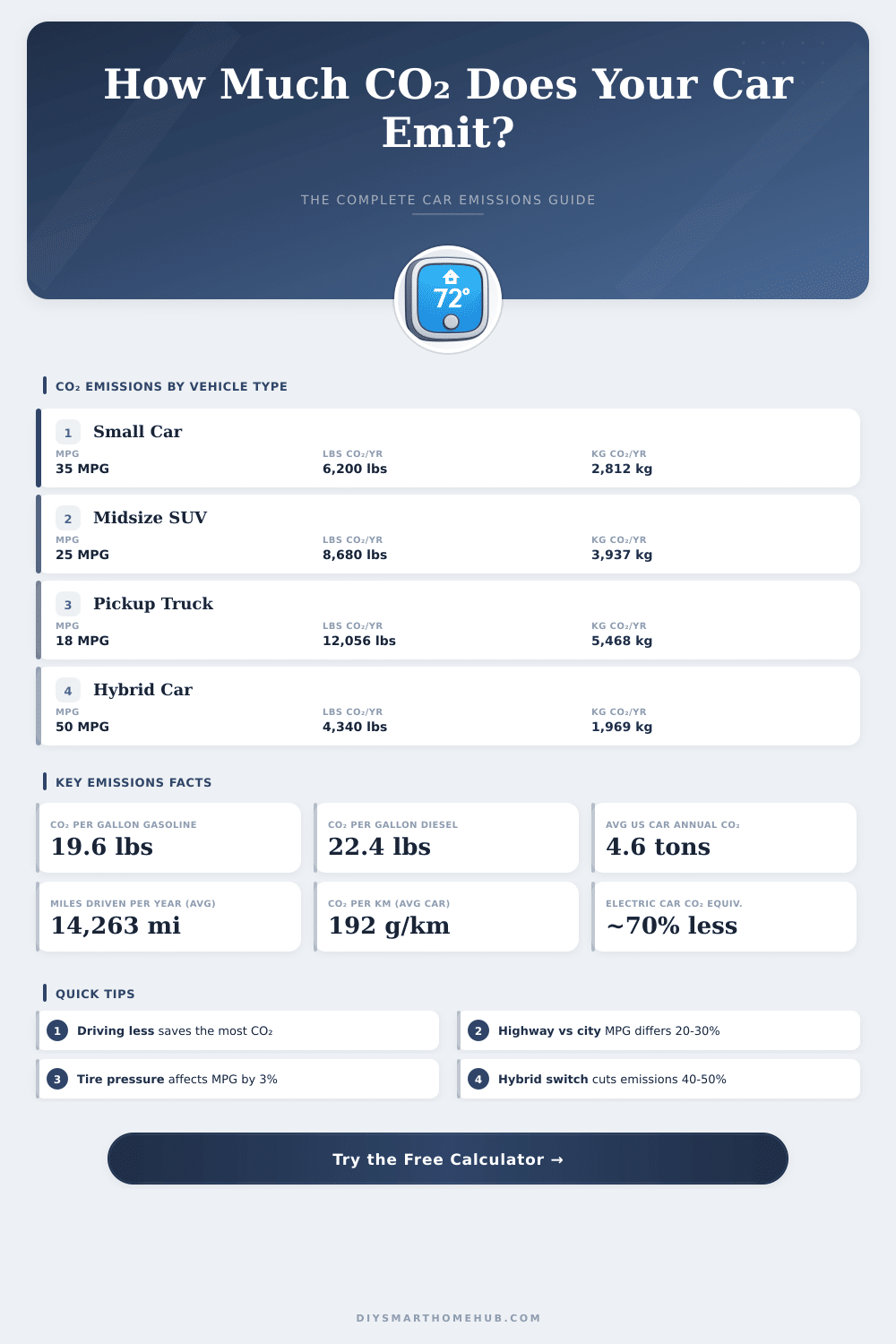
| Vehicle Type | Avg MPG | Annual Miles | lbs CO₂/yr | Metric Tons/yr |
|---|---|---|---|---|
| Small / Compact Car | 35 | 14,263 | 7,972 | 3.61 |
| Midsize Car | 28 | 14,263 | 9,966 | 4.52 |
| Large Car | 22 | 14,263 | 12,685 | 5.75 |
| SUV / Crossover | 25 | 14,263 | 11,184 | 5.07 |
| Large SUV / Minivan | 18 | 14,263 | 15,515 | 7.04 |
| Pickup Truck | 17 | 14,263 | 16,428 | 7.45 |
| Hybrid Car | 52 | 14,263 | 5,369 | 2.44 |
| Sports Car | 20 | 14,263 | 13,969 | 6.34 |
| Electric Car (US avg grid) | — | 14,263 | ~1,652 | ~0.75 |
| MPG | Gallons/yr | lbs CO₂/yr | kg CO₂/yr | Metric Tons/yr |
|---|---|---|---|---|
| 15 MPG | 951 | 18,639 | 8,454 | 8.45 |
| 20 MPG | 713 | 13,979 | 6,341 | 6.34 |
| 25 MPG | 571 | 11,183 | 5,073 | 5.07 |
| 30 MPG | 475 | 9,303 | 4,220 | 4.22 |
| 35 MPG | 408 | 7,975 | 3,617 | 3.62 |
| 40 MPG | 357 | 6,993 | 3,172 | 3.17 |
| 50 MPG | 285 | 5,594 | 2,538 | 2.54 |
| 60 MPG | 238 | 4,661 | 2,115 | 2.12 |
| From | To | Factor | Notes |
|---|---|---|---|
| lbs CO₂ | kg CO₂ | × 0.4536 | Standard weight conversion |
| kg CO₂ | metric tons CO₂ | ÷ 1,000 | 1 metric ton = 1,000 kg |
| Miles | Kilometers | × 1.60934 | Standard distance |
| MPG | L/100km | 235.21 ÷ MPG | Inverse relationship |
| US Gallons | Liters | × 3.78541 | Standard volume |
| g CO₂/km | lbs CO₂/mile | × 0.003527 | Emissions rate conversion |
The role of transportation in climate change is huge. Cars alone make up almost one fifth of all American emissions, that is impressive Burn one gallon of gasoline releases more than 23 pounds of carbon dioxide and other gases, that heat the planet, directly in the air. This adds up quickly, if one considers, how many cars drive every day on the roads.
Carbon dioxide stands at the core of the problem with greenhouse gases caused by human activity. In 2016, it made up around 82 percent of all American emissions of such gases. Vehicles with gasoline or diesel continuously pump CO₂ in the air more quickly, than nature can absorb it through its natural processes.
How Cars Cause Climate Change and How to Reduce Their Pollution
Moreover, the use of vehicles generates ozone and smog, what causes health problems and carries both carbon dioxide and methane; so do not deal only about one kind of pollution.
One estimates, that a typical passenger car releases around 4.6 tons of carbon dioxide yearly. Even so this changes a lot according to the kind of fuel, the efficiency of the engine and the yearly mileage. Simple improvement of fuel efficiency has real impact.
For instance, one saves around 1.7 tons of greenhouse gases yearly, if one switches form car with 20 miles each gallon to one with 25.
Here where electrical cars become interesting. The production of a standard gas car generates around six tons of CO₂ emissions. For an EV of same size?
It requires more than 10 tons. Like this electrical vehicles arrive with a big carbon footprint, without doubt. But the main point is, that most of the carbon footprint of any car comes from the real usage, not from the building.
The newest EV matches even a used gas car after 35,000 to 52,000 miles. Today’s electrical vehicles widely have lower whole footprint than there gas matches.
Making a new vehicle causes almost just as much carbon pollution as using it. So sometimes keeping an older car works better than buying a fresh, more green model. This deserves to remember, when one thinks about buying.
There are calculators for estimating the CO₂ emissions from travel. Some of them consider not only direct emissions from burning fuel, but also gray emissions; that hidden carbon in production and transportation. In Australia, all new vehicles under 3.5 tons must pass a test about fuel use and CO₂ emissions before they reach the stores.
Carmakers themselves work to reduce the carbon footprint. Some aim for zero-emission production. They offer fuel cells, hybrids, plug-in hybrids and battery-based electrical vehicles, what spreads less polluting options in the stores.
Installing solar panels on the roof and charging an EV at home lowers the energy needs, what also reduces the carbon footprint. Reaching truly zero-carbon living is almost impossible in our modern world, but small changes, as choosing a hybrid when buying a new car, stillhelp to progress.