⚡ Buck Boost Transformer Calculator
Find the correct KVA rating, voltage tap, and winding configuration for any buck boost application
| Input Voltage | Output Voltage | Voltage Difference | Mode | Typical Application |
|---|---|---|---|---|
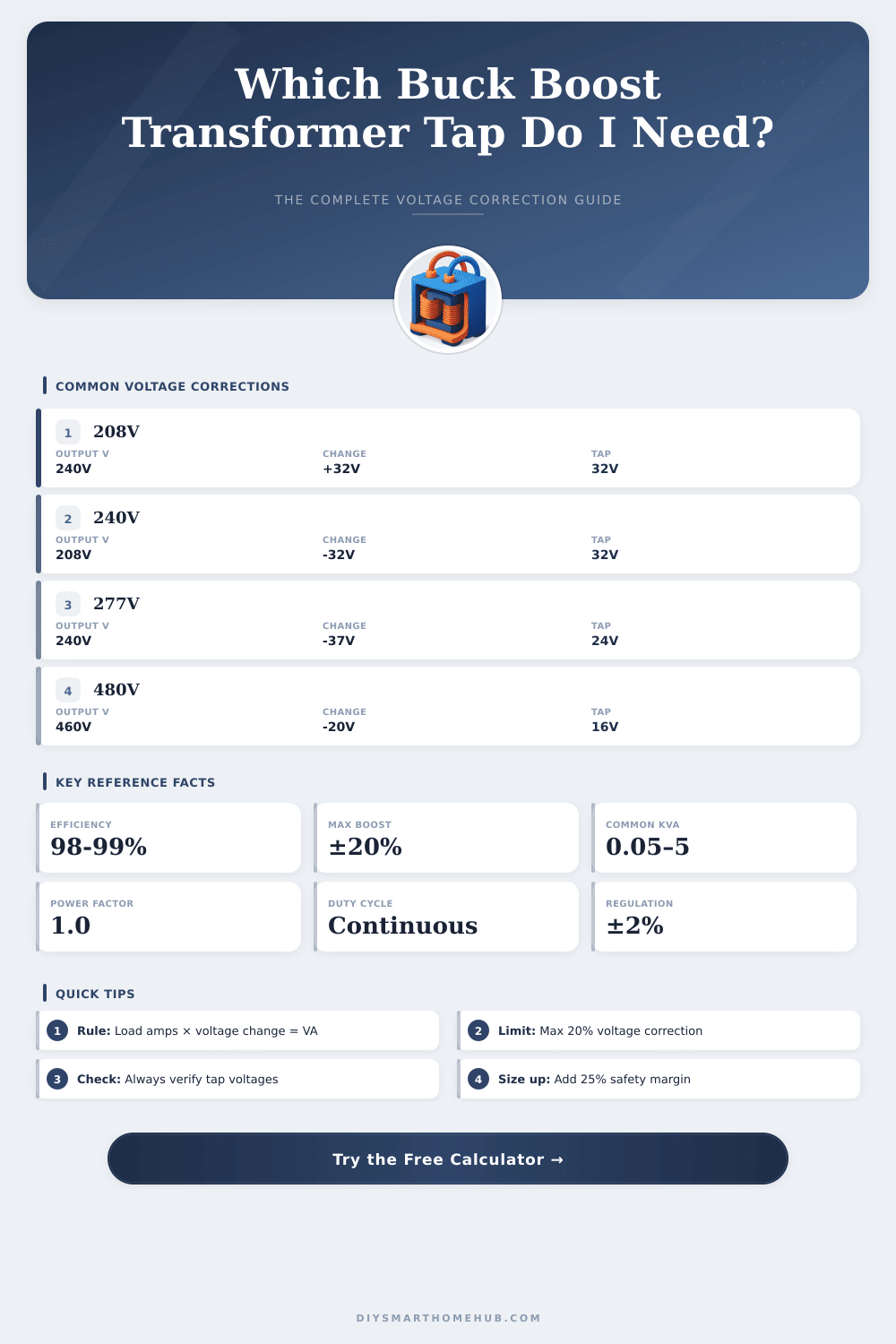
| 208V | 240V | +32V (15.4%) | Boost | HVAC, compressors on low-line |
| 240V | 208V | -32V (13.3%) | Buck | Equipment rated 208V on 240V supply |
| 277V | 240V | -37V (13.4%) | Buck | Lighting ballasts, HVAC fans |
| 240V | 277V | +37V (15.4%) | Boost | Fluorescent ballasts |
| 480V | 460V | -20V (4.2%) | Buck | 460V motors on 480V system |
| 460V | 480V | +20V (4.3%) | Boost | 480V equipment on 460V supply |
| 208V | 230V | +22V (10.6%) | Boost | European equipment on US supply |
| 120V | 110V | -10V (8.3%) | Buck | Legacy 110V equipment |
| Load Current | Voltage Change | Buck/Boost VA | Recommended KVA | Notes |
|---|---|---|---|---|
| 15A | 32V | 480 VA | 0.5 KVA | Lighting circuits |
| 20A | 32V | 640 VA | 0.75 KVA | Standard outlets |
| 30A | 32V | 960 VA | 1.0 KVA | HVAC units |
| 50A | 32V | 1600 VA | 2.0 KVA | Large HVAC / compressors |
| 100A | 32V | 3200 VA | 3.75 KVA | Panels / sub-panels |
| 200A | 32V | 6400 VA | 7.5 KVA | Service entrance boost |
| Phase | Formula | Multiplier vs 1∅ | Example (20A, 32V) |
|---|---|---|---|
| Single Phase (1∅) | V × A ÷ 1000 | 1.0x | 0.64 KVA |
| Three Phase (3∅) | V × A × 1.732 ÷ 1000 | 1.732x | 1.109 KVA |
| KVA Rating | Primary Voltage Options | Secondary Voltage Options | Typical Max Amps Served |
|---|---|---|---|
| 0.05 KVA (50 VA) | 120 / 240V | 12 / 16 / 24 / 32V | 1.5A |
| 0.1 KVA (100 VA) | 120 / 240V | 12 / 16 / 24 / 32V | 3A |
| 0.25 KVA (250 VA) | 120 / 240V | 12 / 16 / 24 / 32V | 7.8A |
| 0.5 KVA (500 VA) | 120 / 240 / 480V | 12 / 16 / 24 / 32 / 48V | 15.6A |
| 0.75 KVA (750 VA) | 120 / 240 / 480V | 12 / 16 / 24 / 32 / 48V | 23.4A |
| 1.0 KVA | 120 / 240 / 480V | 12 / 16 / 24 / 32 / 48V | 31.3A |
| 1.5 KVA | 120 / 240 / 480V | 16 / 24 / 32 / 48V | 46.9A |
| 2.0 KVA | 120 / 240 / 480V | 16 / 24 / 32 / 48V | 62.5A |
| 3.0 KVA | 240 / 480V | 16 / 24 / 32 / 48V | 93.8A |
| 5.0 KVA | 240 / 480V | 16 / 24 / 32 / 48V | 156.3A |
A buck boost transformer is a kind of converter that serves to change the voltage, that is used for alternating electricity in devices. Depending on the way of connection, it fits to either raise or lower the voltage. If it raises the voltage, one calls it boosting.
When it lowers the voltage, it is bucking. Truly simple idea, right?
Buck Boost Transformer: How It Works and What It Does
Such converters come in various versions. Versions for one phase, for three phases in delta-connection and for three phases in star-form exist for both options: step-upper and step-lower. It is very important to choose the right model.
This type does not fit to alter phases, give galvanic separation or allow use of neutral conductor. Because of that it has clear limits on its options.
One commonly uses them for access of 208 volt to 230 volt. For instance, when machines in a workshop run on 208-volt energy, but an air-compressor needs 230 volt, a buck boost transformer can riase the voltage to match the needs of the compressor. Also they can convert 208 volt to 240 volt for one phase, so that a 240-volt device can work here, where only 208 volt is available.
One finds them in steady power units for computers.
Buck boost transformers are not sized the same as average converters. Most of the load passes through the coil for lower voltage. The converter only must be sized according to the amount of energy that is changing, not the whole load.
So, if you need a 12-volt raise in 45 amps, that results in 540 VA. The calculation is easy, after one gets the notion.
Such converters offer a good way to settle problems with voltage. They fit to correct supply voltage that causes drop in the line or demand of gear. Also they can lower voltage that comes from raised system levels because of changes in the supply line.
They are built for small percent change in voltage, as for instance from 110 to 120 volt. One can not use them for a big jump, as from 120 too 220 volt, because the ratio of coils does not work for that.
An important thing to know is that buck boost transformers can not raise the available amps. They only change the voltage. The whole power stays limited by the original source.
A transformer that one uses in parkings for recreational vehicles is basically a buck boost transformer with a switch between coils, that depends on the input voltage. When the incoming voltage falls under a set value, the switch kicks in and adds around 10-percent raise of voltage. Using such reducesthe available amps because of the internal losses of the converter.
The basic coil connections deliver the energy that is needed to raise the output voltage in the secondary coil. If one reverses the connections of the lower-voltage coil, that will lower or buck the basic voltage instead. Also one can connect such converters as auto-converters, which is the practical way, as many buck boost transformer systems run.