❄️ BTU to Ton Converter
Convert BTU/hr to tons of refrigeration — with full HVAC capacity reference tables
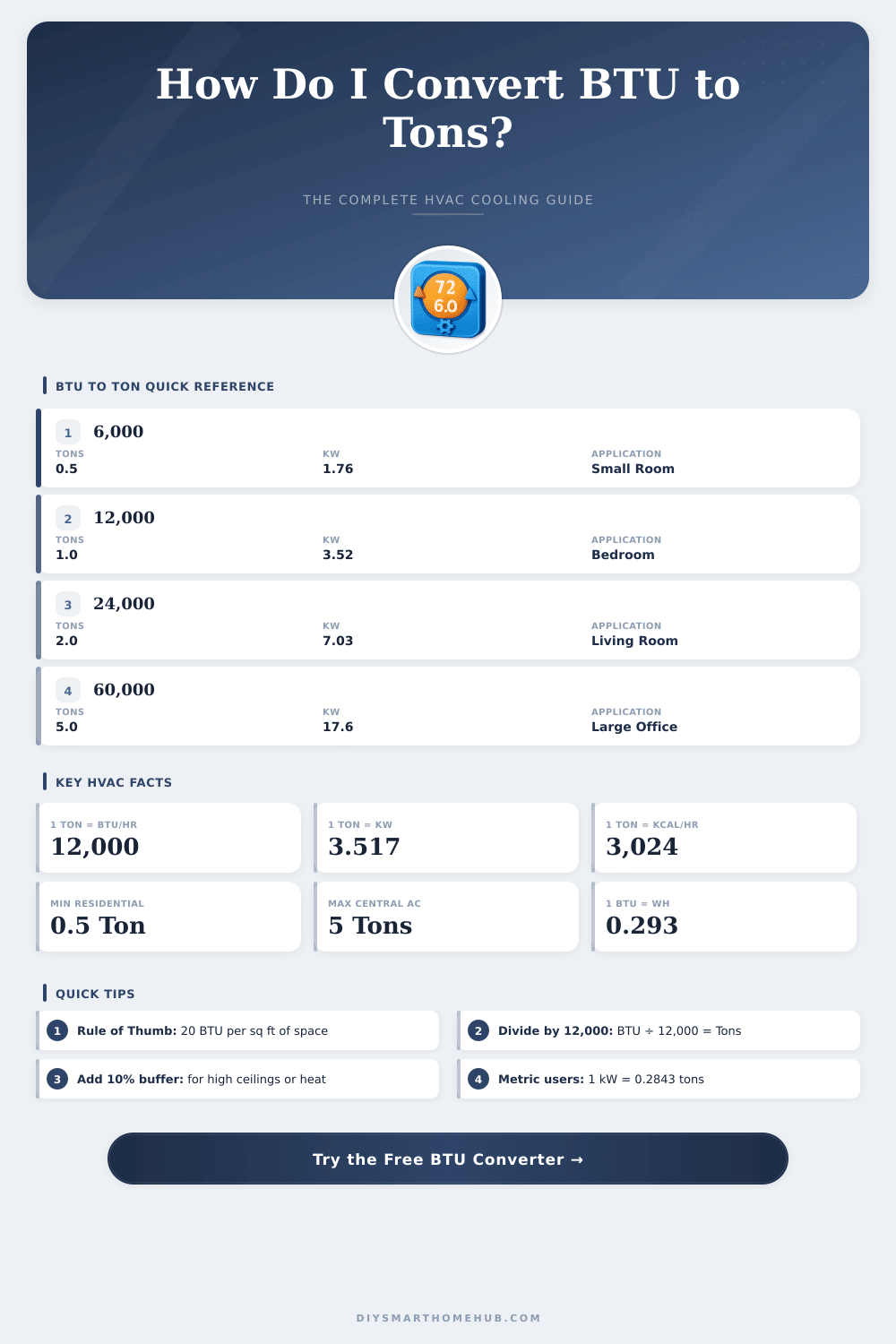
| BTU/hr | Tons | kW | Application |
|---|---|---|---|
| 6,000 | 0.5 | 1.76 | Small Room |
| 9,000 | 0.75 | 2.64 | Bedroom |
| 12,000 | 1.0 | 3.52 | Master Bed |
| 18,000 | 1.5 | 5.27 | Living Room |
| 24,000 | 2.0 | 7.03 | Open Plan |
| 30,000 | 2.5 | 8.79 | Small Home |
| 36,000 | 3.0 | 10.55 | Med. Home |
| 42,000 | 3.5 | 12.31 | Large Home |
| 48,000 | 4.0 | 14.07 | Small Office |
| 60,000 | 5.0 | 17.58 | Large Office |
| 120,000 | 10.0 | 35.17 | Commercial |
| 240,000 | 20.0 | 70.34 | Industrial |
| Unit | 1 Ton | 2 Tons | 5 Tons |
|---|---|---|---|
| BTU/hr | 12,000 | 24,000 | 60,000 |
| kW | 3.517 | 7.034 | 17.584 |
| kJ/hr | 12,661 | 25,321 | 63,303 |
| kcal/hr | 3,024 | 6,048 | 15,120 |
| Watts | 3,517 | 7,034 | 17,584 |
| BTU/min | 200 | 400 | 1,000 |
| Horsepower | 4.717 | 9.434 | 23.584 |
| MJ/hr | 12.661 | 25.321 | 63.303 |
| Space / Application | Area (sq ft) | BTU/hr Needed | Tons Required | kW Equivalent |
|---|---|---|---|---|
| Small Bedroom | 100–150 | 5,000–6,000 | 0.42–0.5 | 1.46–1.76 |
| Standard Bedroom | 150–250 | 6,000–9,000 | 0.5–0.75 | 1.76–2.64 |
| Master Bedroom | 250–400 | 9,000–12,000 | 0.75–1.0 | 2.64–3.52 |
| Living Room | 300–500 | 12,000–18,000 | 1.0–1.5 | 3.52–5.27 |
| Open Plan Kitchen/Living | 500–800 | 18,000–24,000 | 1.5–2.0 | 5.27–7.03 |
| Small House | 800–1,200 | 24,000–30,000 | 2.0–2.5 | 7.03–8.79 |
| Medium House | 1,200–1,800 | 30,000–42,000 | 2.5–3.5 | 8.79–12.31 |
| Large House | 1,800–2,500 | 42,000–60,000 | 3.5–5.0 | 12.31–17.58 |
| Small Office | 500–1,000 | 18,000–30,000 | 1.5–2.5 | 5.27–8.79 |
| Large Commercial | 5,000+ | 120,000+ | 10.0+ | 35.17+ |
| System Type | Typical Range (Tons) | BTU/hr Range | SEER Rating |
|---|---|---|---|
| Window Unit | 0.4–1.5 | 5,000–18,000 | 10–12 |
| Portable AC | 0.5–1.5 | 6,000–18,000 | 8–10 |
| Mini Split / Ductless | 0.75–5.0 | 9,000–60,000 | 16–26+ |
| Central AC (Residential) | 1.5–5.0 | 18,000–60,000 | 14–22 |
| Heat Pump | 1.5–5.0 | 18,000–60,000 | 15–22 |
| PTAC Unit | 0.75–1.5 | 9,000–18,000 | 9–11 |
| Commercial Package | 3.0–25.0 | 36,000–300,000 | 11–16 |
| Industrial Chiller | 20–500+ | 240,000+ | COP 3–6 |
There is big advantage in understand the relation between BTU and tons, especially when you buy devices for cooling. The switch is not hard. Twenty-two thousand BTU matches to one ton.
Here is the key number that you can easily recall.
How to Convert BTU to Tons for Cooling
BTU, or British Thermal Unit, measures heat energy in a simple way. In short words, it points to the amount of heat that must raise the temperature of one pound of water by one degree Fahrenheit. Imagine it as a method for measuring how much heat something truly gives off.
For reference BTU links to the joule, the international energy unit, where around 1 055 joules match with one BTU.
But here it becomes truly interesting. The “ton” that we talk about is not a weight measure. It shows cooling power, namely a cooling ton.
One such ton means the cooling skill that is enough to melt 2 000 pounds of ice (that is one short ton) during one day. The calculation goes like this: one takes 2 000 pounds, multiply by 144 BTU per pound to melt, then divide by 24 hours. Like this one gets 12 000 BTU per hour, exactly the base of that switch.
One ton of cooling mathces also about 3.5 kilowatts, give or take.
To change tons to BTU per hour, the process is very easy. Simply take your tons and multiply by 12 000. So for a 5-ton device?
It reaches 60 000 BTU per hour. The other way is also simple, divide the BTU per hour by 12 000, to find the tons. For instance, 12 800 BTU divided by 12 000 gives around 1.1 ton.
In United States, systems for cooling usually measure in tons. Even so, makers commonly point the power also in BTU per hour, especially for smaller devices. Understanding how to switch between those too units is important when you choose the right gear for a particular room, like this one can well balance comfort with energy savings.
Here comes the surprise. Boilers do not always follow that same rule of 12 000 BTU per ton. A boiler can be rated at around 110 000 input BTU with a blower of 2 200 CFM.
Looking at the cooling needs, according to the standard 400 CFM per ton, that blower would back around 5.5 tons. Two different boilers, both marked as 4-ton, can have inputs of 70 000 BTU to 88 000 BTU, truly different values.
In reality, best is to ask an expert HVAC specialist to do a Manual-J calculation for your home, to get the most accurate idea about the system involved. Wrong choice can cause problems. Especially in humid areas, too big cooling systems barely dump the moisture from the air.
Also, BTU per hour is not commonly used daily. Use of watt-hours, namely kilowatt-hours, became the usual measure almost everywhere, evenoutside United States.