⚡ Ampere Interrupting Capacity Calculator
Calculate the required AIC rating for circuit breakers based on system voltage, impedance, and available fault current
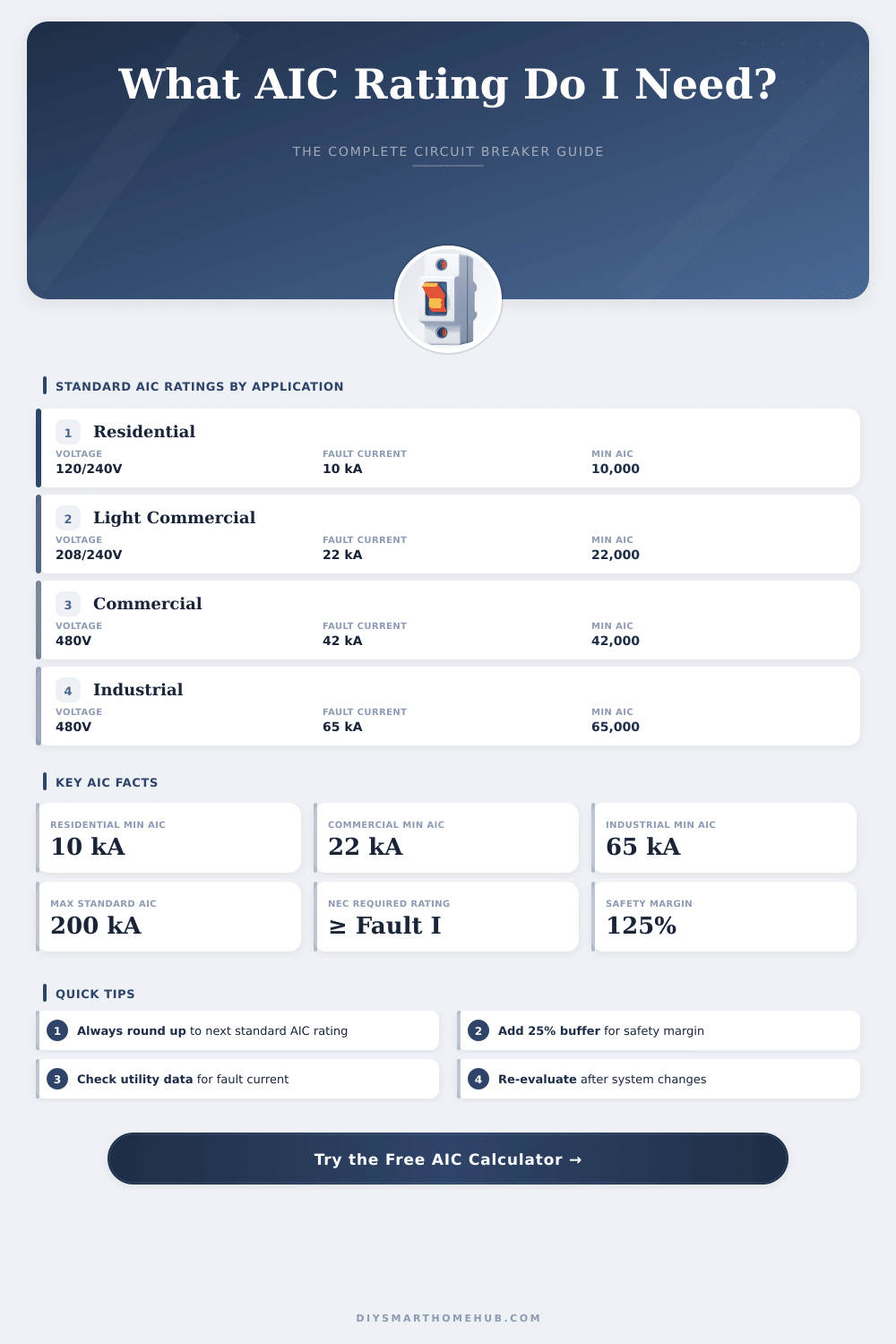
| System Type | Voltage | Typical kVA | Typical AFC (kA) | Min AIC Needed |
|---|---|---|---|---|
| Residential Service | 120/240V | 25–100 kVA | 3–10 kA | 10,000 A |
| Light Commercial | 120/208V 3ϖ | 75–300 kVA | 10–22 kA | 22,000 A |
| Commercial Office | 277/480V 3ϖ | 300–750 kVA | 22–42 kA | 42,000 A |
| Large Commercial | 480V 3ϖ | 750–1500 kVA | 42–65 kA | 65,000 A |
| Industrial Plant | 480V 3ϖ | 1500–3000 kVA | 65–100 kA | 100,000 A |
| Heavy Industrial | 480V 3ϖ | 3000+ kVA | 100–200 kA | 200,000 A |
| Data Center | 480V 3ϖ | 1000–5000 kVA | 50–150 kA | 100,000 A |
| Transformer kVA | %Z (Typical) | Voltage | Full-Load Amps | Short-Circuit kA |
|---|---|---|---|---|
| 25 kVA | 2.0–3.5% | 240V 1ϕ | 104 A | 3.0–5.2 kA |
| 75 kVA | 2.0–4.0% | 208V 3ϕ | 208 A | 5.2–10.4 kA |
| 150 kVA | 3.5–5.75% | 208V 3ϕ | 416 A | 7.2–11.9 kA |
| 225 kVA | 3.5–5.75% | 480V 3ϕ | 271 A | 4.7–7.7 kA |
| 500 kVA | 4.5–5.75% | 480V 3ϕ | 601 A | 10.4–13.4 kA |
| 1000 kVA | 5.0–5.75% | 480V 3ϕ | 1203 A | 20.9–24.1 kA |
| 2000 kVA | 5.75% | 480V 3ϕ | 2406 A | 41.8 kA |
| 3000 kVA | 5.75% | 480V 3ϕ | 3608 A | 62.8 kA |
| Standard AIC Rating | Breaker Class | Typical Application | NEC Compliance |
|---|---|---|---|
| 5,000 A (5 kA) | Molded Case | Low-fault residential | 110.9, 240.86 |
| 10,000 A (10 kA) | Molded Case | Standard residential | 110.9, 230.65 |
| 14,000 A (14 kA) | Molded Case | Residential/light comm. | 110.9 |
| 22,000 A (22 kA) | Molded Case | Light commercial | 110.9, 408.6 |
| 42,000 A (42 kA) | Molded Case | Commercial | 110.9 |
| 65,000 A (65 kA) | Molded Case / ICCB | Large commercial/industrial | 110.9 |
| 100,000 A (100 kA) | Insulated Case / LVPCB | Heavy industrial | 110.9 |
| 200,000 A (200 kA) | LV Power CB | Utility service entrance | 110.9 |
| AWG / Size | Metric (mm²) | Resistance (Ω/1000 ft) | Ampacity (75°C) |
|---|---|---|---|
| #14 AWG | 2.5 mm² | 3.14 Ω | 15 A |
| #12 AWG | 4 mm² | 1.98 Ω | 20 A |
| #10 AWG | 6 mm² | 1.24 Ω | 30 A |
| #8 AWG | 10 mm² | 0.778 Ω | 50 A |
| #6 AWG | 16 mm² | 0.491 Ω | 65 A |
| #4 AWG | 25 mm² | 0.308 Ω | 85 A |
| #2 AWG | 35 mm² | 0.194 Ω | 115 A |
| #1/0 AWG | 50 mm² | 0.122 Ω | 150 A |
| #2/0 AWG | 70 mm² | 0.0967 Ω | 175 A |
| #3/0 AWG | 95 mm² | 0.0766 Ω | 200 A |
| #4/0 AWG | 120 mm² | 0.0608 Ω | 230 A |
| 350 kcmil | 185 mm² | 0.0370 Ω | 310 A |
| 500 kcmil | 240 mm² | 0.0258 Ω | 380 A |
The capacity for suspend amperojn, or AIC, as one commonly calls it, commonly appear in talks about fuses and interrompiloj of circuits. One also hears it call rating of interference of amperoj or similarly. Sometimes it shows up in technical details as available capacity for suspend.
No matter what label one lays on it the notion stays the same.
What AIC Means for Circuit Breakers
Here what AIC truly wants to say: it points to the biggest flow during fault, that interrompilo of circuit or fuse can close without eksplodado, without trigger fire or without fail badly. Picture that situation. Interrompilo of circuit can have normal rating of 200 amperoj.
It will not turn unless the flow passes that limit. Even so that same interrompilo of 200 amperoj can have AIC of 35 000 amperoj. If fault causes 35 000 amperojn flowing through it, the interrompilo quickly take it under control and close itself safely.
The basic rating of AIC, that one meets most commonly, are 10 000 amperoj, short form 10 KAIC. Here the limit, where the device escapes to twist in internal arkŝovilo, what clearly could trigger electrical fire in body. When one talks about ratnigs above 1 000 amperoj, one uses kAIC.
Like this interrompilo of 10 kA can halt until 10 000 amperoj, while interrompilo of 30 kA handles everything until 30 000 amperoj.
At the core, the rating of AIC tells you, what maximum flow the protective device against too much flow can safely last and suspend. The rating of interference of interrompilo is the upper limit for the amperoj, that it can handle during fault state. Big industrial interrompiloj of circuits usually come with rating of KAIC, that shows, for what size of circuit they answer.
Different lines of products range a lot… Some reaches only 500 amperojn, while others go until around 50 000 amperoj.
Here where it becomes interesting: the voltage changes everything. Interrompilo, that can suspend 50 000 amperojn in 208 volts, only can handle 10 000 amperojn in 600 volts. Assume 60-amperan interrompiloon working in 600 volts, and its rating of interference falls too 18 000 amperoj.
Drop it to 480 volts, and sharply the rating jumps to 25 000 amperoj.
AIC truly is only one part of the puzzle when one sizes interrompilojn of circuit. The two other factors, that matter to consider, is the rating of continuous flow and the rating of voltage. Now, AIC commonly confuses with SCCR; rating of flow during short circuit, but they are entirely different.
Both can have rating of 10 kA, but AIC wants to say, that the interrompilo will open the circuit during faults until that level without damage. SCCR wants to say, that the whole unit can last that huge flow through it without damage.
For interrompilo of 10 kA, the main notion is ensure, that it will open the circuit during fault without eksplodado or without internal damage. Any gear, that uses combined ratings in series, must be marked clearly on the place by means oflabel, that shows the rating of the system in amperoj.