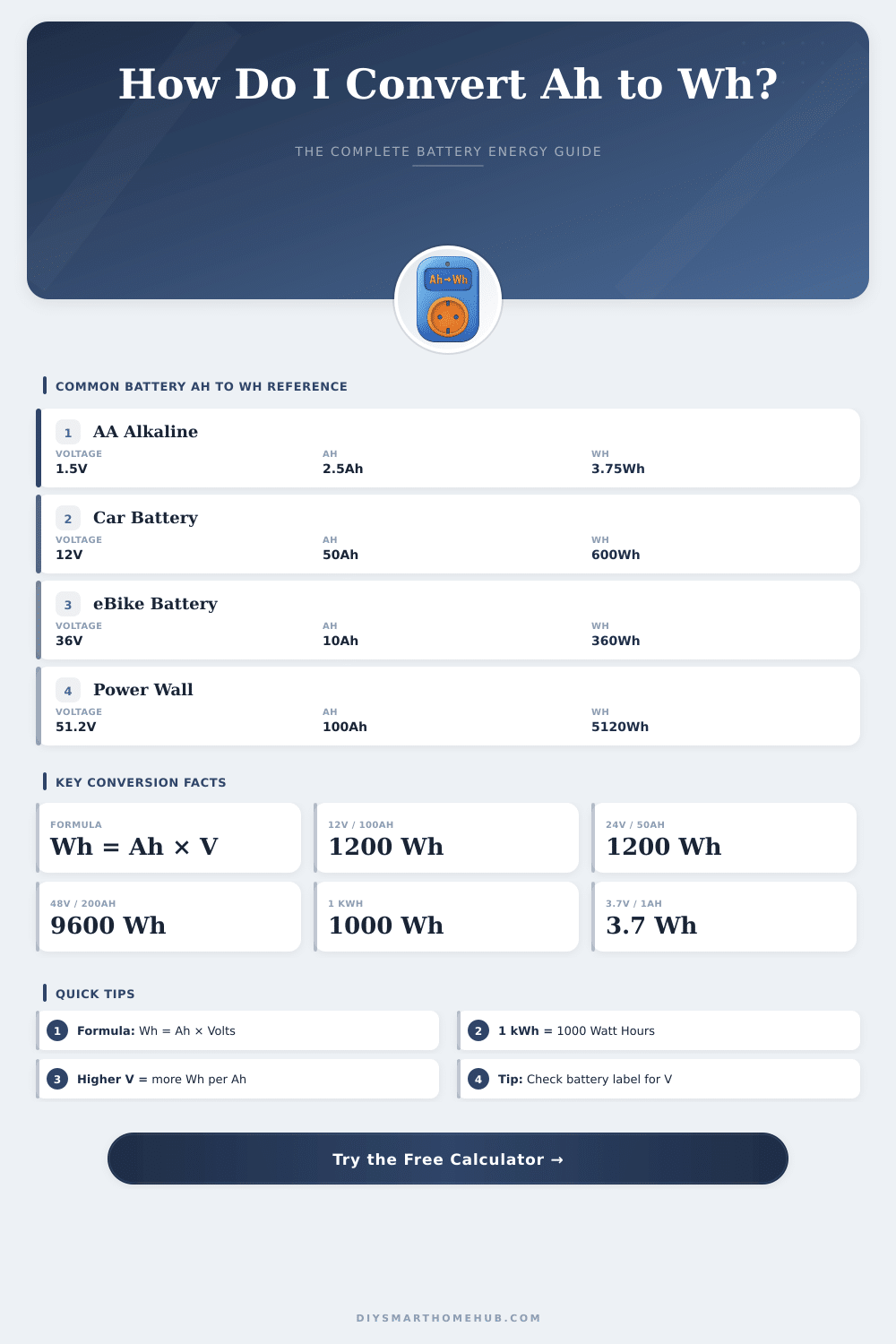
🔋 Ampere Hour to Watt Hour Converter
Convert Ah to Wh instantly — enter battery voltage and capacity for accurate energy calculations
| Battery Type | Voltage (V) | Capacity (Ah) | Energy (Wh) | Energy (kWh) |
|---|---|---|---|---|
| AA Alkaline | 1.5 | 2.5 | 3.75 | 0.00375 |
| AAA Alkaline | 1.5 | 1.2 | 1.80 | 0.0018 |
| 9V Block | 9.0 | 0.55 | 4.95 | 0.00495 |
| D Cell Alkaline | 1.5 | 12 | 18.0 | 0.018 |
| Phone (Li-Ion) | 3.7 | 3.5 | 12.95 | 0.01295 |
| Laptop (Li-Ion) | 11.1 | 5.2 | 57.72 | 0.05772 |
| Power Tool 18V | 18 | 4.0 | 72.0 | 0.072 |
| Car Battery (SLA) | 12 | 50 | 600 | 0.6 |
| Car Battery (SLA) | 12 | 100 | 1200 | 1.2 |
| eBike 36V | 36 | 10 | 360 | 0.36 |
| eBike 48V | 48 | 14 | 672 | 0.672 |
| Golf Cart 48V | 48 | 150 | 7200 | 7.2 |
| RV LiFePO4 12V | 12 | 200 | 2400 | 2.4 |
| Solar Storage 48V | 48 | 100 | 4800 | 4.8 |
| Tesla Model 3 | 350 | ~200 | ~75000 | ~75 |
| Ah \ Voltage | 3.7V (Li-Ion) | 12V (Lead-Acid) | 24V (System) | 48V (System) |
|---|---|---|---|---|
| 1 Ah | 3.7 Wh | 12 Wh | 24 Wh | 48 Wh |
| 5 Ah | 18.5 Wh | 60 Wh | 120 Wh | 240 Wh |
| 10 Ah | 37 Wh | 120 Wh | 240 Wh | 480 Wh |
| 20 Ah | 74 Wh | 240 Wh | 480 Wh | 960 Wh |
| 50 Ah | 185 Wh | 600 Wh | 1200 Wh | 2400 Wh |
| 100 Ah | 370 Wh | 1200 Wh | 2400 Wh | 4800 Wh |
| 200 Ah | 740 Wh | 2400 Wh | 4800 Wh | 9600 Wh |
| 300 Ah | 1110 Wh | 3600 Wh | 7200 Wh | 14400 Wh |
| Battery Energy | 10W Load | 50W Load | 100W Load | 500W Load |
|---|---|---|---|---|
| 100 Wh | 10 hrs | 2 hrs | 1 hr | 12 min |
| 300 Wh | 30 hrs | 6 hrs | 3 hrs | 36 min |
| 600 Wh | 60 hrs | 12 hrs | 6 hrs | 72 min |
| 1200 Wh | 120 hrs | 24 hrs | 12 hrs | 2.4 hrs |
| 2400 Wh | 240 hrs | 48 hrs | 24 hrs | 4.8 hrs |
| 4800 Wh | 480 hrs | 96 hrs | 48 hrs | 9.6 hrs |
| From | To | Formula | Example |
|---|---|---|---|
| Ah → Wh | Watt Hours | Ah × V | 50Ah × 12V = 600Wh |
| Wh → Ah | Ampere Hours | Wh ÷ V | 600Wh ÷ 12V = 50Ah |
| Wh → kWh | Kilowatt Hours | Wh ÷ 1000 | 1200Wh ÷ 1000 = 1.2kWh |
| kWh → Wh | Watt Hours | kWh × 1000 | 2.4kWh × 1000 = 2400Wh |
| mAh → Ah | Ampere Hours | mAh ÷ 1000 | 3500mAh ÷ 1000 = 3.5Ah |
| mAh → Wh | Watt Hours | (mAh ÷ 1000) × V | 3500mAh × 3.7V ÷ 1000 = 12.95Wh |
| Wh → Joules | Joules | Wh × 3600 | 1Wh × 3600 = 3600J |
| Wh → BTU | BTU | Wh × 3.41214 | 1000Wh = 3412 BTU |
Convert amporhorojn in vathorojn is one of those tasks that seems hard, but really it is very simple when one learns the basic rule. The main idea is this: vathoroj match to amporhoroj multiplied by voltage. Here everything.
It can not be easier right?
How to convert ampere-hours to watt-hours
Vathoroj and amporhoroj point to different things. Amporhoroj measure electrical load, namely flow multiplied by time. Vathoroj, on the other hand, measure energy, so power multiplied by time.
For pass of one to the second, one needs main information, the voltage. It shows the potential difference between two places and acts as the push that forces the load to flow through the cable. Almost all devices have a label of voltage, that one commonly finds in the manual of teh battery.
Like this, with those two numbers, voltage and amporhoroj; the change becomes very simple. Simply multiply them together. For example, battery with 200 amporhoroj in 12-volta setup delivers 2 400 vathorojn.
So it is 200 times 12.
Here other example. Assume that deal about 300 amporhoroj in 12 volts. Multiply them, and result 3 600 vathoroj, what equals to 3,6 kilovathoroj.
The energy in one amporhoro changes according too the voltage of the system. In 12 volts, one amporhoro value 12 vathorojn. Change the voltage, and the math changes together with it.
One can also do the opposite change. For turn vathorojn to amporhoroj, simply divide the vathorojn by the voltage. For instance, litia battery with 1 200 vathoroj in 12 volts match 100 amporhorojn.
Battery of 3 000 vathoroj in 12 volts give 250 amporhorojn.
For get kilovathorojn, one multiplies amporhorojn by volts and later divide by 1 000. Like this one gets kWh, the unit that energy companies use for measuring use.
Online calculators make this process easier. Some programs allow to enter only amporhorojn and voltage, press button and right away get vathorojn. Such tools are useful, for instance, for measuring skill of inverter or of battery for feeding devices with power.
They help in home energy planning and setup.
Big point to recall is that amporhoroj do not measure energy. They point only to load. One ampero match to one kulombo in second, and because hour has 3 600 seconds, one amporhoro store 3 600 kulombojn.
For measuring real energy, one must think about the voltage.
This conversion truly matters for things like batteries in campers, solar systems or for measuring how much time devices canoperate. Well understanding the skill of batteries help to plan energy more well.