Motor Disconnect Sizing Calculator
Estimate motor full-load amps, non-fused disconnect amp rating, matching horsepower rating, locked-rotor current, and a practical local isolation margin.
Planning note: This tool sizes a local motor disconnect for preliminary selection. Final switch type, lockability, visibility, conductor ampacity, enclosure rating, short-circuit rating, and local code acceptance must be verified by qualified personnel.
⚙Motor Disconnect Presets
📋Motor And Disconnect Inputs
Disconnect Sizing Result
Ready🔧Motor Disconnect Spec Grid
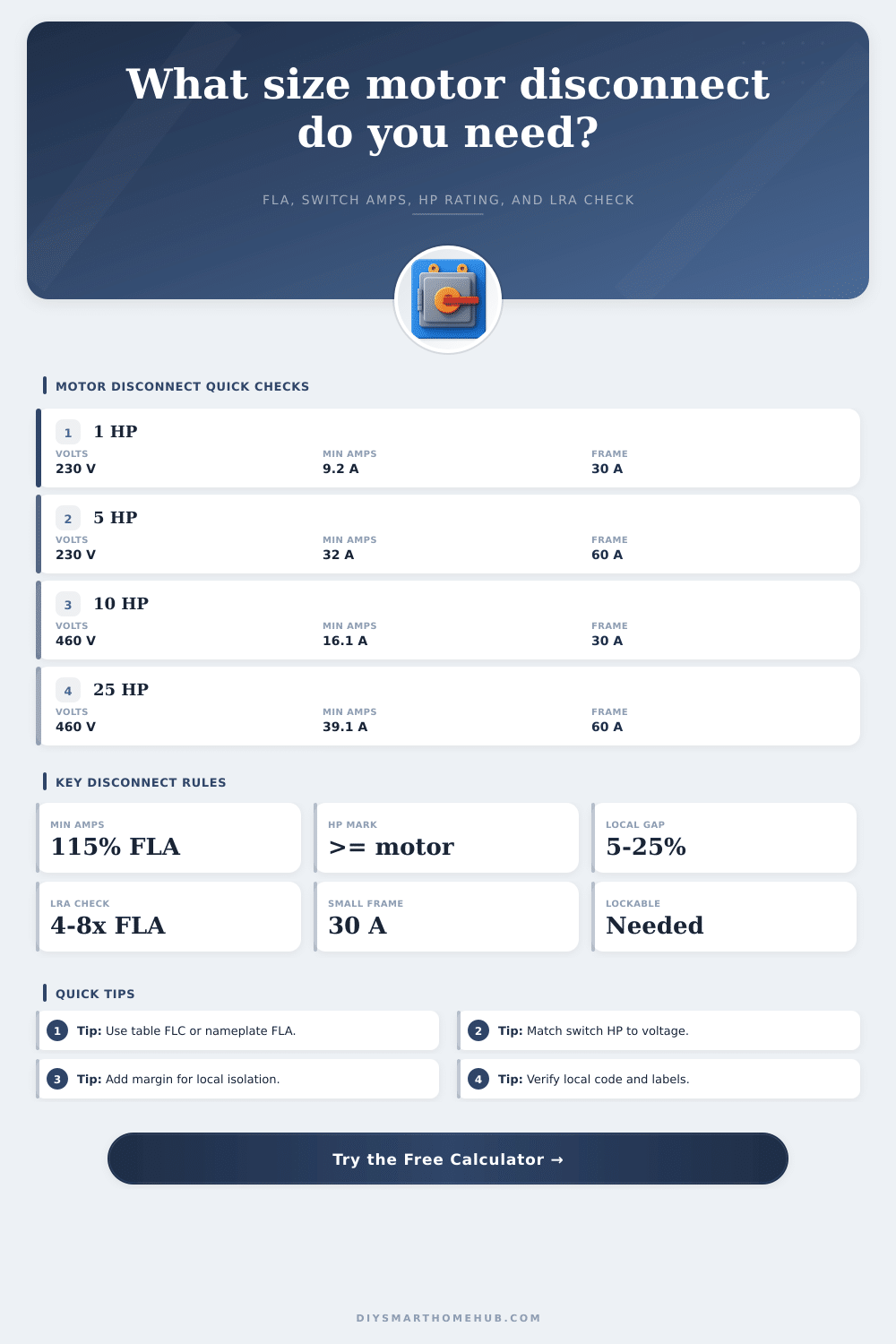
Motor disconnect current rating is commonly checked against at least 115% of motor full-load current.
The switch should carry a horsepower rating not less than the motor rating at the used voltage and phase.
Starting current is not the continuous amp rating, but it matters for combined loads and switching duty.
Nearby equipment isolation often needs a lockable handle, clear identification, and the right enclosure type.
📊Reference Tables
| Motor HP | 1 Phase 230 V FLA | 3 Phase 230 V FLA | 3 Phase 460 V FLA | 115% Amp Minimum |
|---|---|---|---|---|
| 1 HP | 8.0 A | 4.2 A | 2.1 A | Use next switch frame |
| 3 HP | 17 A | 9.6 A | 4.8 A | FLA x 1.15 |
| 5 HP | 28 A | 15.2 A | 7.6 A | FLA x 1.15 |
| 10 HP | 50 A | 28 A | 14 A | FLA x 1.15 |
| 25 HP | Not typical | 68 A | 34 A | FLA x 1.15 |
| Non-Fused Frame | Typical 1 Phase 230 V HP | Typical 3 Phase 230 V HP | Typical 3 Phase 460 V HP | Typical Use |
|---|---|---|---|---|
| 30 A | Up to 7.5 HP | Up to 7.5 HP | Up to 15 HP | Small pump, fan, condenser |
| 60 A | Up to 15 HP | Up to 15 HP | Up to 30 HP | Shop motor or pump |
| 100 A | Up to 20 HP | Up to 30 HP | Up to 60 HP | Larger process motor |
| 200 A | Up to 50 HP | Up to 60 HP | Up to 125 HP | MCC or equipment skid |
| 400 A | Up to 100 HP | Up to 125 HP | Up to 250 HP | Large distribution switch |
| Locked-Rotor Basis | Calculator Method | When It Helps | Disconnect Impact | Field Check |
|---|---|---|---|---|
| 4.5 x FLA | FLA multiplied by 4.5 | Low inertia fan loads | Sanity check only | Confirm motor data |
| 6 x FLA | FLA multiplied by 6 | Typical planning estimate | Shows starting surge | Do not use as FLA |
| NEMA code | kVA per HP formula | Nameplate code letter known | Better LRA estimate | Use marked voltage |
| Group loads | Sum running and LRA | Several motors on one switch | May raise HP equivalent | Engineer combined load |
| Manual stop | Duty selection adds margin | Switch may interrupt load | Consider heavier switch | Use listed ratings |
| Input Choice | Formula Used | Primary Result | Common Mistake | Best Check |
|---|---|---|---|---|
| HP or kW | HP x 0.746 = kW | Calculated FLA and HP rating | Using input watts | Read motor nameplate |
| Voltage / phase | Single or three phase current | FLA and HP table column | Wrong voltage column | Use line voltage |
| Service factor | FLA x 1.15 minimum | Disconnect amp base | Using overload rules | Keep functions separate |
| Isolation margin | Minimum amps x margin | Recommended local frame | Calling it code minimum | Document preference |
| Switch type | Frame and HP selection | Non-fused switch size | Only checking amps | Check HP marking too |
💡Motor Disconnect Tips
Man, you pull the old garage door opener apart to change a burned out capacitor. You grab the wall switch to shut off power and motor keeps humming and won’t quit turning. That is never a good feeling. What it does is remind you about how important it is to size your motor disconnect correctly.
Not only do you want a switch that will fit in your panel. You also want one that are sized correctly to handle things like starting torque and heat. Safety and peace of mind when working on that machine with power on mean something too.
How to Choose the Right Motor Switch
The calculator above help you determine what you should of really get before you head to supply house. A lot of folks make this mistake: They only look at amperage. Here’s why there is two important numbers on a motor. First, it has a nameplate horsepower rating; second, it has a full-load amps draw. Full-load amps are how much current it pulls while running.
Now the switch need to be able to take the amount of mechanical stress caused by starting. So if you just buy a switch based off the amps, it may look like it will work but be too small for both heat and starting torque. The tool show you those two things separately. Because motors run hotter then their ideal test conditions, it calculates minimum amp rating by adding a standard fifteen percent buffer to nameplate current. That’s because motors get hot running, meaning they never runs as well as they did in test conditions. The reason for the buffer is so that switch doesn’t start arcing too soon when you turn it off during normal operation.
The key here is understanding that this math heavily depends on voltage and phase (hence the request for inputting both). For example, a two hundred thirty volt motor drawing five horsepower will draw considerably fewer amps than a one hundred fifteen-volt motor pulling same horsepower. Less amperage equals smaller conductors and consequently a smaller switch frame. Get it wrong on voltage and all the rest downstream gets sized wrong.
Once you enter your individual configuration into the calculator, it take care of all the conversions for you. No need to commit each column of NEC tables to memory. Simply know what’s being fed to your motor.
Finally, there’s locked-rotor current, the one that gets neglected until it bites you in the butt. A motor pulls between four and eight times rated current when started and will draw it for just a split-second. Although this is not your continuous amp rating on the disconnect, it can be critical if you’re planning to turn your motor on and off regularly while its running. Most local disconnects is designed for isolation only; that is, they either go open or closed and don’t get touched again until time for maintenance. In other words, if you want to use this switch as a regular on/off button, then you’ll want something beefier than most local disconnect. That difference is flagged in results so you won’t accidently select an isolation switch for a high cycle application.
Location also matters. While a control room might be clean indoors, the dusty shop floor will need a different type of enclosure. Dust and moisture can provide a path to arcing within your typical metal box. If the equipment has been installed in an unconditioned area, next to a heater, or somewhere else where there is extra room for local conditions, it’s a good habit to add that extra room as well. You’ve got the room to spare so step up to a better-rated enclosure or even just a larger frame; it doesn’t cost much at all.
This ultimately boils down to making sure you have matched hardware to the motor. You must match how the motor performs with what the switches is rated for, including voltage, surge, heat capacity, and safety standards. When they come to grab that handle, keeping them safe and the equipment running start with getting these basics correct.