Disconnect Sizing Calculator
Estimate the disconnect amp rating, continuous-load basis, voltage and phase match, HP rating, fused or non-fused selection, SCCR/AIC margin, and next standard switch size.
Disconnect sizing result
Often used for fractional motors, small HVAC units, and local service switches when HP rating also matches.
Fuse clips and listed fuse classes can raise or coordinate short-circuit ratings when the label allows it.
Motor disconnects need an amp rating and a horsepower rating at the actual voltage and phase.
The marked SCCR or AIC must exceed the available fault current, with practical margin for data changes.
| Standard size | Typical poles | Common use | Calculator role |
|---|---|---|---|
| 30 A | 2 or 3 | Small motor, mini split, light equipment | First standard size above the calculated basis |
| 60 A | 2 or 3 | HVAC, shop machines, small feeders | Common jump when 30 A is too small |
| 100 A | 2 or 3 | Large equipment or panel-adjacent loads | Next common frame after 60 A |
| 200 A | 2 or 3 | Service equipment and large machines | Used when load basis exceeds 100 A |
| 400 A+ | 2 or 3 | Industrial feeders and large services | Requires project-specific gear selection |
| Motor load | Voltage / phase | Modeled FLA band | Disconnect check |
|---|---|---|---|
| 1 HP pump | 120 V 1-phase | 12 to 16 A | 30 A switch with matching HP marking |
| 3 HP compressor | 240 V 1-phase | 16 to 22 A | 30 A may fit by amps; verify HP rating |
| 5 HP blower | 230 V 3-phase | 13 to 18 A | 30 A 3-pole switch often starts the review |
| 10 HP unit | 480 V 3-phase | 13 to 17 A | HP rating can govern more than amps |
| 25 HP pump | 480 V 3-phase | 32 to 40 A | 60 A frame with listed HP marking likely |
| Switch type | Best fit | SCCR / AIC note | Calculator signal |
|---|---|---|---|
| Non-fused disconnect | OCPD already upstream and SCCR is adequate | Relies on the switch label and upstream protection | Selected when fault margin is healthy |
| Fused safety switch | Local fusing, equipment protection, or high fault current | Can improve listed short-circuit performance when coordinated | Recommended when SCCR margin is tight |
| Motor-rated switch | Manual motor disconnecting means | Must carry voltage, phase, amp, and HP markings | Required whenever motor HP is entered |
| Service-rated switch | Service disconnect role | Requires service-equipment listing and neutral/bonding review | Outside simple branch-equipment sizing |
| Preset | Input basis | Fault current | Expected result |
|---|---|---|---|
| Small exhaust fan | 0.5 HP, 120 V 1-phase | 5 kA available | 30 A non-fused if HP rating matches |
| Garage pump motor | 1 HP, 240 V 1-phase | 8 kA available | 30 A motor-rated disconnect |
| Shop compressor | 3 HP, 240 V 1-phase | 10 kA available | 30 A or 60 A depending nameplate FLA |
| Dust collector | 5 HP, 230 V 3-phase | 14 kA available | Fused switch often favored for margin |
| Backup/PV disconnect | 9.6 kW, 240 V 1-phase | 22 kA available | 60 A or larger with adequate SCCR |
The disconnect switch doesn’t match the load. Aha! So there’s an air handler or compressor with a hum, and you’re standing in front of it wondering how to make all the wires fit inside lugs? No… that’s not the only issue. You want something that will handle fault currents and interrupt power safely while making the code inspector happy too. That’s where the math comes in. The disconnect sizing calculator makes that part easy for you.
But now you have to know what those numbers represent. This isn’t just about amps; it’s about how the parts works together. A load profile is based off all this. Motors (for example) pull far more current at start-up compared to a resistive heater; it’s a different animal. To calculate that startup stress, the calculator wants to know horsepower, voltage, phase, efficiency and power factor. You can’t skip those questions or you risk choosing a switch that trips immediately upon your machine’s startup.
How to Size Your Disconnect Switch Correctly
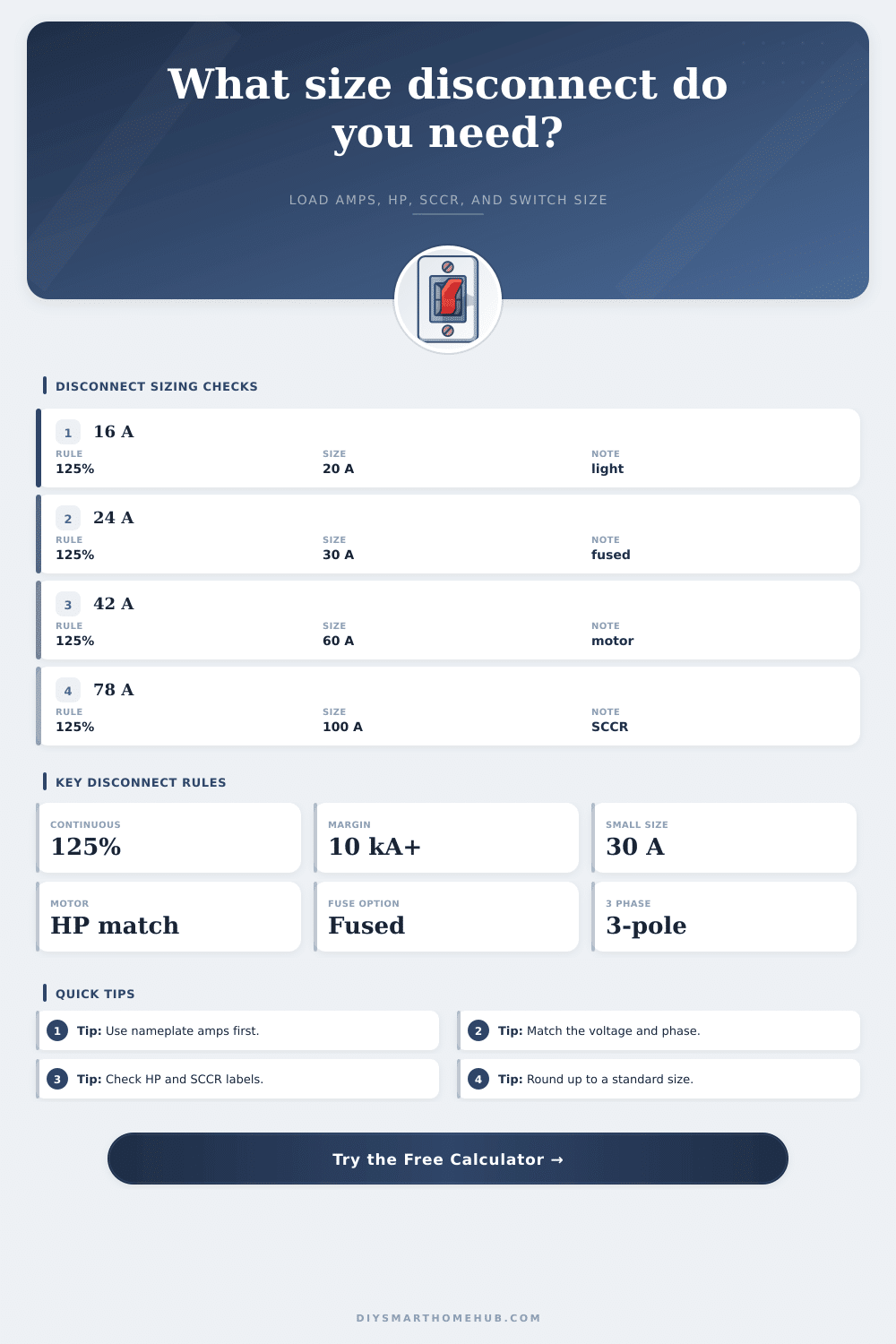
That’s why nameplate amps are important. What does the piece of equipment realy draw normally? Type in those numbers where available. They beat any general equations, preventing unnecessary oversizing. Next there’s the ever-present load factor. If you have an equipment running more than three hours it must be multiplied by 125 percent according to code. No one does this because they want to pad their load. It’s a cushion; it’s a safety buffer against terminals and conductors heating up with continued use. And when you punch in the information, the tool will apply the correct factor automatically so your disconnect never exceeds its thermal limit. Don’t worry about having to remember what percentage it is. Simply remember if your equipment is cycling off and on intermittently or if it’s on continuously throughout the day.
Everything changes from that point. People gets tripped up by horsepower ratings on their motor switches. They know to look at the amps. That’s fine. But they also need the disconnect’s horsepower rating to match its voltage and phase. Just because a switch is rated for 30 amps doesn’t mean it can supports the current flow from a small pump even though it could pass inspection. The electrical capacity is sufficient, but there is a mechanical mismatch, which is a common oversight until inspector points out the small detail. And they do. This keeps your disconnects properly aligned according to code so you won’t waste time or get flagged at an inspection. This calculator takes care of it for you.
Then there’s fault current. Most novices don’t consider this either. Older switches cannot interrupt more current then what your panel can provide during a fault. Short circuits release energy with great force. Your disconnect has to be able to handle it or you’ll be in trouble quickly. It will compare the SCCR rating of the switch versus your estimated fault level and give you some margin for safety. Ten thousand amps? Plenty, right? Often, no. With today’s service entrances, it isn’t always enough. Fused switches help here because they increase interrupting capacity, whereas a non-fused switch do not.
Jumping from 30 to 60 to 100 amp is standard size. That’s because that’s what they make the switches in. There isn’t often a 45-amp switch. The calculator jumps to the next frame size so you won’t have to search around for oddball parts. It gives you presets such as dust collector or garage pump if you aren’t sure of the input values. They are common scenarios so you don’t have to start from scratch guessing.
To conclude. And this isn’t some piece of paper we’re talking about here. This is a test to see if the disconnect can handle what the circuit dishes out. When you size up your HVAC unit or wire your workshop compressor, make sure all the measurements matches. No more failures, no more callbacks. Simple. Get a device that outlasts the equipment it safeguards. That’s how you gain confidence with your installs.